

AI Review Assistant vs Generic AI Writing Tool for Local Businesses
An AI review assistant and a generic AI writing tool can both help a local business write faster, but they solve different problems.
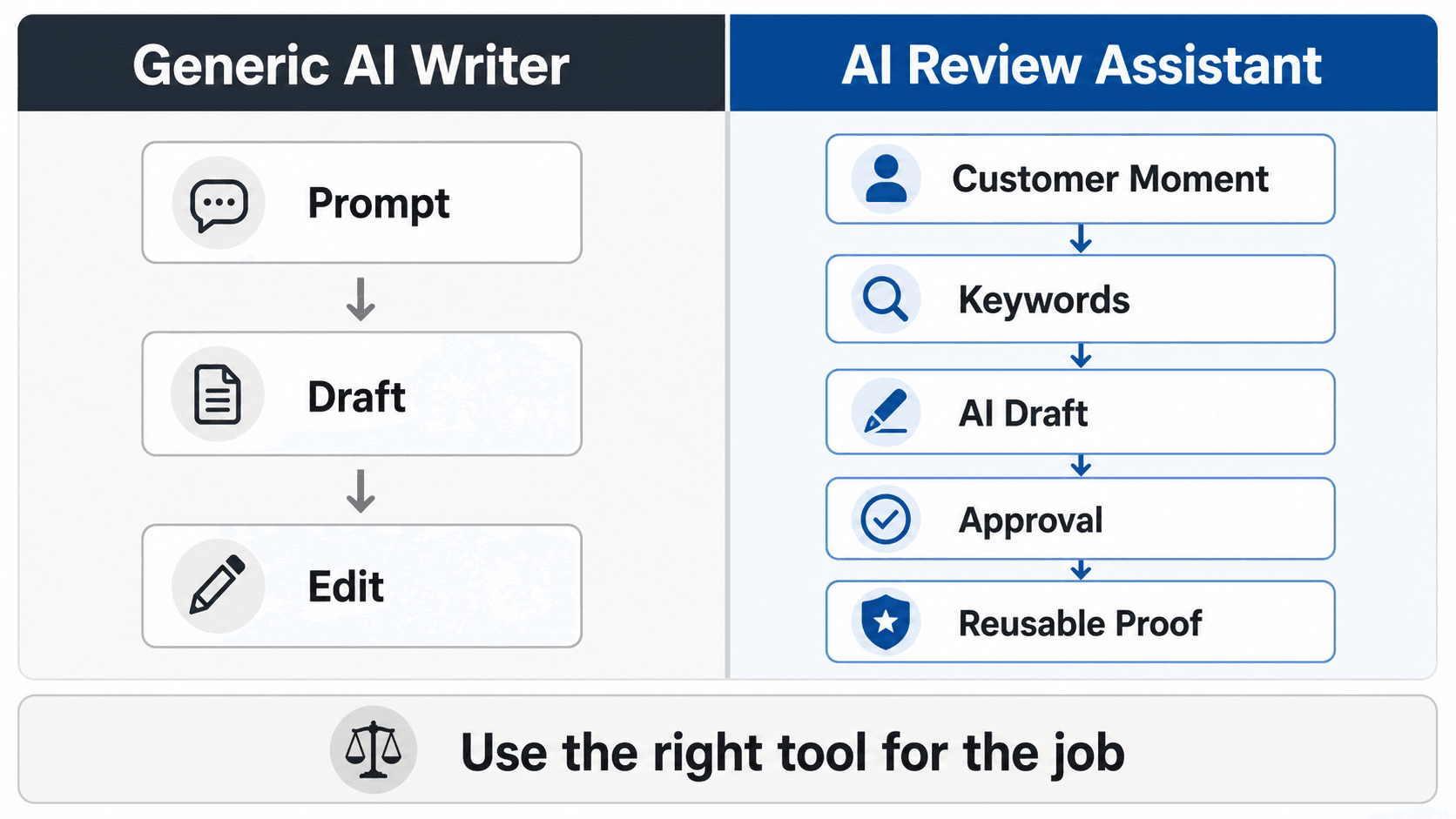
A generic AI writing tool starts with a blank prompt. It is useful when you already know what you want to say, such as a social caption, email, menu update, FAQ answer, or blog paragraph. An AI review assistant starts with a customer moment. It is useful when a real customer has just had an experience and needs an easier way to turn that experience into a review draft, testimonial, social post, or other reusable proof.
For a restaurant, cafe, salon, spa, gym, pet shop, retail store, or education center, the practical difference is simple: use a generic AI writer when the business needs content from its own point of view. Use an AI review assistant when the workflow needs to preserve the customer's point of view.
The core difference is the input
The biggest difference is not the AI model. It is the starting point. A generic AI writing tool usually asks the business to describe the task. An AI review assistant should ask the customer or staff to capture real experience details first, then use AI to shape those details into draft content.
That distinction matters because reviews and testimonials are not ordinary marketing copy. A review should reflect a genuine customer experience. A testimonial should not imply that a customer said something they did not say. A social proof workflow should make the customer's real words easier to express, not manufacture praise from nothing.
Here is the simplest way to think about it:
| Tool type | Main input | Best output | Main risk if misused |
|---|---|---|---|
| Generic AI writing tool | A business prompt | Business-owned content, captions, emails, blog sections, announcements, staff scripts | It can sound polished but disconnected from what customers actually experienced |
| AI review assistant | A customer moment, selected keywords, and business context | Review drafts, testimonials, social proof, customer story snippets, video scripts | It can become risky if it writes praise without real customer input or approval |
| Vibpost approach | A smart review QR code scan, customer-selected keywords, and AI-assisted drafting | Review drafts, social posts, testimonials, and video scripts based on real customer moments | It should still be used with customer control, consent, and honest review practices |
This is why a small business should not choose only by asking, "Which tool writes better?" The better question is, "Where does the content need to come from?"
If it comes from the business, a generic writer may be enough. If it comes from the customer's experience, the workflow needs more structure.
Generic AI writers are good for business-side content
A generic AI writing tool is useful when the business owns the message. It can help turn a rough idea into cleaner copy, create variations, simplify a paragraph, adjust tone, or draft a first version that staff can edit.
For local businesses, that can be valuable in everyday situations:
- A cafe needs three Instagram caption options for a seasonal drink.
- A salon wants a polite text reminder before appointments.
- A pet shop needs a short product description for a new grooming package.
- A gym wants a friendly onboarding email for new members.
- A restaurant needs a blog paragraph about its private event room.
- A retail store wants a weekend promotion message that does not sound too salesy.
In these cases, the business is not claiming that a customer said something. The tool is helping the owner, manager, or marketer express the business's own message.
The blank-prompt model is flexible, but that flexibility is also the weakness. A generic AI writer usually depends on the user's prompt quality. If the prompt is vague, the output becomes vague. If the prompt invents details, the output can make those details sound real. If a staff member asks it to "write a five-star review from a happy customer," the tool may produce text that looks useful but creates a trust problem.
Generic AI works best when the task is clearly business-owned:
- The business can verify every claim.
- The content does not pretend to be from a customer.
- The output will be edited before publishing.
- The goal is communication, not simulated customer proof.
For normal marketing drafts, that is often enough. For reviews and testimonials, it usually is not.
AI review assistants are better for customer-moment workflows
An AI review assistant should be built around the customer moment: the meal just ended, the appointment went well, the class finished, the shopper found what they needed, or the pet owner had a good experience. The tool's job is to reduce writing friction while keeping the customer's experience at the center.
That is a different workflow from asking a blank AI chat box to invent a review.
A safer AI review assistant usually includes several steps:
- The customer is invited in a neutral way.
- The customer chooses details that match the real experience.
- AI turns those details into a draft.
- The customer or business reviews the draft.
- The final content is published, shared, or reused only when appropriate.
Vibpost is designed around this kind of workflow. It is an AI marketing assistant for local businesses that uses a smart review QR code workflow, called a Seeding Code inside the product, to help customers turn real experiences into review drafts, social posts, testimonials, and video scripts.
The important part is not just that AI writes. It is that the workflow starts before the writing. A customer scans, selects experience-based keywords, and gives the AI something grounded to work with. For a local business without a full-time marketing team, that can be more useful than a blank prompt because the tool fits into the moment where customer proof is usually lost.
This is especially relevant for businesses that hear compliments in person:
- "The service was so kind."
- "This haircut turned out exactly how I wanted."
- "The space felt clean and relaxing."
- "My dog came back happy."
- "The class helped my child feel more confident."
Those comments often disappear after the customer leaves. An AI review assistant gives the business a way to capture the signal while it is fresh, without asking staff to write everything manually.
A blank prompt can miss the customer voice
The danger of a generic writing tool is not that it is bad at writing. The danger is that it can write too smoothly without enough truth underneath.
A local business might ask for "a positive review about our restaurant," and the tool can produce something that sounds convincing. But if the text is not based on a real customer's experience, it should not be treated as a customer review. Even when the business means well, the output can blur the line between marketing copy and customer proof.
Reviews work because readers believe another person had the experience. If the business creates that voice from scratch, trust weakens. The copy may be grammatically good, but the source is wrong.
That is why the input layer matters. A better review workflow should answer these questions before AI drafts anything:
- Who is the experience from?
- What actually happened?
- Which details did the customer choose?
- Is the customer free to edit or reject the draft?
- Is the business avoiding pressure, gating, or incentives tied to positive sentiment?
- If the content becomes a testimonial, does the business have the right context and consent to reuse it?
A generic AI tool can support parts of this process if the business designs the workflow carefully. But the workflow itself is not built into the blank prompt. Staff must remember the rules every time.
An AI review assistant should make those boundaries easier to follow by design.
Compliance should shape the tool choice
Review workflows need a higher trust standard than ordinary marketing workflows. Google says Maps contributions should be based on real experiences and information in its Maps user-generated content policy. The FTC's Consumer Reviews and Testimonials Rule, which went into effect on October 21, 2024, addresses deceptive practices involving consumer reviews and testimonials, including fake or false reviews, certain incentive problems, and review suppression.
For a local business, the practical lesson is straightforward: do not use AI to create reviews from nothing, do not pressure customers to say something positive, and do not hide negative feedback to make the business look better than it is.
A safe workflow should follow five principles:
- Ask neutrally. The request should invite honest feedback, not only praise.
- Start from a real experience. The draft should be based on what the customer actually experienced.
- Keep the customer in control. The customer should be able to edit, approve, ignore, or reject a draft.
- Separate private feedback from public review manipulation. It is fine to listen to unhappy customers, but not to block them from public options while only routing happy customers to review sites.
- Reuse testimonials carefully. If customer feedback becomes marketing material, keep the wording, context, and consent clear.
This is where a review-specific assistant can be stronger than a generic AI writer. The tool can be designed around neutral prompts, customer-selected details, approval, and reuse boundaries. A blank writing tool can help draft language, but it does not automatically protect the process.
Where Vibpost fits between the two options
Vibpost fits between a basic review QR code and a generic AI writing tool. It is not just a QR code that sends customers to a blank review page, and it is not just a prompt box that writes content for the business. It is a customer proof workflow for local businesses.
In practice, Vibpost is most useful when the business wants to turn real customer moments into more than one kind of content:
- A review draft for a platform such as Google Maps or Yelp.
- A short testimonial the business can review and reuse with proper context.
- A social post based on a real visit.
- A short video script for customer story or store content.
- A clearer set of customer language that helps the business understand what people value.
Vibpost is especially relevant for small teams because the workflow can live where the customer experience happens: at the table, counter, checkout desk, front desk, treatment room exit, class pickup, or follow-up message.
The goal is not to replace the customer's voice. The goal is to lower the friction between a genuine customer experience and a useful piece of customer proof.
That distinction also keeps Vibpost from sounding like a generic AI writer. Generic AI starts from "write me something." Vibpost starts from "a real customer had an experience, now help them express it clearly."
When a generic AI writing tool is enough
Use a generic AI writing tool when the content is clearly from the business and does not need to represent a customer's personal experience.
It is a good fit for:
- Blog outlines and first drafts.
- Staff training scripts.
- Promotion copy.
- FAQ answers.
- Email sequences.
- Menu descriptions.
- Service page copy.
- Social captions from the business.
- Internal planning notes.
It can also help improve review-related operations without writing fake reviews. For example, a business can use a generic AI tool to draft neutral staff scripts:
"If you would like to share feedback about your visit, this code makes it easy."
That kind of script helps staff ask without sounding pushy. It does not pretend to be a customer's review.
The main rule is source clarity. If the business is speaking, a generic AI writer can help. If a customer is supposed to be speaking, the workflow needs customer input.
When an AI review assistant is the better fit
Use an AI review assistant when the business needs a repeatable way to capture real customer feedback and turn it into review or social proof assets.
It is a better fit when:
- Customers often say nice things in person but do not write them online.
- Staff do not have time to explain what to write.
- Customers struggle with the blank review box.
- The business wants feedback details before AI drafting begins.
- The team wants one workflow for reviews, testimonials, social posts, and video scripts.
- The business wants to reduce manual content work without losing authenticity.
For a salon, this could mean a customer scans after an appointment, chooses details like cut, color, stylist care, timing, and atmosphere, then reviews an AI-assisted draft. For a restaurant, it could mean the guest scans after a meal and chooses food, service, speed, ambience, or value. For a pet shop, it could mean a pet owner selects grooming care, staff friendliness, cleanliness, or product guidance.
The common pattern is the same: the customer moment comes first, the AI draft comes second.
How to choose in five minutes
If you are deciding between a generic AI writer and an AI review assistant, start with the job you need done this week.
Ask these questions:
- Are we writing from the business's point of view or the customer's point of view?
- Do we need a one-off draft or a repeatable customer workflow?
- Will the content become a public review, testimonial, or social proof asset?
- Do customers need help turning real experience details into words?
- Does our staff have time to collect, edit, and reuse customer feedback manually?
- Do we need approval, consent, and review boundaries built into the process?
Then use this decision rule:
| If your main need is... | Start with... | Why |
|---|---|---|
| Business-owned marketing copy | Generic AI writing tool | The business controls the message and can edit the draft |
| A neutral staff script for asking reviews | Generic AI writing tool or AI review assistant | The output is operational copy, not a customer review |
| Turning a real visit into a review draft | AI review assistant | The workflow needs customer input, approval, and experience details |
| Capturing testimonials for reuse | AI review assistant | The business needs a clear path from real feedback to approved proof |
| Social proof without a full-time marketer | AI review assistant | The workflow should collect customer language before drafting |
| Long-form articles, emails, or service pages | Generic AI writing tool | These are usually business-side content tasks |
For many local businesses, the answer is not either-or. A generic AI writer can help with business copy. An AI review assistant can help with customer proof. The mistake is using one tool for the other job.
A practical setup for a local business
A local business can keep the workflow simple.
First, define the customer moment. For a restaurant, it might be after the meal. For a salon, it might be at checkout. For a gym, it might be after a class or personal training session. For an education center, it might be after a parent pickup conversation.
Second, write a neutral invitation. Staff should not pressure customers or suggest that only positive feedback is welcome. The request can be short: "If you would like to share feedback about your visit, this code makes it easy."
Third, use a structured input step. Instead of asking the customer to write from scratch, let them choose experience-based keywords. The keywords should reflect real options, such as service, quality, cleanliness, atmosphere, results, timing, staff care, value, or convenience.
Fourth, let AI draft only after the customer signal exists. The draft should be a starting point, not the final truth.
Fifth, require review before reuse. If the content is going to be posted publicly, used as a testimonial, or turned into a social post, the customer or business should check that it is accurate and appropriate.
This is the workflow an AI review assistant is built for. A generic AI writer can support the script or the editing, but it should not be the source of the customer experience.
FAQ
Is an AI review assistant the same as a review generator?
Not necessarily. The safer version of an AI review assistant helps customers turn real experiences into drafts they can review and control. A risky "review generator" creates praise without enough customer input. Local businesses should avoid any workflow that manufactures reviews from nothing.
Can a local business use a generic AI tool to write review replies?
Yes, if the business reviews and edits the reply before posting. Review replies are business-side content, so a generic AI writer can help. The business should still be specific, respectful, and honest, especially when responding to criticism.
Can AI help customers write Google reviews safely?
AI can reduce writing friction, but the review should still reflect the customer's genuine experience. A safer workflow uses customer-selected details, neutral review requests, and customer control over the final wording.
Does Vibpost post reviews automatically?
Vibpost should be understood as an AI marketing assistant and smart review QR code workflow for helping customers create review drafts, social posts, testimonials, and video scripts. Do not assume automatic posting or official platform integration unless the product documentation confirms it.
What is the simplest way to choose?
If the business is writing, use a generic AI writing tool. If the customer experience is the source, use an AI review assistant. The best tool is the one that preserves the right voice, the right workflow, and the right trust boundary.