

Can Customer Testimonials Be Reused in Local Business Marketing?
Yes, customer testimonials can usually be reused in local business marketing when the words come from a real customer, the business has permission to use them, and the final marketing message does not change the meaning of the customer's experience. The safer rule is simple: treat every testimonial as the customer's words, not as free ad copy the business owns forever.
For a restaurant, salon, gym, clinic, pet service, or neighborhood retailer, testimonials can be useful on a website, in-store signage, email, social posts, landing pages, and local service pages. They help new customers understand what real people value about the business. But testimonials also sit close to reviews, endorsements, privacy, and advertising rules. That means the workflow matters as much as the quote.
The goal is not to collect the most flattering sentence and paste it everywhere. The goal is to preserve a real customer moment, get the customer's permission, keep the context honest, and reuse it in a way that still feels true.
Start with three questions before reusing a testimonial
Before you reuse a customer comment, ask three questions: did a real customer actually say this, do you have permission to use it in this channel, and will the reused version still mean what the customer meant? If the answer is unclear, pause before publishing.
That small pause protects the business in several ways. It keeps marketing from drifting into fake social proof. It reduces the risk of quoting someone who did not expect to appear in an ad. It also helps the team avoid over-editing a casual comment until it sounds like a claim the customer never made.
A practical testimonial review should check:
- Source: where the words came from, such as a review, feedback form, email, text message, survey, social comment, or in-person note.
- Permission: whether the customer agreed that the words, name, photo, or other details could be used in marketing.
- Context: what service, visit, product, location, or experience the comment referred to.
- Channel: where the quote will appear, such as the website, a printed card, social media, an ad, or an email.
- Meaning: whether edits, cropping, translation, AI rewriting, or design layout changed the substance.
For Google reviews specifically, Google's own customer review guidance says customer reviews belong to the person who wrote them and that businesses need the reviewer's consent before using those reviews in their own marketing. That does not mean a local business can never quote a review. It means the business should not treat a public review as automatically licensed for every ad, flyer, or website section.
Reviews, testimonials, and customer proof are related but not identical
A review is usually a customer's evaluation published on a review platform or business profile. A testimonial is usually an advertising message that uses a customer's experience to promote a business. Customer proof is the broader category: reviews, testimonials, social posts, short quotes, customer photos, and experience-based content that help other people trust the business.
For a local business, the distinction matters because the same customer words can move from one context to another.
| Customer words | Original context | Reuse risk | Safer handling |
|---|---|---|---|
| Google review | Review platform | Customer owns the review; platform and brand rules may apply | Ask the reviewer for permission before using it in marketing |
| Survey response | Private feedback form | Customer may not expect public reuse | Add a marketing-use consent checkbox or follow-up request |
| Social comment | Public social platform | The comment is public, but ad reuse may still need permission | Ask before quoting in ads, website pages, or printed materials |
| In-person compliment | Verbal conversation | Hard to prove wording and consent later | Ask the customer to write or approve the quote |
| AI-assisted draft | Draft based on customer input | Risk of changing the customer's meaning | Let the customer review, edit, and approve the final wording |
This is where many small teams make a hidden mistake. They think the question is only, "Is this nice quote useful?" The better question is, "Can we show where this came from, why it is fair to use, and whether the customer had control?"
What local businesses can usually reuse
The safest testimonials are specific, recent, permissioned, and tied to a real experience. They do not need to be dramatic. A clear sentence about a real visit is usually more useful than a polished line that sounds like it came from a campaign deck.
A restaurant might reuse a customer's approved comment about a friendly server, a clean dining room, or a favorite dish. A salon might reuse a customer's note about feeling listened to during a haircut. A gym might reuse a member's words about a welcoming class environment. A pet service business might reuse a customer's approved feedback about careful communication after a visit.
Good testimonial reuse usually looks like this:
- A short quote on a service page that keeps the customer's meaning intact.
- A social post that turns a customer-approved sentence into a small customer story.
- An in-store display that highlights the kind of experience the business wants to repeat.
- A testimonial section that includes initials, first name, or full name only according to the customer's permission.
- A local landing page that uses customer language to explain what the business is known for, without claiming guaranteed results.
The testimonial does not need to claim that the business is "the best in town." In many local categories, a grounded detail is stronger: the staff explained the process clearly, the appointment started on time, the cafe remembered a regular's order, or the pet groomer sent a helpful update.
Where testimonial reuse becomes risky
Testimonial reuse becomes risky when the business changes the speaker, changes the meaning, hides incentives, uses a quote without permission, or makes one customer's unusual result look typical. The risk is not only legal. It can also damage trust if customers feel their words were taken out of context.
Avoid these patterns:
- Invented testimonials: Do not create fake customer quotes, fake customer names, AI-generated reviews, or staged endorsements.
- Unapproved reuse: Do not lift a review from Google, Yelp, Facebook, Instagram, or a private message and place it in an ad without permission.
- Over-edited meaning: Do not remove caveats, complaints, dates, or context in a way that changes the customer's point.
- Outcome inflation: Do not use one exceptional result to imply that every customer should expect the same outcome.
- Hidden incentives: Do not reward customers only for positive testimonials or hide a reward, relationship, or employee connection.
- Review suppression: Do not ask customers to avoid public reviews if they have negative feedback, and do not pressure people to change or remove honest reviews.
- Personal details: Do not reuse faces, full names, health details, children's information, financial details, or other sensitive details unless the customer clearly approved that use.
The FTC's 2024 consumer reviews and testimonials rule addresses deceptive review and testimonial practices, including fake reviews, buying positive or negative reviews, certain insider testimonials without clear disclosure, and review suppression. For local businesses, the practical takeaway is not complicated: do not manufacture proof, do not buy sentiment, and do not make a testimonial say more than the customer can fairly support.
Google Maps also frames review content around real experiences and fair, honest contributions. If a local business is asking for or reusing customer feedback connected to Google Maps, the workflow should stay grounded in real visits and avoid misleading, promotional, or manipulated content.
A permission-first workflow for testimonial reuse
The most reliable workflow is to build consent into the moment when the customer is already sharing feedback. That is easier than trying to chase permission weeks later after a review, survey response, or social comment has already been collected.
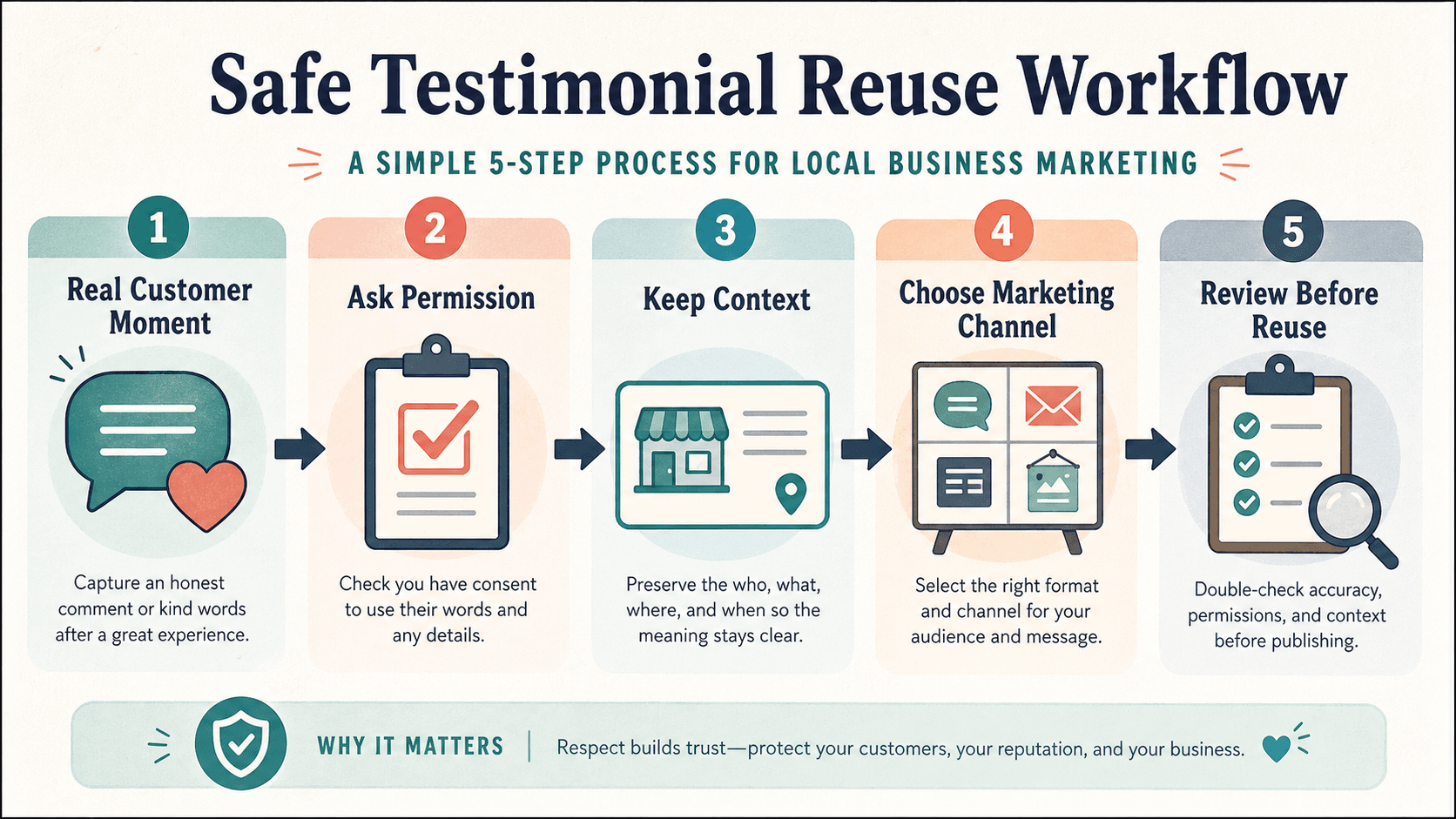
Use this five-step workflow:
1. Capture the real customer moment
Start from the customer's actual experience. The source might be a comment after a meal, a post-appointment compliment, a review draft, a feedback form, or a short survey response. Do not begin with a marketing claim and then look for a customer sentence to support it.
2. Ask permission for the use you want
Permission should match the channel. A customer may be comfortable letting you display a first name and quote on your website but not in a paid ad. Another customer may approve an anonymous quote but not a photo. Ask in plain language, not legal-heavy language that customers ignore.
A simple consent prompt might say:
"May we use your comment in our marketing, such as our website, social posts, or printed materials? We can use your first name only, initials, or keep it anonymous."
3. Preserve the original context
Store the source, date, location, service, and approved version. This does not need to become a complicated legal archive for a small business, but someone should be able to answer: who said it, what experience it referred to, what version was approved, and where it is being used.
4. Choose the right marketing channel
Not every testimonial belongs everywhere. A short service compliment may work well on a website service page. A customer photo may fit a social post if the customer approved photo use. A detailed story may belong in a blog post or case-style article, but only if it is accurate and permissioned.
5. Review before reuse
Before publishing, check the final design, caption, headline, and surrounding copy. A testimonial can become misleading because of the headline above it, not only because of the quote itself. For example, placing one quote under "Guaranteed Results" is much riskier than placing it under "What customers notice about our service."
How AI should and should not help
AI can help organize customer feedback, draft cleaner language for customer review, and turn a customer-approved comment into different marketing formats. AI should not invent the customer's experience, exaggerate the result, or replace customer approval.
A safe AI-assisted workflow keeps the customer in control:
- The customer shares their own experience or chooses experience-based keywords.
- AI helps draft a review, testimonial, social post, or video script from those inputs.
- The customer or business reviews the output for accuracy.
- The business gets permission before using the customer's words in marketing.
- The final version preserves the original meaning.
This is the difference between assistance and fabrication. A local business can use AI to reduce friction, but it should not use AI to create a speaker who does not exist or a result that did not happen.
Vibpost is built around this customer-moment workflow. It uses a smart review QR code workflow, called a Seeding Code inside the product, to help local businesses turn real customer experiences into review drafts, social posts, testimonials, and video scripts. The useful part is not merely that AI can write a sentence. The useful part is that the workflow starts with a real customer moment, customer-selected keywords, and a reviewable draft rather than a blank prompt.
A practical testimonial policy for small local teams
A small business does not need a twenty-page policy to reuse testimonials responsibly. It needs a repeatable checklist that staff can follow without guessing.
Use this as a lightweight internal rule:
| Decision | Recommended rule |
|---|---|
| Can we quote a review from Google? | Only after getting the reviewer's consent for marketing use. |
| Can we shorten a quote? | Yes, if the shortened version keeps the meaning and does not hide important context. |
| Can we fix grammar? | Usually yes, but keep the customer's voice and let them approve meaningful edits. |
| Can we use a first name and photo? | Only if the customer approved that identity and image use. |
| Can we use a testimonial in ads? | Ask for ad-specific permission, because ads are a stronger marketing context. |
| Can we use incentives? | Avoid rewards tied to positive sentiment; disclose material connections when they exist. |
| Can employees write testimonials? | Do not present insider comments as ordinary customer testimonials; disclose relationships clearly. |
| Can AI rewrite a testimonial? | Use AI for clarity, not to change the speaker, experience, result, or sentiment. |
For regulated or sensitive services, such as health, finance, legal, childcare, or services involving minors, use extra caution. Testimonials in those categories can carry privacy, professional, and advertising implications beyond a normal cafe or retail quote.
Examples by local business type
The same consent-first logic can work across local industries, but the best marketing use depends on the customer moment.
| Business type | Good testimonial reuse | Risky version to avoid |
|---|---|---|
| Restaurant | A customer-approved quote about service, atmosphere, or a favorite dish on a local landing page | A fake "best restaurant in the city" quote or a copied review used without consent |
| Salon | A first-name-only testimonial about feeling listened to during an appointment | Before-and-after claims that imply guaranteed results for every client |
| Gym | A member-approved comment about feeling welcome in a beginner class | A transformation story that hides how unusual the result was |
| Pet service | A quote about communication, care, and updates after a visit | Reusing a pet owner's photo or full name without permission |
| Wellness clinic | A comment about staff clarity, comfort, or scheduling experience | Health-result claims that go beyond what the customer actually said |
| Retail boutique | A short quote about fit help, gift guidance, or local service | Editing a mixed review until it sounds purely positive |
The strongest testimonial is not always the most dramatic one. It is the one that a new customer can believe and a current customer would still recognize as true.
Before you publish a testimonial, check the surrounding message
A testimonial can be accurate by itself and still become misleading in context. The headline, page placement, CTA, image, star graphics, and surrounding claims all shape what the reader understands.
Before publishing, scan the whole block:
- Does the headline imply a result the customer did not promise?
- Does the design make the quote look like an official platform rating when it is not?
- Does the testimonial include a date or "as of" note when rating counts or star ratings are shown?
- Does the channel require stronger permission, such as paid ads or printed materials?
- Does the quote reveal personal information that should stay private?
- Does the testimonial represent one person's experience rather than a guaranteed outcome?
- Does the customer know how their words will appear?
If the testimonial passes those checks, it is more likely to work as durable customer proof instead of fragile marketing decoration.
FAQ about reusing customer testimonials
Can I copy a Google review onto my website?
You should get consent from the reviewer before using a Google review in your own marketing. A review being public on your Business Profile does not mean the business owns it for website, print, ad, or social reuse.
Can I use only the best sentence from a longer customer comment?
Yes, if the shorter version keeps the meaning fair. Do not remove context that changes the customer's point, hides a limitation, or turns a mixed comment into a stronger endorsement than the customer intended.
Do I need a signed release for every testimonial?
Not every local testimonial requires a formal signed contract, but you should keep clear permission records. A simple written approval, form checkbox, email reply, or platform-based consent record is much better than relying on memory.
Can AI rewrite a testimonial to sound better?
AI can help clean up grammar, format a quote, or draft a version for customer approval. It should not invent details, add claims, change the customer's experience, or make the quote sound like a different person.
Can I reuse negative feedback internally?
Yes. Negative feedback can be useful for training, operations, and service improvement. Be careful with public reuse, especially if the feedback includes personal details or if the customer did not approve publication.
Is a testimonial the same as a review?
Not exactly. A review is often a customer's evaluation on a review platform or product page. A testimonial is usually used by the business as a marketing message. The same words can become a testimonial when the business republishes them to promote itself.
The safest testimonial is still recognizably the customer's
Customer testimonials are valuable because they do something brand copy cannot do: they show how real people describe the experience in their own language. The more a business edits, stretches, anonymizes, or repackages that language without care, the less trustworthy the proof becomes.
For local businesses, the better system is straightforward. Capture real customer moments while they are fresh. Ask permission before reuse. Keep the context attached. Use AI only to reduce friction and improve clarity. Review the final marketing message before publishing.
That workflow gives the business reusable customer proof without turning testimonials into something customers would no longer recognize.