

How to Collect Negative Feedback Without Suppressing Honest Reviews
You can collect negative feedback safely by giving customers a private way to explain problems, responding to those problems in good faith, and still leaving the public review invitation honest and open. The line you should not cross is filtering: do not ask only happy customers to leave public reviews, do not steer unhappy customers away from review platforms, and do not pressure customers to change what they experienced.
For a restaurant, salon, gym, pet service, clinic, cafe, or neighborhood retailer, negative feedback is not just a reputation risk. It is operational data. It tells you where the wait felt too long, where the handoff was confusing, where the service did not match the promise, or where a small fix could save a customer relationship.
The safest workflow is simple: listen privately, fix what you can, then invite honest feedback without deciding who is "allowed" to review you.
Treat private feedback as service recovery, not review filtering
Private feedback is useful when it helps you understand and resolve a customer problem. It becomes risky when the business uses it to separate happy customers from unhappy customers before making a public review request.
A good private feedback channel might ask:
- What happened during your visit?
- What could we have done better?
- Would you like a manager to follow up?
- Which part of the experience did not meet expectations?
- Is there anything specific we should fix before your next visit?
That kind of feedback helps the business act. It gives the customer a path to be heard before frustration becomes a one-star review, angry social post, chargeback, or permanent lost relationship.
The risky version looks similar on the surface but has a different intent. It asks customers to rate the business first, then sends only satisfied customers to Google, Yelp, Facebook, or another public review site. Unhappy customers are routed into a private complaint form and never shown the same public review option.
That is review gating. It may feel efficient, but it is not a trust-building workflow. It filters the public picture of your business by sentiment.
What review suppression looks like in everyday operations
Review suppression is not always dramatic. Most small businesses are not threatening customers or buying reviews. The common risk is quieter: a team member, form, text message, QR flow, or follow-up sequence nudges unhappy customers away from public review channels while encouraging happy customers to post publicly.
Watch for these patterns:
| Pattern | Why it is risky | Safer alternative |
|---|---|---|
| "If you had a great visit, leave us a Google review. If not, tell us here." | The public request is tied to positive sentiment. | Ask every customer for honest feedback, then give the same public review option without filtering by mood. |
| A survey sends 4-5 star respondents to a public review link and everyone else to support. | The workflow selectively solicits positive reviews. | Use survey responses for service recovery, but keep public review invitations separate and open. |
| Staff are told to ask only "happy-looking" customers for reviews. | The team is screening customers before asking. | Train staff to ask in neutral language after real service moments. |
| A manager asks a customer to remove a negative review in exchange for a discount. | The incentive is tied to review revision or removal. | Resolve the issue. If the customer chooses to update their review, that must be their choice. |
| AI rewrites a complaint into a more flattering review draft. | The draft no longer reflects the customer's real experience. | Use AI to summarize the issue internally or help the customer write accurately, not to change sentiment. |
The safer mindset is not "How do we avoid bad reviews?" It is "How do we hear problems early and invite honest public feedback fairly?"
The policy boundary local businesses should understand
When reviews are involved, the business should assume two things: public reviews must reflect genuine customer experiences, and review requests should not manipulate the rating or content of the review.
Google Maps' prohibited and restricted content policy is especially clear on this point. It does not prohibit a merchant from asking real customers for reviews. It does warn against discouraging negative reviews, selectively soliciting positive reviews, offering incentives for reviews or review removal, pressuring customers to review while on the premises, or requesting specific content in a review.
The FTC's consumer reviews and testimonials rule also matters for U.S. businesses because it focuses on deceptive review practices, including fake reviews, paid sentiment, certain undisclosed insider testimonials, and review suppression.
For a local operator, the practical takeaway is straightforward:
- Ask real customers, not fake accounts or staff posing as customers.
- Ask for honest feedback, not a particular star rating.
- Do not pay, discount, reward, or pressure people for a positive review.
- Do not hide negative feedback from public review paths while promoting positive feedback.
- Do not ask customers to revise or remove a negative review in exchange for something.
- Do not write the review for the customer without their input and control.
This is not legal advice, and high-risk industries should get proper counsel. But as a day-to-day operating rule, it is enough for most small teams: keep the customer's experience real, keep the invitation neutral, and keep the customer in control.
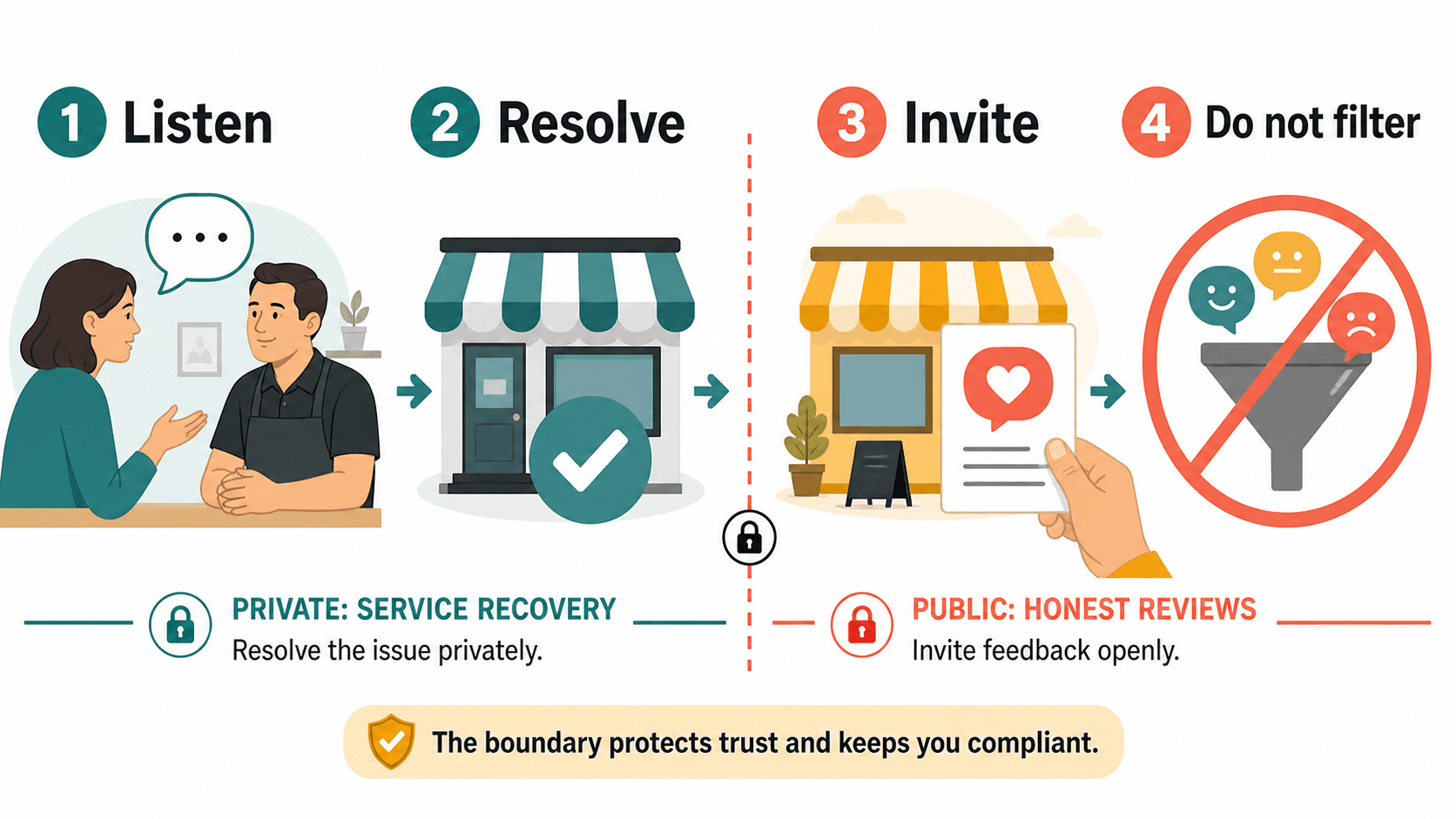
A practical workflow for collecting negative feedback
The cleanest workflow separates service recovery from review solicitation. You can make it easy for customers to report problems, but you should not make public review access depend on whether the feedback is positive.
Use this sequence:
1. Ask for feedback while the experience is still fresh
The best time to hear a problem is close to the customer moment: after checkout, after a meal, after an appointment, after a class, or shortly after delivery of a local service. The customer still remembers details, and your team may still be able to fix the issue.
Use neutral wording:
How was your visit? We read every response and use it to improve.
Avoid wording that implies only praise is welcome:
Loved your visit? Leave us a review. Not happy? Tell us privately.
The second version may seem customer-friendly, but it splits the path based on sentiment.
2. Let customers describe the issue in their own words
Negative feedback is most useful when it is specific. A vague "bad service" comment is hard to act on. A specific comment about a slow handoff, unclear pricing, rushed appointment, wrong order, or uncomfortable interaction tells you what to fix.
Ask for details without coaching the customer toward a better rating:
- What part of the visit should we look into?
- Was this about wait time, service, quality, cleanliness, communication, billing, or something else?
- Would you like a follow-up from the owner or manager?
- What would a better experience have looked like?
This helps the business respond without rewriting the customer's experience.
3. Respond before you request anything else
If a customer has a real complaint, do not immediately ask for a public review. First acknowledge the issue and decide whether the business can fix it.
A useful response is specific:
Thank you for telling us. We missed the timing on your order, and I can see why that was frustrating. I am checking with the team now. If you are open to it, I would like to follow up today and make this right.
Avoid defensive, scripted replies:
We are sorry you feel that way. Please leave us a better review after we resolve this.
The first response treats feedback as a relationship moment. The second response treats the customer's frustration as a rating problem.
4. Keep the public review option honest
After you have listened and responded, you can still invite the customer to share an honest public review. The key is to avoid conditions.
Safer language:
If you would like to share your experience publicly, you are welcome to leave an honest review here. We appreciate feedback from every customer because it helps future customers know what to expect.
Riskier language:
If we fixed this for you, would you update your review to five stars?
The safer version leaves control with the customer. It does not ask for a specific rating, does not tie the request to a reward, and does not imply that negative feedback should stay private.
How a smart review QR code can help without gating
A smart review QR code can help local businesses collect feedback because it reduces friction at the exact moment a customer still remembers the experience. The important part is how the workflow is designed: it should capture real customer input and support honest review drafts, not screen customers by sentiment.
Vibpost is an AI marketing assistant for local businesses that uses a smart review QR code workflow, called a Seeding Code inside the product, to help customers turn real experiences into review drafts, social posts, testimonials, and video scripts. In a feedback-sensitive workflow, that can be useful when the customer remains in control.
A safer Vibpost-style setup would:
- Let the business create a customer feedback QR code for a real touchpoint, such as a table, counter, receipt, appointment follow-up, or checkout moment.
- Let the customer choose experience-based keywords instead of starting from a blank page.
- Use AI to help structure a review draft, testimonial, social post, or video script based on the customer's own input.
- Let the customer edit, reject, or approve the draft.
- Avoid deciding that only positive customers should see a public review path.
The product value is not "hide unhappy feedback." The product value is reducing the gap between a real customer moment and a useful piece of customer proof while keeping the workflow grounded in that customer's experience.
Train staff to ask without sounding defensive
Your staff do not need a complicated script. They need a neutral, repeatable sentence that works for happy customers, quiet customers, and unhappy customers.
Good staff language:
- "We read every response. If anything was off today, please tell us so we can fix it."
- "Your honest feedback helps us improve and helps future customers know what to expect."
- "If you want to share your experience publicly, you can use this link. Please write what was true for your visit."
- "If something went wrong, I can ask a manager to follow up."
Avoid staff language:
- "If you can give us five stars, please scan this."
- "Don't leave a bad review, just tell me."
- "My manager wants each of us to collect reviews today."
- "Please mention my name in the review."
- "We can give you a discount if you update the review."
The best request does not sound like a plea for ratings. It sounds like a business that is confident enough to hear the truth.
What to measure without chasing only positive reviews
A healthy feedback workflow should measure response quality and service recovery, not only public rating volume. If the only metric is "more five-star reviews," staff will eventually learn to filter, pressure, or avoid difficult customers.
Track a more balanced set of signals:
- Feedback scan rate or response rate.
- Common complaint categories.
- Time to first response for unhappy feedback.
- Number of issues resolved.
- Staff friction: whether the ask feels natural or awkward.
- Public review invitations sent without sentiment filtering.
- Public reviews that mention specific real experiences.
- Follow-up notes from customers after an issue is handled.
This gives the owner a better operating picture. A week with three tough complaints may be more valuable than a week with five vague compliments if those complaints reveal a fixable pattern.
FAQ
Can I ask unhappy customers for private feedback before they review us publicly?
Yes, you can offer a private feedback channel for service recovery. The safer approach is to make that channel available to everyone and avoid using it as a filter that keeps unhappy customers away from public review platforms.
Is it review gating to ask, "Were you satisfied?" before showing a review link?
It can become review gating if satisfied customers are sent to a public review link and dissatisfied customers are sent only to a private form. If you use a satisfaction question, do not let the answer determine who gets access to the public review option.
Can we ask a customer to update a negative review after we fix the problem?
You can let the customer know they are welcome to update their review if they want to. Do not pressure them, offer a reward, or make the fix conditional on changing or removing the review.
Should AI write a response to negative feedback?
AI can help draft a clearer response, but a human should review it for accuracy, empathy, and specific next steps. Avoid generic replies that sound automated or defensive.
Can Vibpost help with negative feedback?
Vibpost can support a customer feedback workflow by helping customers turn real experience-based input into review drafts, social posts, testimonials, or video scripts. It should be used to reduce writing friction and preserve customer control, not to suppress negative reviews or manufacture positive ones.
Keep the invitation honest
Negative feedback is not the enemy of a local business. Mishandled feedback is.
When customers complain, they are giving you a chance to see what the operation feels like from the outside. Some issues will be small. Some will be uncomfortable. A few will be unfair. But the workflow should still respect the same principle: listen first, respond honestly, and do not filter public review opportunities by sentiment.
That is how a local business protects trust while still building customer proof. The goal is not a perfect-looking review profile. The goal is a review and feedback system that customers can believe.