

Google Review Requests in 2026: How to Ask Without Review Gating or Losing Trust
Key Points
- Review gating means pre-screening customers by sentiment before deciding who gets a public review link.
- A safer Google review request gives every real customer the same opportunity to share feedback, without incentives, pressure, or scripted wording.
- Businesses should avoid shared review kiosks, gifts for reviews, employee or family reviews, and requests that tell customers exactly what to write.
- A smart review QR code workflow can still help when it starts from real customer experience and keeps the customer in control.
- Vibpost helps local businesses turn real customer moments into review drafts, social posts, testimonials, and video scripts without positioning AI as a fake-review shortcut.
Google reviews are still one of the easiest trust signals for a local business to understand. A customer searches for a cafe, salon, gym, or pet shop, sees recent reviews, reads the tone, and decides whether the place feels safe to try.
That is why so many businesses have built review requests into checkout, receipts, table cards, appointment follow-ups, and front-desk conversations. The risky part is that some of those habits cross the line from "make it easy" into "shape the review."
If your current process asks only happy customers to post publicly, rewards people for leaving reviews, gives customers a company tablet, or tells them which words to include, it is time to clean it up. The goal is not to stop asking. The goal is to ask in a way that protects trust.
What changed about Google review requests in 2026?
The core rule has not changed: reviews should reflect genuine customer experiences. What has changed for local businesses is the need to treat review collection as a trust workflow, not a shortcut for ratings.
Google's Maps user-generated content rules describe categories such as fake engagement, misrepresentation, conflicts of interest, and incentives. In practical terms, that means the safest review process should not try to control who posts, what rating they leave, what exact words they use, or whether negative feedback stays private.
Here is the practical version for a local business:
| Review practice | Risk level | Safer replacement |
|---|---|---|
| Sending review links only to happy customers | High | Ask all eligible customers in the same way |
| Offering a discount, gift, or loyalty point for a review | High | Thank customers without tying the thank-you to a review |
| Asking customers to mention a staff member or keyword | High | Ask them to share their own experience in their own words |
| Using a shared tablet or review station | High | Let customers use their own device when they are ready |
| Asking employees, vendors, or family to review the business | High | Collect feedback only from genuine customers |
| Making the review path easier after a real visit | Allowed when neutral | Provide a clear link, QR card, or follow-up message without pressure |
The safest question is simple: would this process still feel fair if the customer wanted to leave a three-star review?
Can Google delete reviews that look manipulated?
Yes. Reviews can disappear when a platform's systems or moderators decide they violate policy, look spammy, or appear to come from a conflicted source.
That does not mean every removed review proves wrongdoing. Reviews can be filtered for many reasons, and local businesses do not always get a detailed explanation. But certain patterns create obvious exposure:
- A sudden burst of reviews from one campaign.
- Several reviews using the same phrase.
- Reviews that repeatedly mention the same staff name because customers were coached.
- Reviews left from a shared device or similar network pattern.
- Reviews from people connected to the business instead of real customers.
For a restaurant, salon, spa, or retail store, the better goal is a steady review rhythm. Ask at natural moments, keep the request neutral, and let customers decide what to say.
What is review gating, and why is it still a bad idea?
Review gating is when a business checks sentiment first and then routes customers differently based on the answer.
The common version looks like this:
- A customer receives a message asking how the visit went.
- If they choose a positive rating, they get a Google review link.
- If they choose a negative rating, they are sent to a private feedback form.
That may feel efficient, but it creates a biased review funnel. Happy customers are invited to post publicly. Unhappy customers are quietly diverted. Even if the business sees it as customer service, the public review profile no longer reflects the same opportunity for every customer.
A compliant workflow can still collect private feedback. The difference is that private feedback should not be used as a filter that decides who gets a public review request.
Why should you avoid telling customers what to write?
Because the moment you script the review, the review becomes less trustworthy.
A staff member might say, "Could you mention my name?" A manager might say, "Please say the service was fast." A printed card might suggest a set of exact phrases. Those requests can feel harmless, especially when the customer really did have a good experience.
But from the customer's point of view, the business is no longer asking for honest feedback. It is asking for a specific piece of marketing copy.
There is a safer way to help customers who do not know what to write: give them prompts that help them remember the real visit without dictating the conclusion. For example:
- What did you order or buy?
- What part of the visit stood out?
- Was the team helpful?
- Was the place clean, comfortable, or easy to use?
- Would you recommend it to someone looking for the same thing?
That keeps the review grounded in memory, not pressure.
What about asking while the customer is still in your location?
The risk is pressure.
If a customer is still standing at the front desk, sitting in the chair, or waiting at the counter while an employee asks for a review, the request may not feel optional. The customer may worry about being watched, judged, or put in an awkward position.
This is also why shared devices are a poor fit. A tablet at the counter may increase completion, but it can also create privacy, pressure, and spam-pattern risks.
A better local-business workflow gives the customer space:
- A neutral card on the counter or receipt.
- A follow-up message after the appointment or visit.
- A small table card that customers can scan if they choose.
- A staff script that says, "If you would like to share your experience, this link makes it easy."
The words "if you would like" matter. The customer should feel invited, not cornered.
What counts as an incentivized review?
An incentivized review is any review tied to a reward, discount, payment, gift, loyalty point, free item, or special treatment.
For local businesses, this is one of the easiest mistakes to make. A cafe might offer a free cookie for a review. A salon might offer a discount on the next visit. A gym might run a raffle for members who post feedback.
The safer approach is to separate appreciation from review behavior. You can thank customers for visiting. You can run loyalty programs. You can invite feedback. But do not make the benefit conditional on leaving a review, leaving a positive review, changing a negative review, or removing a review.
The same boundary matters for testimonials. The FTC's consumer review guidance also treats review manipulation and undisclosed incentives as a serious business risk, so the trust issue is not limited to one platform.
What review requests are still allowed?
Businesses can still ask real customers for reviews. The allowed path is simpler than many owners think:
- Ask all customers in a consistent, neutral way.
- Use a review link, receipt note, follow-up message, or QR card.
- Do not offer rewards for reviews.
- Do not tell customers what rating to leave.
- Do not tell customers which staff name, phrase, or keyword to include.
- Let customers write, edit, and decide what to publish.
- Respond professionally to both positive and negative reviews.
The point is to reduce friction, not to manufacture praise.
For a local business, the biggest missed opportunity is often the moment right after a good experience. A customer says the haircut looks great, the pastry was excellent, the front desk was helpful, or the class was worth coming back for. Then they leave, get busy, and the moment disappears.
That is where a structured workflow helps.
Where does Vibpost fit in a safer review workflow?
Vibpost is an AI marketing assistant for local businesses that uses a smart review QR code workflow, called a Seeding Code inside the product, to help customers turn real experiences into review drafts, social posts, testimonials, and video scripts.
The important part is the starting point. Vibpost is not for fake reviews, bought reviews, or reviews written by the business without customer input. It starts from a real customer moment:
- The business places a smart review QR code in the customer journey.
- The customer scans from their own device.
- The customer selects experience-based keywords that match the real visit.
- AI helps turn those inputs into a review draft, social post, testimonial, or video script.
- The customer or business reviews the output before anything is shared or reused.
For a cafe, salon, restaurant, spa, gym, pet shop, or local retailer, that workflow solves a practical problem: many customers are willing to share, but they do not know what to write.
Vibpost helps make the blank page less blank. It should not be used to decide which customers are allowed to post, pressure customers into a rating, or replace their actual experience.
How do you know if your current process is at risk?
Audit the workflow, not just the wording.
If any of these are true, your review request process needs attention:
- You ask only visibly happy customers to leave public reviews.
- You ask unhappy customers for private feedback but do not give them the same public review path.
- Your staff uses a script that tells customers what to mention.
- You use a shared tablet, kiosk, or in-store review station.
- You offer a reward for leaving, changing, or removing a review.
- You ask employees, vendors, friends, or family to review the business.
- You measure staff performance by exact review mentions.
- You see sudden review spikes after campaigns instead of a steady flow.
The fix is usually operational, not technical. Train staff to invite feedback neutrally. Use the same request path for eligible customers. Move from pressure to convenience. Review any AI-assisted draft before it becomes public content.
What happens if you ignore the boundary?
The immediate risk is that reviews may be removed. The larger risk is that customers stop trusting the process.
A local business can recover from a deleted review. It is much harder to recover when customers feel that feedback is being managed, filtered, or scripted.
That is why a healthy review workflow should have two jobs:
- Make it easier for real customers to share what happened.
- Protect the credibility of the business by avoiding shortcuts.
The best review systems do not chase perfect ratings. They make real customer proof easier to capture, understand, and reuse.
Reviews are harder to engineer, but easier to respect
Review collection is not going away. If anything, it matters more because local customers use reviews to decide where to eat, book, shop, work out, or bring their pets.
What is changing is the tolerance for shortcuts.
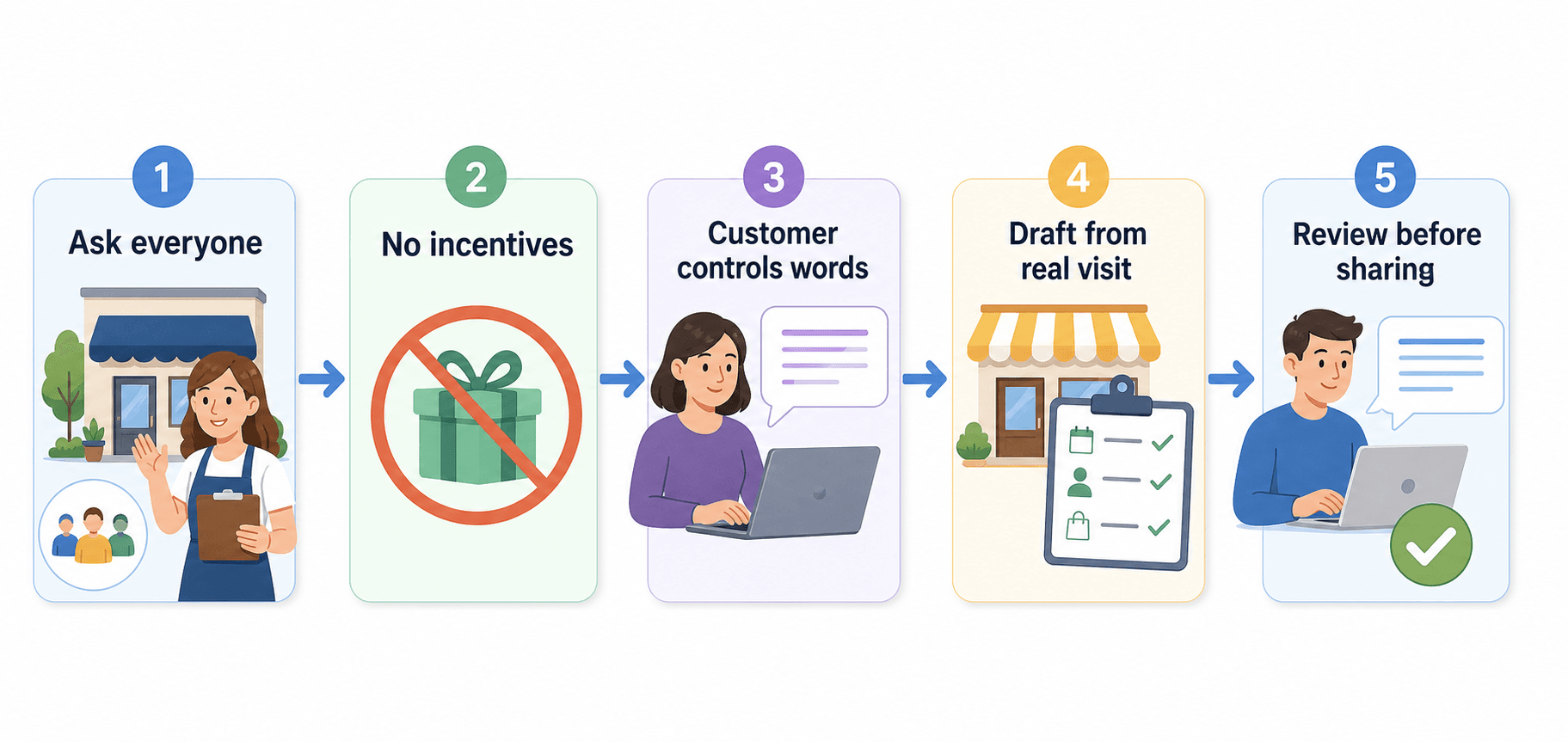
If your business depends on real customer moments, build a workflow around those moments. Ask everyone fairly. Avoid incentives. Let customers control their words. Use AI to reduce friction, not to manufacture praise.
That is the lane where Vibpost belongs: helping local businesses turn genuine customer experiences into review drafts and reusable social proof while keeping the customer in control.