

How Local Businesses Can Build Google Review Trust Without Review Gating
For a local business, Google review trust is not built by asking only your happiest customers to post. It is built by giving real customers a fair, low-friction way to share what actually happened.
That distinction matters. A restaurant, salon, gym, pet shop, retail store, or wellness studio may look at nearby competitors and see the same pattern again and again: fresher reviews, more specific comments, and a profile that feels active. The temptation is to route only positive feedback to Google and keep everything else private.
That is review gating. It may feel efficient, but it weakens the credibility of the whole review profile.
A better goal is simpler: create a repeatable review request workflow that invites every eligible customer, keeps the customer in control, and turns real customer moments into useful proof without scripting the outcome.
The review trust board: 10 signals to audit before asking for more reviews
Before changing your review request process, look at your current Google Business Profile like a customer would. You do not need a complicated reputation dashboard to spot the first trust gaps.
Use these ten signals as your review trust board.
01. Recent review activity
A profile with reviews from the last few weeks often feels more alive than a profile where the newest feedback is months old. Recency does not prove quality by itself, but it tells customers that people are still visiting, booking, buying, and sharing experiences.
If your review request process only happens during occasional campaigns, you may see bursts followed by silence. A healthier process builds review invitations into normal customer moments.
02. Specific experience details
Generic praise is weaker than concrete memory. "Great service" is fine. "The front desk helped me find the right appointment time" or "the lunch special was fast enough for a work break" is more useful.
The safest way to support specificity is not to tell customers what to write. It is to help them remember the real visit: the dish, service, room, staff helpfulness, wait time, class, treatment, product, or result they experienced.
03. A natural mix of sentiment
No local business has a perfect customer experience every day. A trustworthy profile usually looks human: strong positive reviews, occasional criticism, and owner responses that show the business is paying attention.
Trying to hide every unhappy customer from the public review path can make the profile look less credible over time. The fairer workflow is to invite feedback consistently and respond professionally when the feedback is not glowing.
04. Owner responses that feel human
Reviews do not work alone. A thoughtful owner response can show future customers that the business listens. That matters for positive reviews and even more for negative ones.
Avoid canned replies that sound copied across every review. Thank the customer, acknowledge the specific point when appropriate, and keep private details out of public replies.
05. Customer-owned devices
Reviews are safer when customers use their own phones at a time that feels comfortable. Shared tablets, counter kiosks, or staff-handled devices can create pressure and may also create suspicious review patterns.
A QR card, receipt note, table tent, or follow-up message can reduce friction without taking control away from the customer.
06. Neutral language
The request should not suggest a required rating, desired phrase, or expected outcome. A neutral review request sounds like an invitation, not a script.
Instead of "Please leave us a five-star review," use language closer to: "If you would like to share your experience, this link makes it easy."
07. No incentives tied to reviews
Discounts, gifts, raffle entries, loyalty points, or free items in exchange for reviews create risk. The problem is not only the reward. The problem is that the reward can change what customers say or whether they feel comfortable being honest.
You can thank customers for visiting. You can run loyalty programs. You can ask for feedback. Keep those actions separate from review behavior.
08. No sentiment filtering
If your workflow asks, "How was your visit?" and only sends happy customers to Google, you are filtering the public review path. That is the core review gating pattern.
Private feedback can still be useful for operations. It should not decide who is allowed to leave a public review.
09. Review requests at natural moments
The best request timing depends on the business. Restaurants may ask after the meal or on the receipt. Salons and spas may ask after the appointment. Gyms may ask after a class. Retail stores may ask after checkout or through a follow-up message.
The common principle is the same: ask close enough to the experience that the customer remembers it, but not in a way that feels watched or pressured.
10. A repeatable workflow, not a one-time push
Trust grows through consistency. A one-week "review drive" can create a spike, but it does not necessarily create a durable habit.
Build a process your team can run every day: place the request, explain it neutrally, let the customer decide, and review the results without chasing perfect ratings.
What strong review profiles usually have in common
The best local review profiles are not always the ones with the most aggressive request campaigns. They usually have a few operational habits in common.
They ask at the right moment. A customer has just finished a meal, haircut, class, appointment, or purchase. The experience is still fresh, so the review has something real to say.
They reduce the blank-page problem. Many happy customers would be willing to share, but they do not know where to start. Helpful prompts can remind them of the visit without dictating the rating or wording.
They keep control with the customer. The customer chooses whether to write, edit, publish, or skip. The business can make the path easier, but it should not manufacture the opinion.
They learn from the full range of feedback. Public reviews, private comments, repeat themes, and staff observations all help the business improve. A review workflow that only chases public praise misses part of the value.
Google's review guidance says businesses can ask customers for reviews and share a review link, while its Maps contribution policies warn against fake engagement, conflicts of interest, and incentivized or misleading content. For a local operator, the practical lesson is straightforward: make reviews easier, not less honest.
How to close the review trust gap in 90 days
You do not need to rebuild your entire reputation strategy at once. Start with a 90-day review workflow that your staff can actually run.
01. Pick the customer moment
Choose one moment where a real customer experience is fresh and the request will not feel forced.
For a restaurant, that might be the receipt or a small table card. For a salon, it might be the checkout conversation or a follow-up message after the appointment. For a gym, it might be after a class milestone. For a retail store, it might be after a helpful product recommendation.
Do not ask every staff member to improvise. Pick the moment, write the neutral script, and make it easy to repeat.
02. Ask every eligible customer the same way
The safest workflow does not start by deciding who is happy enough to receive a link. It gives the same opportunity to real customers who completed a visit, purchase, class, appointment, or service.
That does not mean you need to interrupt every customer. It means the public review path should not depend on a pre-screened sentiment score.
03. Help customers remember, not perform
Customers often freeze when they see an empty review box. A helpful workflow can give them memory prompts:
- What did you try, buy, or book?
- What stood out during the visit?
- Was the team helpful?
- Was the place clean, comfortable, fast, friendly, or easy to use?
- What would you tell someone considering the same business?
Those prompts support honest detail. They do not tell the customer what rating to leave or which exact phrase to include.
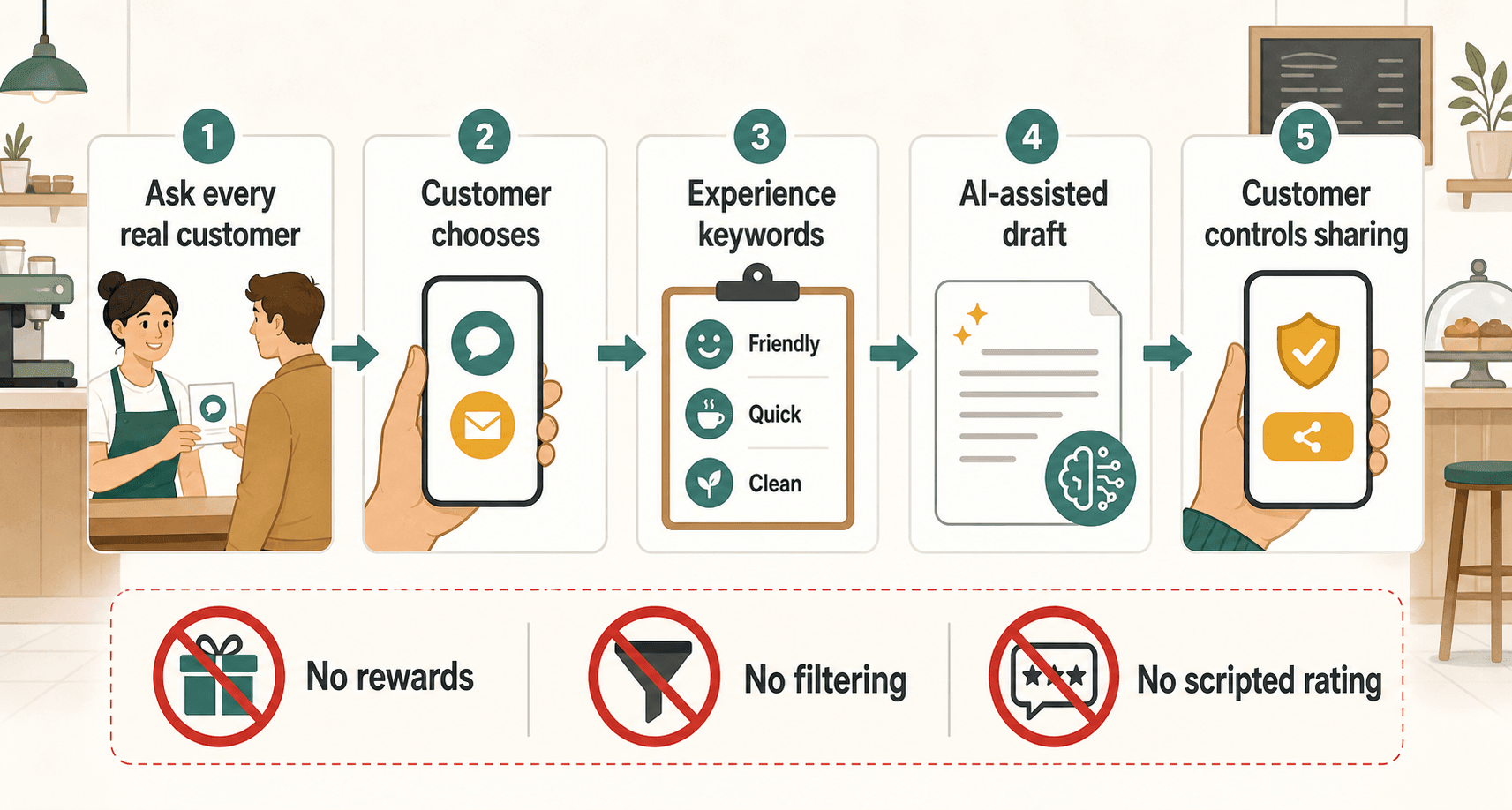
04. Use AI only after the customer provides real input
This is where Vibpost fits naturally. Vibpost is an AI marketing assistant for local businesses that uses a smart review QR code workflow, called a Seeding Code inside the product, to help customers turn real experiences into review drafts, social posts, testimonials, and video scripts.
The workflow starts from the customer moment:
- The business places a smart review QR code in the customer journey.
- The customer scans from their own device.
- The customer selects experience-based keywords that match the real visit.
- Vibpost helps turn those inputs into a review draft, social post, testimonial, or video script.
- The customer or business reviews the output before anything is shared or reused.
That is different from using AI to invent praise. The customer still supplies the experience, controls the wording, and decides what to publish.
05. Measure the workflow without promising rankings
Do not measure the 90-day test by a guaranteed ranking outcome. Local visibility is affected by many factors, and no review workflow should promise Google ranking gains.
Measure operational signals instead:
| Metric | What it tells you |
|---|---|
| QR scans or link visits | Whether customers notice the request |
| Draft starts | Whether the prompt feels easy enough |
| Completed feedback | Whether customers are willing to share |
| Review recency | Whether your profile is becoming more active |
| Common keywords | Which parts of the experience customers remember |
| Staff adoption | Whether the workflow is practical in daily service |
If scan volume is low, the placement may be wrong. If starts are high but completions are low, the prompt may feel too long. If staff adoption is weak, the process may be awkward or unclear.
Treat the workflow like an operating system for customer proof, not a magic review button.
What to avoid when the pressure to get more reviews rises
Review pressure can push local businesses into shortcuts. Most of those shortcuts create long-term trust problems.
Avoid asking only the customers who already praised you in person. They may be a good moment to invite feedback, but they should not be the only people who receive a public review path.
Avoid telling customers which rating to leave. Even a friendly nudge toward five stars can make the request feel transactional.
Avoid writing the review for the customer. AI can help structure a draft after the customer provides real inputs, but the review should still reflect the customer's experience and choice.
Avoid rewarding review behavior. A thank-you is fine. A discount for a review, a prize for a positive review, or a benefit for changing a review is not a healthy trust practice.
Avoid treating negative feedback as something to bury. A fair workflow can collect private feedback for service recovery, but it should not use private feedback as a filter that blocks public review access.
The FTC's consumer review rule also makes review manipulation a broader compliance issue, not just a platform preference. For small businesses, the safer habit is to keep the request fair, transparent, and customer-led.
More workflows for local businesses
The same review trust workflow can be adapted across different local-business categories.
Restaurants can place a neutral review card on the receipt or table and invite guests to share the part of the meal that stood out.
Cafes and bakeries can ask after pickup, delivery, catering, or a memorable staff interaction.
Salons and spas can invite feedback after an appointment, when the result and service experience are still fresh.
Gyms and wellness studios can ask after classes, milestones, or trial sessions, especially when customers have a clear moment to describe.
Retail boutiques can ask after a staff recommendation, fitting-room help, gift purchase, or local pickup experience.
Pet shops and local services can ask after a completed appointment, grooming visit, class, or consultation.
The channel may change. The trust rule does not: ask fairly, reduce friction, and let customers control what they share.
A better review request is a better customer proof system
If your business has real customer moments, you already have the raw material for stronger reviews and reusable social proof. The missing piece is usually not pressure. It is workflow.
Vibpost helps local businesses turn those moments into structured review drafts, social posts, testimonials, and video scripts through a smart review QR code workflow. It is designed for small teams that need an easier way to capture customer trust before it disappears.
Use it to make honest feedback easier to share. Use it to turn specific customer moments into reusable proof. Do not use it to filter, script, or manufacture reviews.
That is how a local business can build Google review trust without review gating: invite the real customer, support the memory, keep control with the customer, and make the process repeatable.