How Beauty Salons Can Use AI to Write Service Descriptions and Seeding Notes
Beauty salons do not need AI to make every service sound bigger than it is. They need AI to turn messy service information into clear content that a customer can understand, a manager can review, and an operator can reuse across channels.
That distinction matters. A salon can ask AI to "write a Xiaohongshu seeding note," but the result often feels generic because the AI has not been given the real service context: who the service fits, what the customer usually asks, what the appointment flow looks like, what cannot be promised, and which visuals are safe to use.
A better workflow starts before the article or post is written. It starts with a service content brief.
Xiaojia, JustAI's AI content marketing agent, is designed for this kind of workflow. It is not a QR code tool and it is not an auto-publishing system. Its job is to help merchants and content creators turn a simple instruction into organized marketing materials: image-text posts, long-form articles, content plans, presentation outlines, AI cover images, body visuals, and publishing schedules.
For beauty salons, the value is not "AI writes everything." The value is that AI can help the salon build a repeatable content SOP.
Start With a Service Content Brief
A service content brief is the input layer for every future post.
Instead of giving AI only a service name and an activity price, the salon should prepare a small brief with practical information:
- What the service is called internally and how customers describe it.
- Who it is usually suitable for, and who needs extra confirmation.
- What happens before, during, and after the appointment.
- What customers repeatedly ask in consultation chats.
- What the salon can say publicly and what must remain a private consultation.
- Which images are available and which visuals should be generated only as explanation.
- Which claims should be avoided, especially guaranteed results or invented customer feedback.
This brief does not need to be beautiful. It needs to be accurate.
Once the brief exists, AI can turn it into multiple assets without guessing. A service description becomes easier to write. A seeding note becomes less vague. A cover direction becomes more connected to the article. A weekly schedule becomes more than a list of similar titles.
Write the Service Description Before the Seeding Note
A service description is not a sales poster. It should help the customer understand what the service is, whether it may fit their situation, what the process looks like, and what needs human confirmation.
A practical service description can follow five parts:
- The customer question.
- The service positioning.
- The appointment flow.
- The usage or care reminders.
- The consultation boundary.
For example, a salon should avoid opening with broad claims like "this treatment creates obvious improvement." A safer opening explains why customers ask about the service in the first place: they are comparing options, preparing for an appointment, checking the process, or trying to understand whether the service fits their situation.
That kind of opening is less dramatic, but it is more useful. It gives the reader a reason to keep reading.
Use AI to Organize, Not Invent
AI can help a salon draft content, but it should not invent a customer's personal experience.
A salon can use AI to organize:
- Service steps.
- Customer questions.
- Caption drafts.
- Article outlines.
- Cover image directions.
- In-article visual ideas.
- Review checklists.
- Scheduling plans.
A salon should not use AI to invent:
- Customer testimonials.
- Before-and-after claims.
- Medical or treatment outcomes.
- Staff quotes that were never said.
- Personal experiences from a customer who did not provide them.
- Platform ranking or conversion promises.
This is especially important for seeding notes. A seeding note should feel close to real life, but the source of that feeling should be real service information and confirmed customer input, not fabricated experience.
Build Seeding Notes Around Real Scenarios
There are several safer ways to create seeding-style content without pretending to be a customer.
The first is a question-led note. It answers what customers usually ask before booking: "What should I know before choosing this service?" or "What should I confirm before an appointment?"
The second is a process-led note. It explains the steps from consultation to aftercare in plain language.
The third is a scenario-led note. It connects the service to a real life context such as preparing for a trip, a new hairstyle, a seasonal change, a photo day, or a regular maintenance routine.
The fourth is a mistake-led note. It explains what customers often misunderstand, such as reading only the service name, ignoring aftercare, or treating AI-generated images as real proof.
These formats give the content a human context without making false claims.
Plan Images at the Same Time as Copy
Beauty content is rarely text-only. But images need a role.
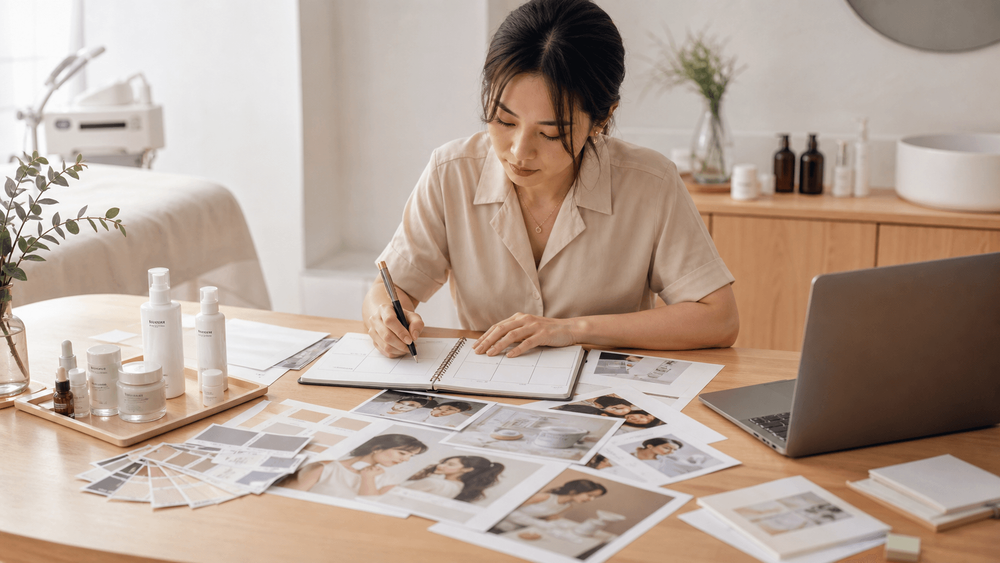
The cover image should show the topic or situation. It does not need brand names, logos, QR codes, platform UI, or product screenshots. For a salon article about AI-assisted content planning, a neutral planning scene can work better than a fake customer result.
The body image should explain the method.
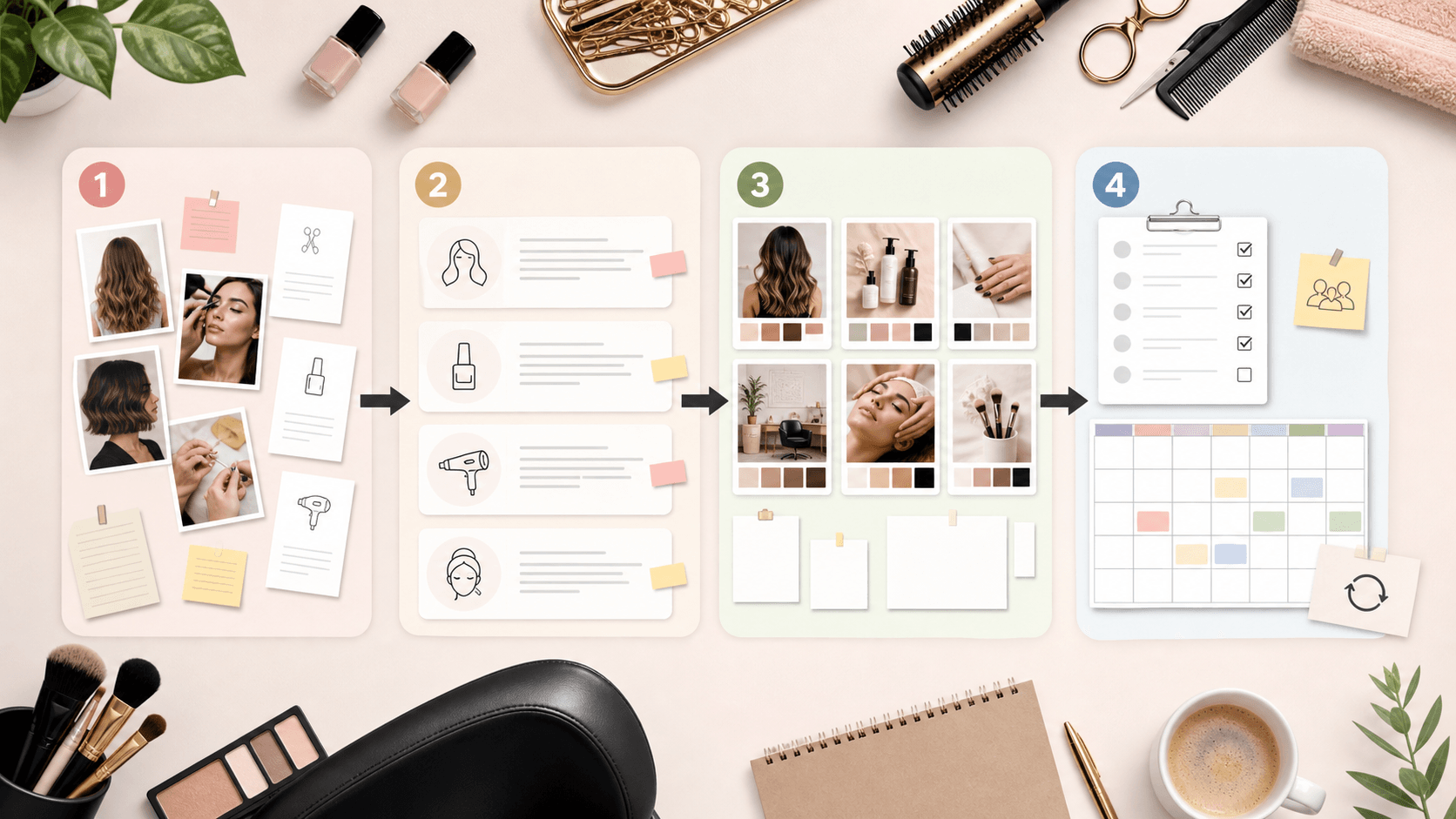
A useful body visual might show this flow:
Service brief -> description draft -> seeding note draft -> human review -> schedule reuse.
That visual is more useful than a decorative stock image because it tells the operator what to do next.
Turn One Service Into a Weekly Content Plan
Many salons make the same mistake after discovering AI: they generate ten posts at once.
The problem is that ten posts without roles quickly become the same post with different titles. A better approach is to turn one service into a one-week plan:
- Day 1: What this service is and who usually asks about it.
- Day 2: What the appointment flow looks like.
- Day 3: Who may need extra confirmation.
- Day 4: Common customer questions.
- Day 5: Before and after appointment reminders.
- Day 6: Visual material and service details.
- Day 7: Activity information and consultation guidance.
The salon does not have to publish every day. The point is that each post has a job. This makes AI-generated content easier to review and easier to reuse.
Keep a Human Review Step
AI should not be the final approver.
Before publishing, the salon should check:
- Whether the service facts are accurate.
- Whether the content implies a guaranteed result.
- Whether a customer experience has been invented.
- Whether the image could be mistaken for real proof.
- Whether the title is too exaggerated.
- Whether the channel version fits the channel.
- Whether the owner, technician, or customer service team needs to confirm details.
Xiaojia can help prepare the draft, but the salon still owns the facts and the final decision.
A Simple SOP for Salons
Here is a practical first version:
- Choose one service.
- Build a service content brief.
- Ask AI to generate several content angles.
- Select two angles and create one service description plus one seeding note draft.
- Generate a cover direction and at least one explanatory visual.
- Review the content for facts, claims, and image risk.
- Save the approved version back into the salon's content library.
This workflow is slower than asking AI for a finished post in one sentence. It is also more reliable.
For a salon, the goal is not to produce a single impressive draft. The goal is to create a repeatable content system: clear briefs, safer drafts, useful visuals, reviewable claims, and reusable schedules. That is where an AI content marketing agent can help.