

How Can Businesses Reuse Testimonials Without Misleading Customers?
Businesses can reuse testimonials safely when the customer's words stay honest, permission is clear, the context is not stripped away, and the quote is not edited into a bigger claim than the customer actually made.
That sounds simple, but many local businesses get this wrong in small ways. A restaurant turns "the server was kind" into "best service in town." A salon posts a client quote without asking whether the client is comfortable being named. A gym pulls the happiest sentence from a long review and leaves out the part that explained who the experience was for. A retailer puts a testimonial beside a product the customer did not buy.
The problem is not that testimonials are unsafe. Real customer words are one of the most useful forms of local proof a business can have. The risk comes from treating those words like raw marketing copy instead of a customer's real experience.
The safer standard is this: reuse the testimonial in a way the customer would still recognize as true.
A testimonial is not just a nice quote
A testimonial is a customer's statement about their experience with your business, product, service, staff, location, or result. For a local business, that might include:
- A Google review
- A written feedback form
- A text message from a customer
- A social media comment
- A video clip after a service
- A parent comment after a class
- A client quote after an appointment
The moment the business reuses that statement in marketing, it stops being just private feedback. It becomes a public trust signal. That means the quote should be handled with more care than an internal note.
If you run a cafe, salon, spa, gym, dental office, pet shop, local retail store, or education center, the practical question is not "Can I use customer praise?" The better question is:
Can I use this customer's words in a way that is truthful, permitted, and clear to the next person who sees them?
If the answer is yes, testimonials can help new customers understand what real people value about your business. If the answer is no, the same testimonial can create confusion, platform risk, or a trust problem.
The four-part test before you reuse a testimonial
Before you turn any customer comment into website copy, a social post, an email, a printed sign, or a sales page quote, run it through four checks.
1. Is it from a real customer experience?
Do not use testimonials from people who did not actually use the service, visit the location, purchase the product, or interact with the business in the way implied.
This sounds obvious, but it gets messy when businesses use friends, staff, family members, agencies, creators, or AI-generated review drafts. If the person did not have the experience, do not present the statement as if they did.
If the person has a relationship with the business that a reader would not expect, make that relationship clear. The FTC's Endorsement Guides focus heavily on whether material connections are disclosed when they could affect how people judge the endorsement.
For local businesses, a simple rule works well:
- Real customer, real experience: usually usable with permission and context.
- Employee, owner, family member, paid creator, or business partner: disclose the connection or avoid using it as ordinary customer proof.
- AI-written praise without a real customer behind it: do not use it as a testimonial.
2. Do you have permission to reuse it?
Permission does not have to be complicated, but it should be intentional.
If a customer posts a public review, that does not automatically mean they want their name, photo, words, or story reused everywhere else. A public review page, a website homepage, a social ad, and an in-store poster are different contexts.
For low-risk reuse, ask directly:
Would it be okay if we shared this quote on our website or social channels? We can use your first name only, initials, or keep it anonymous.
Give the customer a real choice. Do not make permission feel like a condition of service, a refund, a discount, or future access.
For sensitive services, such as wellness, medical-adjacent, education, finance, legal, or children's services, be more careful. Even a positive testimonial may reveal information the customer did not intend to share broadly.
3. Are you keeping the quote in context?
Editing for length is normal. Editing meaning is the problem.
Safe editing removes clutter without changing the claim. Risky editing changes what the customer appears to have said.
| Original customer words | Safer reuse | Risky reuse |
|---|---|---|
| "The front desk was patient and helped me reschedule." | "The front desk was patient and helped me reschedule." | "The most helpful team in the city." |
| "My haircut looked great for the event." | "My haircut looked great for the event." | "Guaranteed event-ready hair every time." |
| "The class helped my son feel more confident." | "A parent said the class helped her son feel more confident." | "Our program improves every child's confidence." |
| "The food came fast on a busy Friday." | "The food came fast on a busy Friday." | "Fast service every night." |
The risky versions are not just shorter. They turn one person's experience into a broad promise.
When editing testimonials, preserve:
- What the customer actually experienced
- Which service, product, location, or visit the quote refers to
- Whether the result was personal to that customer
- Any limitation that would change the reader's understanding
If you would be uncomfortable showing the edited version to the customer who said it, do not publish it.
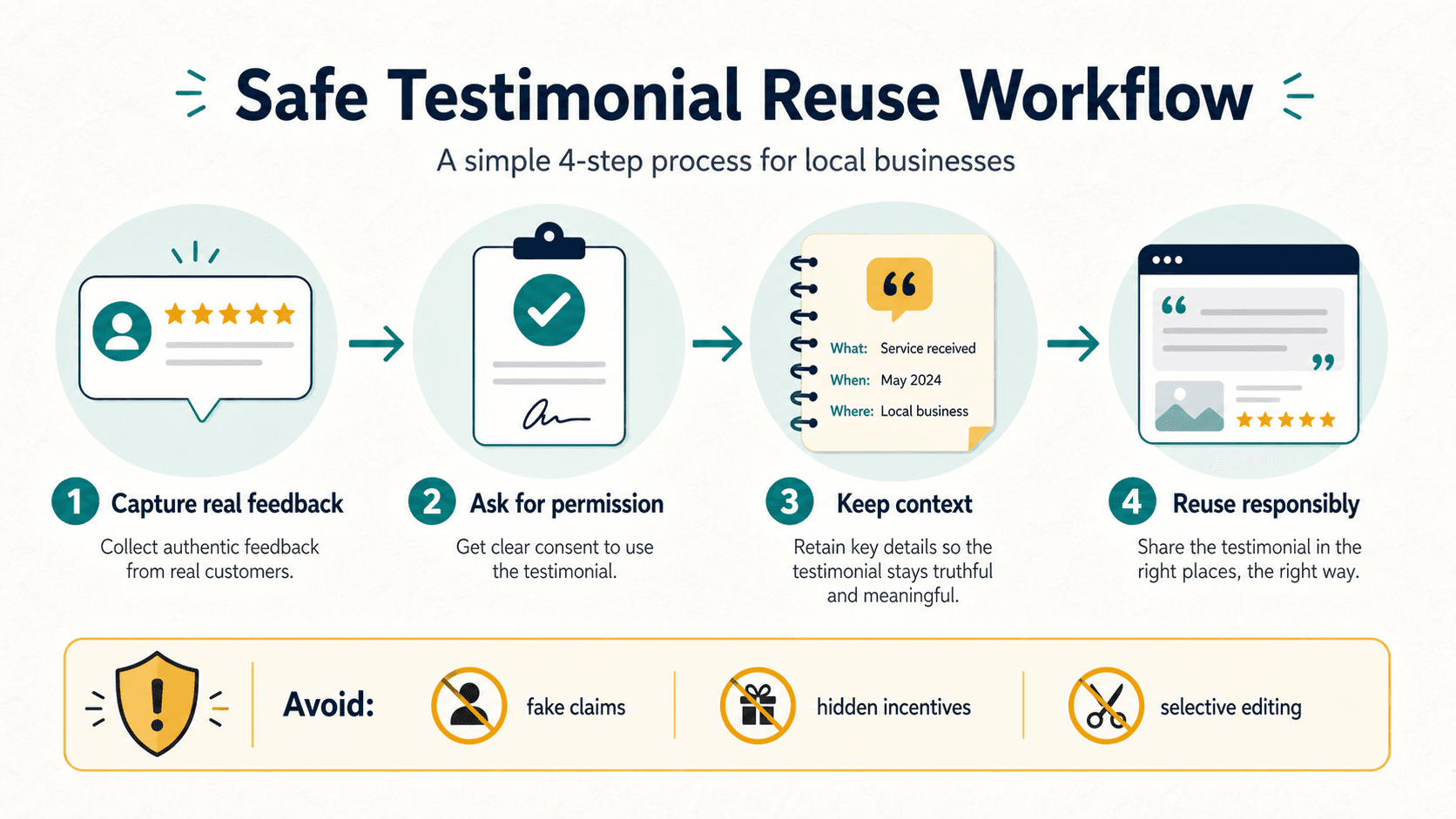
Where testimonials become misleading
Most testimonial problems come from overextension. The business starts with real praise, then stretches it too far.
Turning one customer's result into a general promise
A customer can say, "I felt better after my first session." A business should be careful about rewriting that into "Feel better after one session."
The first version is a personal experience. The second version sounds like a promise to everyone.
This matters across many local categories:
- A gym should not turn one member's fitness progress into a guaranteed transformation.
- A tutor should not turn one student's improvement into a guaranteed grade outcome.
- A spa should not turn one client's comfort into a health claim.
- A restaurant should not turn one good night into a universal service guarantee.
- A retail store should not imply a product solved a problem the customer did not actually describe.
If the testimonial suggests a result, keep the result attached to the person and situation that produced it.
Removing the boring context that makes the quote honest
Context often makes a testimonial more credible, not weaker.
"Great service" is nice, but vague. "They helped me choose a birthday gift in ten minutes before closing" is more useful because it tells the reader what actually happened.
When possible, keep small details such as:
- Visit type
- Service type
- Product category
- Customer need
- Occasion
- Location
- Timing
- Staff interaction
You do not need to expose private information. You only need enough context to prevent the quote from becoming generic hype.
Hiding incentives, rewards, or relationships
If a testimonial is connected to a payment, gift, discount, free service, contest entry, affiliate relationship, employee relationship, family relationship, or other benefit, ask whether that connection would matter to the audience.
The FTC's Consumer Reviews and Testimonials Rule is especially relevant when businesses buy reviews, suppress negative reviews, or condition incentives on review sentiment. Even when a business is not trying to deceive anyone, an undisclosed connection can make a testimonial look more independent than it really is.
The safer local-business pattern is:
- Do not pay for positive reviews.
- Do not give perks for a specific rating or sentiment.
- Do not ask customers to change or remove criticism in exchange for a benefit.
- If a quote comes from a paid creator, partner, employee, or rewarded participant, disclose that relationship clearly.
For ordinary customer feedback, the cleanest approach is usually to collect honest feedback without attaching a reward to the public testimonial.
Using the testimonial beside the wrong offer
Placement can change meaning.
If a customer praises your haircut service, do not place the quote next to a skin-care package in a way that implies the customer used that package. If a parent praises a summer camp, do not use the quote to sell a one-on-one tutoring program unless the quote clearly applies.
The same principle applies to locations. A review for one branch should not be presented as if it describes every branch.
When in doubt, label the context:
- "From a downtown location customer"
- "After a first haircut appointment"
- "Parent feedback from a weekend class"
- "Review from a catering order"
- "Customer comment after a product exchange"
These small labels reduce ambiguity and make the testimonial more useful.
A safer workflow for collecting reusable customer proof
A good testimonial system is not just a folder full of quotes. It is a workflow that captures customer words while they are fresh, asks for permission, keeps context, and gives staff a clear review step before anything goes public.
Step 1: Capture the customer's own words
Ask open questions that let customers describe their actual experience:
- What did you come in for today?
- What stood out about the visit?
- What would you tell a friend who is considering us?
- Which part of the service was most helpful?
- Is there anything we should improve?
Avoid leading prompts such as:
- Tell us why we are the best.
- Write a five-star review.
- Say our staff was amazing.
- Mention that we are the top choice in town.
The first group collects real input. The second group tries to script the outcome.
Step 2: Ask where the quote may be used
Give customers a simple permission choice:
- Website
- Social media
- Email newsletter
- In-store material
- Anonymized internal training only
- Do not reuse publicly
Also let the customer choose attribution:
- Full first name
- First name and last initial
- Initials only
- Anonymous customer
- Business category only, such as "salon client" or "parent of student"
This is more respectful, and it makes your team less likely to overuse a quote later.
Step 3: Store the quote with context
Do not save only the polished sentence. Save the context that keeps it honest:
- Date
- Location
- Service or product
- Original wording
- Edited wording, if any
- Permission status
- Approved attribution
- Where it has been used
- Any incentive or relationship disclosure, if relevant
This matters because a testimonial may be reused months later by someone who was not present when the customer gave it.
Step 4: Review before publishing
Before publishing, ask three questions:
- Would the customer recognize this as what they meant?
- Would a future customer understand the context?
- Are we implying a broader result than the quote supports?
If any answer is no, revise the placement, add context, use a shorter excerpt, ask the customer again, or skip the quote.
How Vibpost fits into testimonial reuse
Vibpost is an AI marketing assistant for local businesses that helps turn real customer moments into review drafts, social posts, testimonials, video scripts, and reusable social proof through a smart review QR code workflow.
For testimonial reuse, the important part is not simply generating smoother wording. The value is helping the business collect customer input while the experience is still fresh, keep the customer's own intent visible, and turn that input into usable content formats without starting from a blank prompt.
A safe Vibpost-style workflow looks like this:
- A customer scans a smart review QR code after a real visit or service.
- The customer chooses experience-based keywords or describes what happened.
- AI helps shape the customer's input into a review draft, testimonial, social post, or video script.
- The customer or business reviews the wording before it is reused.
- The business keeps permission, attribution, and usage context attached to the quote.
The boundary is important. Vibpost should not be used to invent customer experiences, create fake praise, pressure customers into positive reviews, or remove the customer's control. It works best when the business already has real customer moments and needs a lighter way to capture, organize, and reuse them responsibly.
Good testimonial reuse examples
Here are practical ways a local business can reuse testimonials without making them misleading.
Restaurant
Customer comment:
The staff made our anniversary dinner feel special, and the dessert recommendation was perfect.
Safer reuse:
"The staff made our anniversary dinner feel special." - Dinner guest, anniversary visit
Why it works:
The quote stays tied to a specific dining experience. It does not imply every guest will get a special occasion outcome.
Salon
Customer comment:
I was nervous about trying a shorter cut, but my stylist listened and helped me feel confident.
Safer reuse:
A first-time client said her stylist listened carefully and helped her feel confident about a shorter cut.
Why it works:
The quote explains the service moment and avoids turning confidence into a guaranteed emotional result for every client.
Gym
Customer comment:
The beginner class helped me understand the equipment without feeling embarrassed.
Safer reuse:
"The beginner class helped me understand the equipment." - New member feedback
Why it works:
The quote is useful for other beginners, but it does not promise a specific fitness result.
Education center
Customer comment:
The teacher gave us clear updates after each class, which helped us support homework at home.
Safer reuse:
Parent feedback: "The teacher gave us clear updates after each class."
Why it works:
It keeps the focus on the communication experience, not on a guaranteed academic outcome.
A quick checklist before publishing a testimonial
Use this checklist before a testimonial goes live:
- The quote comes from a real customer or the relationship is clearly disclosed.
- The customer gave permission for this use.
- The attribution matches what the customer approved.
- The quote is not edited into a bigger claim.
- The placement matches the product, service, or location described.
- Any incentive, reward, payment, or relationship is disclosed when relevant.
- Sensitive personal details have been removed or approved.
- The quote does not guarantee results.
- The quote is not presented as typical unless you have support for that claim.
- The business has a record of the original wording and permission.
If the quote fails one of these checks, do not force it. A smaller, more accurate testimonial is better than a bigger claim that weakens trust.
FAQ
Can I reuse a Google review on my website?
Often, yes, but do it carefully. A public review is still a customer's words, and the customer may not expect their name, photo, or full review to appear in a different marketing context. Ask permission when practical, keep the wording accurate, and do not imply the review applies to a different service or location.
Can I fix grammar in a testimonial?
Light cleanup is usually fine if it does not change meaning. Correcting a typo or trimming a repeated phrase is different from rewriting the quote into a stronger claim. If the edit changes tone, specificity, or result, ask the customer to approve the edited version.
Can I use only the best sentence from a longer review?
Yes, if the excerpt remains fair. Do not pull one positive sentence from a mixed review in a way that hides important context. If the rest of the review changes the meaning, either include more context or choose a different quote.
Can AI help turn feedback into a testimonial?
AI can help organize, shorten, or format real customer input. It should not invent the experience, add claims the customer did not make, or remove the customer's ability to review the wording. For local businesses, AI works best as a drafting assistant, not as a replacement for real customer proof.
What is the safest testimonial format for a small business?
Use the customer's own words, first name or anonymized attribution, service context, and a simple permission record. For example: "The front desk helped me reschedule quickly" - first-time salon client, appointment visit. It is specific, useful, and not inflated.
The takeaway
Testimonials work because they sound like real customers, not because they sound like perfect ads.
If your business wants to reuse customer praise, keep the quote close to the real experience. Ask permission. Preserve context. Disclose relationships when they matter. Avoid turning one person's result into a promise to everyone.
The most trustworthy testimonial is not the loudest one. It is the one a future customer can believe and the original customer would still recognize.