

How Cafes Can Turn Repeat Customers Into Reusable Social Proof
Key Takeaways
- Repeat customers already create the strongest proof a cafe can ask for: familiar faces, remembered orders, favorite drinks, and small moments of trust.
- The challenge is not only getting more reviews. It is turning those real customer moments into review drafts, testimonials, social posts, and other content your cafe can reuse.
- A smart review QR code workflow can make the process easier for customers without making the request feel pushy.
- The safest workflow keeps the customer in control, asks for honest feedback, avoids incentives tied to positive reviews, and turns real experiences into useful content.
- Vibpost helps cafes use a QR-based customer proof workflow so customers can scan, select experience keywords, and turn a real visit into a review draft, social post, testimonial, or video script.
Introduction
In a busy cafe, social proof is usually happening before anyone writes a word online.
A regular walks in and the barista already knows their order. A student chooses the same corner table every afternoon. A parent recommends the pastries to a friend while waiting for coffee. A customer says, "This place always feels calm," and then leaves before that compliment becomes anything your next customer can see.
That is the gap most cafes struggle with. The customer experience is real, but the proof disappears.
Reviews matter, but so do the smaller pieces of trust around them: short testimonials, social captions, customer stories, photo ideas, and repeatable prompts your team can use after a good visit. The goal is not to pressure customers into saying something positive. The goal is to make it easier for real customers to share what they already experienced.
For cafe owners who do not have a full-time marketing team, the practical question is simple: how do you turn repeat visits into reusable social proof without adding another complicated marketing task?
Why Reusable Social Proof Matters
A cafe does not win trust only through ads or polished brand copy. It wins trust through visible customer signals.
Someone searching for a nearby cafe wants to know whether the place feels welcoming, whether the coffee is consistent, whether the staff is friendly, whether people come back, and whether the experience is worth trying. A review can answer that better than a slogan.
But reviews are only one format. A repeat customer moment can also become:
- a Google review draft the customer can edit and publish
- a short testimonial for your website or menu board
- an Instagram caption idea based on a real visit
- a TikTok or Reels script about a favorite drink or pastry
- a staff training example of what customers appreciate
- a customer quote you can reuse with permission
That is why social proof should be treated as a workflow, not a lucky accident.
If your cafe waits for customers to remember on their own, only a small share of happy moments becomes visible. If your team has a simple, respectful way to ask at the right time, more of those moments can become useful content.
The Importance of Reviews for Local Visibility
Reviews also support local discovery. When customers compare cafes on Google Maps, Yelp, or other local platforms, recent and specific feedback can help them understand what makes one place different from another.
Google's Business Profile guidance says businesses can encourage customers to leave reviews by sharing a review request link or QR code. That does not mean every QR code is a strategy. A static link can reduce friction, but it still sends the customer to a blank page and asks them to figure out what to write.
For cafes, the stronger opportunity is to connect the request to the moment the customer just had.
Instead of asking, "Can you leave us a review?" your workflow can help the customer remember what made the visit worth sharing:
- friendly staff
- quiet place to work
- fresh pastry
- fast pickup
- cozy atmosphere
- great latte
- reliable morning routine
- good place to meet a friend
Those details create more useful proof than generic praise.
There is also a trust boundary. Google Maps policies expect contributed content to reflect real experiences, and the FTC's consumer review rule is clear that fake reviews, purchased sentiment, and review suppression create risk. A cafe should ask honestly, make the process easier, and let the customer decide what to publish.
Step-by-Step Guide to Turning Repeat Customers Into Social Proof
1. Start with the moments customers already repeat
Do not begin with a platform. Begin with the customer moments your cafe sees every week.
Look for moments such as:
- a regular ordering the same drink
- a customer complimenting a new pastry
- a remote worker choosing your cafe for quiet focus
- a family returning for weekend breakfast
- a customer thanking the team for fast service
- a friend recommending the cafe while still in line
These moments are useful because they are specific. A review that says "great coffee" is fine. A review that says "I come here before work because the oat latte is consistent and the staff remembers my order" is much more believable.
Your review workflow should help customers capture that specificity.
2. Put the request where the experience is still fresh
Timing matters. The best request usually happens after a positive interaction, not days later when the customer has forgotten the details.
Useful cafe placements include:
- a small table card near the pickup area
- a counter card beside the register
- a receipt insert
- a follow-up message after a catering order
- a friendly staff mention after a compliment
- a sign near a community board or loyalty card area
The request should feel light. A cafe does not need a pushy script. A simple line works better:
"If today's visit made your day easier, you can share your experience here."
That wording invites real feedback instead of demanding praise.
3. Use experience keywords instead of a blank review box
A blank review box creates friction. Many customers are willing to help, but they do not know what to write.
This is where a smart review QR code workflow is different from a basic review link. With Vibpost, a cafe can use a QR-based workflow that lets customers scan, select experience-based keywords, and turn those inputs into a review draft, social post, testimonial, or video script.
Inside Vibpost, this workflow is called a Seeding Code. For a cafe, it works best when the keywords match real customer language:
- friendly service
- quiet workspace
- fresh pastries
- cozy atmosphere
- fast pickup
- great latte
- family-friendly
- local favorite
- easy parking
- good brunch spot
The customer stays in control. The keywords simply help them remember and describe the experience.
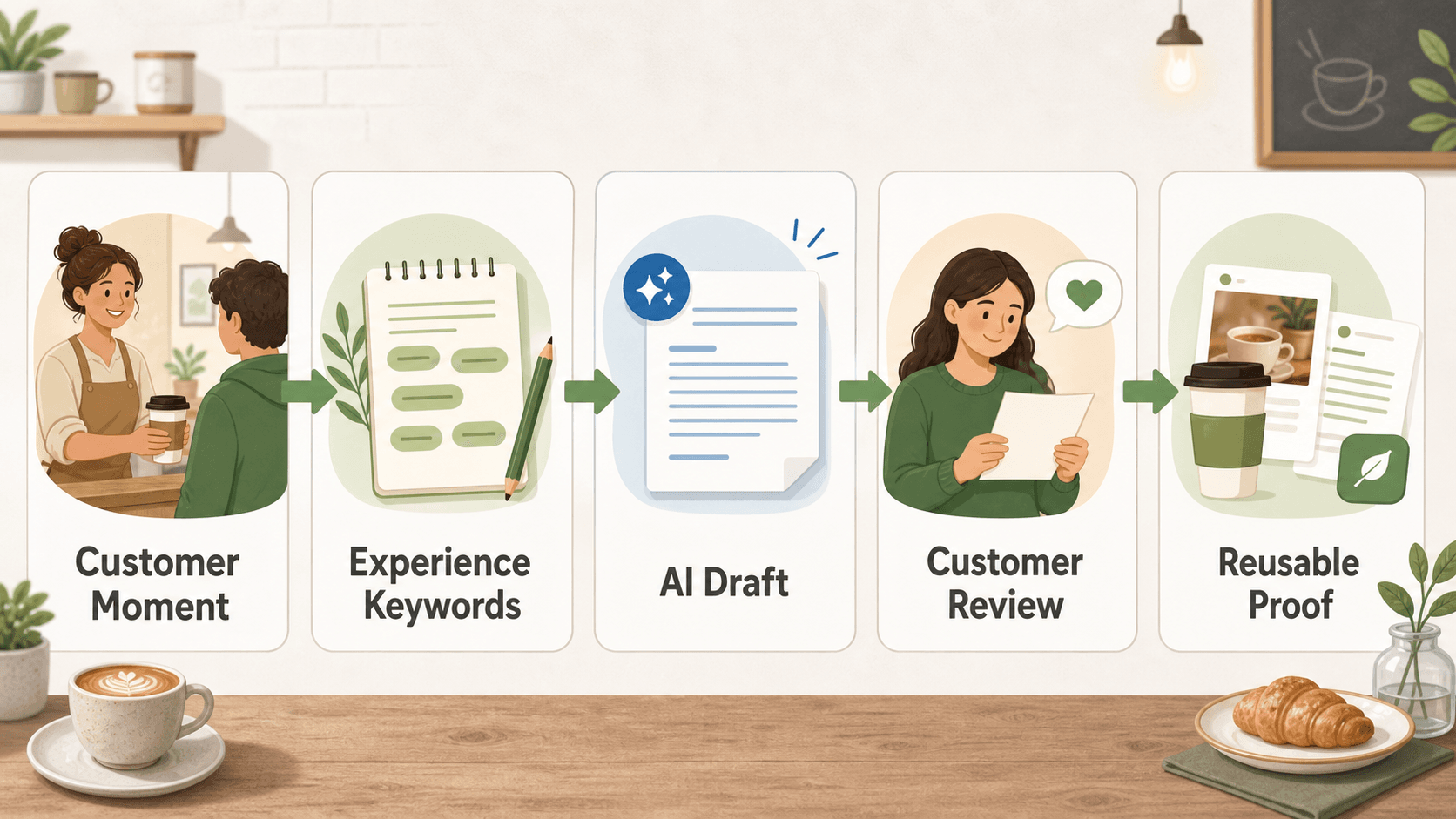
4. Turn one customer moment into more than one useful asset
Many cafes think of reviews as a single destination: Google, Yelp, or another review site.
That is too narrow.
A real customer moment can support several useful formats, as long as the content is honest and used appropriately:
- Review draft: the customer can edit and publish their own experience.
- Testimonial: with permission, a short quote can support your website or in-store materials.
- Social caption: the same moment can become a post about a seasonal drink, favorite table, or neighborhood routine.
- Video script: a simple customer story can become a short-form video idea.
- Team learning: repeated phrases can show what customers value most.
Vibpost is useful here because it is not only a QR code generator. It is an AI marketing assistant for local businesses that helps turn real customer moments into reusable proof. The cafe still needs good service. The customer still needs a real experience. The tool simply reduces the friction between the experience and the content.
5. Respond to reviews and reuse themes, not private details
Once customers leave reviews, reply to them. A thoughtful response shows that the cafe is present, listening, and grateful.
Keep replies simple:
- Thank the customer.
- Mention one specific detail from their review.
- Avoid arguing publicly.
- For complaints, acknowledge the issue and invite a direct follow-up.
- Do not pressure the customer to change a negative review.
Then look for patterns. If many customers mention quiet mornings, make that part of your local positioning. If they mention fresh pastries, build content around the baking schedule. If they mention friendly staff, highlight the people behind the counter.
The review itself is useful. The pattern behind the review is even more useful.
Technology Tips for Cafe Owners Who Are Not Marketers
You do not need a complicated marketing stack to make this work.
Start with a simple weekly rhythm:
- Pick three customer moments your team hears often.
- Turn those moments into experience keywords.
- Place one review QR workflow at the counter or pickup area.
- Ask only after a real positive interaction.
- Review new feedback once a week.
- Choose one review theme to reuse in social content.
If you use Vibpost, the workflow can be more structured. A cafe can set up a smart review QR code, guide customers with keywords, and help turn those inputs into review drafts, testimonials, social posts, or video scripts. That gives the owner or manager a repeatable system instead of a random reminder to "ask for more reviews."
The important part is to keep the process honest. Do not reward only positive reviews. Do not write reviews for customers. Do not hide negative feedback. Do not treat AI as a way to manufacture praise.
Use technology to make sharing easier, not to make the experience less real.
FAQs
How often should a cafe ask customers for reviews?
Ask regularly, but not constantly. The best moment is after a real positive interaction: a compliment, a repeat visit, a catering pickup, a successful event, or a friendly conversation at checkout. A gentle QR-based invitation usually feels better than repeated follow-up messages.
What should the review request say?
Keep it simple and honest. For example:
"Enjoyed your visit? Share what stood out so other neighbors know what to expect."
That invites a real experience instead of pushing for a perfect rating.
Can a cafe offer incentives for reviews?
Be careful. In the US, the FTC says incentives cannot be tied to a review expressing a particular positive or negative sentiment, and undisclosed incentives can create risk. Many review platforms also have their own policies. A safer cafe workflow is to ask for honest feedback without promising a reward for praise.
What if customers do not know what to write?
Use experience keywords. Instead of leaving customers with a blank page, let them choose what matched their visit: cozy atmosphere, friendly service, fast pickup, great latte, fresh pastries, quiet workspace, or another real detail. Vibpost can help turn those selected keywords into draft content the customer can edit.
Is a basic QR code enough?
Sometimes. If all you need is a link to your Google review page, a basic QR code can reduce friction. But if your cafe wants to turn repeat customer moments into reviews, testimonials, social posts, and video ideas, a smart review QR code workflow gives customers more guidance and gives your business more reusable proof.
Conclusion
Encouraging customer reviews does not have to feel awkward, technical, or pushy.
For a cafe, the strongest starting point is already inside the business: the regular who comes back, the customer who compliments the pastry, the quiet corner people choose for work, the friendly staff moment someone mentions on the way out.
The job is to capture those moments while they are fresh.
A smart review QR code workflow helps by giving customers a simple path: scan, choose what matched their experience, review the AI-assisted draft, and decide what to share. With Vibpost, that same customer moment can become a review draft, social post, testimonial, or video script.
The cafe earns the trust first. The workflow helps that trust become visible.