

How Should Local Businesses Handle Incentives When Asking for Reviews?
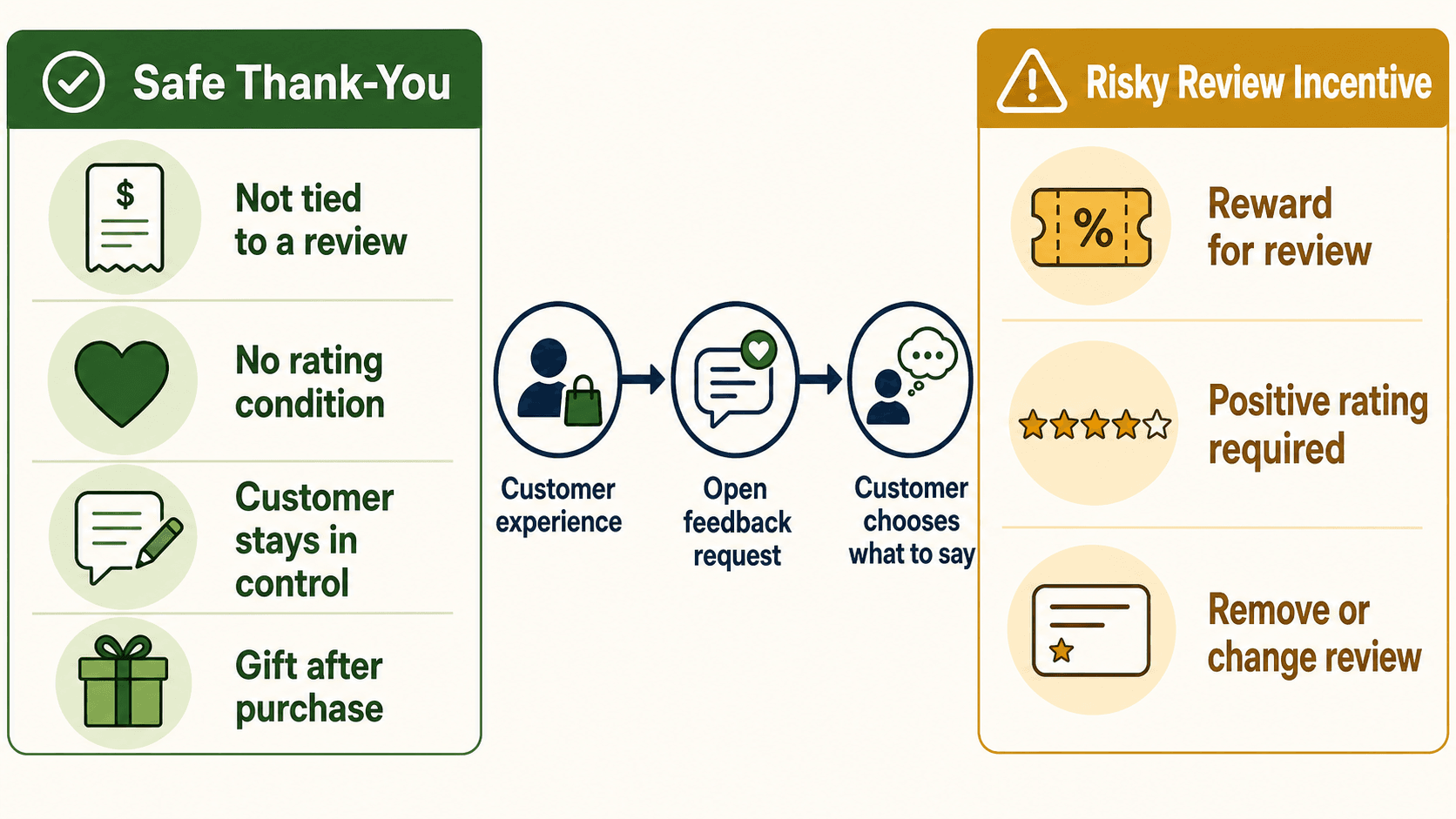
Local businesses should keep incentives separate from public review requests. It is usually safer to thank customers for their business, make feedback easy, and ask for honest reviews without offering a discount, free item, contest entry, or reward in exchange for posting, editing, or removing a review.
That does not mean every customer perk is risky. A cafe can run a loyalty program. A salon can send a birthday discount. A restaurant can give a thank-you card after a visit. The risk starts when the reward is tied to the review action itself, especially when it is tied to a positive rating, specific wording, or the removal of a negative review.
For a local business trying to build durable trust, the better goal is simple: reward the relationship, not the review.
The safest rule: do not pay for reviews
If a customer has to leave a review to receive the reward, treat that workflow as risky.
Google is explicit about this. Its Business Profile guidance says reviews should reflect genuine experiences, and that offering incentives such as free or discounted goods or services in exchange for customers posting reviews, changing reviews, or removing negative reviews is prohibited. Google's Maps policy also says reviews or ratings paid for directly or in kind are fake engagement, and merchants should not offer incentives for any review, review revision, or removal of a negative review.
The practical version for a local business is:
- Do not offer "10% off for a Google review."
- Do not offer "free dessert for a five-star review."
- Do not run "leave a review to enter our gift card drawing."
- Do not ask an unhappy customer to edit or remove a review in exchange for a refund, coupon, or extra service.
- Do not make staff compete to collect a certain number of positive reviews.
Even if the business owner means well, the customer may feel pressured. The platform may treat the review as biased. Future customers may trust the business less if the request looks like a review-buying program.
A thank-you gift is different from a review incentive
A thank-you gift is usually safer when it is not conditioned on a review.
For example, a coffee shop might give every customer a loyalty stamp after a purchase. A spa might send all returning clients a birthday offer. A local retailer might include a small thank-you card in every bag. Those gestures are part of customer experience. They are not review incentives if the customer gets them whether or not they post anything.
A review incentive is different. It says, directly or indirectly, "You get this because you reviewed us." That changes the weight a future reader may give the review and can create platform risk.
Use this test:
| Customer perk | Safer pattern | Risky pattern |
|---|---|---|
| Loyalty reward | "Earn points with each visit." | "Earn points only after leaving a review." |
| Thank-you gift | "Here is a free sample with today's purchase." | "Show us your posted review for a free sample." |
| Service recovery | "We are sorry and would like to make this right." | "We will give you a refund if you remove the bad review." |
| Feedback request | "Tell us about your visit." | "Leave a five-star review for a discount." |
| Contest | "Enter after your purchase." | "Enter after posting a review." |
The safer pattern rewards the customer relationship or the purchase. The risky pattern rewards the public review.
The FTC adds another reason to be careful
Platform rules are not the only issue. In the United States, review and testimonial practices also sit under advertising and consumer protection rules.
The FTC's Consumer Reviews and Testimonials Rule, which went into effect on October 21, 2024, addresses deceptive conduct involving reviews and testimonials. The FTC's guidance explains that if a business pays for or gives incentives for consumer reviews of its business, products, or services, those incentivized reviews can also be considered testimonials under the rule. The same guidance says compensation or incentives conditioned on reviews expressing a particular sentiment can create liability for businesses and intermediaries.
That matters because a local business review often looks like a casual customer comment, but it can become a marketing asset once a business solicits, rewards, displays, edits, or reuses it. If there is a material connection between the reviewer and the business, the FTC's Endorsement Guides focus on whether the connection is clear and whether the endorsement reflects the customer's honest experience.
For a local business owner, the simple version is:
- Do not buy reviews.
- Do not reward only positive reviews.
- Do not ask for specific praise.
- Do not hide the fact that a review, testimonial, or social post was connected to a reward if that connection would matter to readers.
- Do not turn customer words into marketing copy in a way that changes what the customer actually meant.
This is not about being afraid to ask for feedback. It is about keeping the ask honest enough that the review remains useful to other people.
Yelp is stricter than Google
Local businesses also need to remember that platforms do not all treat review requests the same way.
Google allows businesses to remind customers to leave reviews, including through a review link or QR code, as long as the request is neutral and not incentivized. Yelp's business guidance is stricter: its Don't Ask for Reviews page says businesses should not proactively ask customers to review them on Yelp, and that solicited reviews may not be recommended by Yelp's software.
That difference changes the workflow.
For Google, a business can usually use a neutral request such as:
If you would like to share feedback about your visit, this link makes it easy.
For Yelp, the safer approach is usually to make the profile easy to find and focus on earning organic reviews, not directly asking customers to post there.
A smart review workflow should respect the platform the customer chooses. The same QR code, sign, or follow-up message should not push every customer into the same public review action without regard for platform rules.
What local businesses can do instead
The best alternative to review incentives is to remove friction from honest feedback.
Most happy customers do not ignore review requests because they dislike the business. They ignore them because the request comes too late, feels awkward, or starts with a blank review box. The customer may remember that the service was good, but not know what to write.
A safer workflow gives the customer a simple path:
- Ask for honest feedback at a natural moment.
- Let the customer choose the experience details that were true for them.
- Help them turn those details into language they can edit or ignore.
- Keep the customer in control of whether anything is posted publicly.
- Use private feedback for service recovery before asking for public proof.
That workflow does not need to bribe the customer. It helps the customer remember and express what already happened.
For example, a salon can ask after checkout:
We are always trying to understand what clients notice most. If you would like to share feedback about today's appointment, this takes less than a minute.
A restaurant can say:
Thanks for coming in tonight. If anything stood out, good or bad, we would appreciate your feedback.
A pet shop can add a receipt note:
Tell us what helped during your visit so we can keep improving.
None of these requests promises a reward. None asks for a rating. None tells the customer what to say. They simply open the door.
Build a safer incentive policy for staff
Review risk often starts with unclear staff instructions.
An owner may tell the team, "We need more reviews this month." A manager may turn that into a contest. A cashier may start saying, "Leave us five stars and we will give you a discount." The business did not intend to buy reviews, but the workflow drifted into risky territory.
Write a short internal policy before asking staff to request feedback.
Safe staff language
Use language that keeps the review voluntary:
- "If you would like to share feedback, this code makes it easy."
- "We appreciate honest feedback about today's visit."
- "You are welcome to mention anything that stood out."
- "If something was not right, please tell us so we can improve."
- "There is no reward for reviewing, and you do not have to leave a public review."
Staff language to avoid
Avoid language that adds pressure or conditions:
- "Show me your review and I will give you a discount."
- "Can you leave us five stars?"
- "Only scan this if you had a great experience."
- "Please mention my name in the review."
- "If you remove the bad review, we can give you a refund."
Staff incentives need boundaries too
Do not reward employees only for collecting positive public reviews. That can create pressure on customers and distort the request. If you want to recognize staff, focus on operational behaviors you can control, such as:
- Explaining the feedback option clearly.
- Handling concerns before the customer leaves.
- Responding professionally to private feedback.
- Improving recurring service issues.
- Keeping table cards, receipt inserts, or counter signs available.
The metric should support better service, not review manipulation.
Where Vibpost fits
Vibpost is useful when a local business wants a feedback workflow instead of a review-buying shortcut.
Vibpost is an AI marketing assistant for local businesses. It uses a smart review QR code workflow, called a Seeding Code inside the product, to help customers turn real experiences into review drafts, social posts, testimonials, and video scripts. A customer can scan, choose experience-based keywords, and use AI assistance to shape what they want to say.
For incentive-sensitive workflows, the important part is customer control. Vibpost should be used to reduce friction around honest feedback, not to manufacture praise. The customer experience comes first. The keyword choices should match what actually happened. The AI draft should be editable. The business should not promise a reward for posting, require a rating, or pressure the customer to publish specific language.
Used this way, Vibpost helps solve the real problem: happy customer moments often disappear before they become usable customer proof. The tool can help local businesses capture the moment without turning the request into a paid review.
A practical review request policy
Use this policy as a starting point for your store, restaurant, salon, spa, gym, retail shop, or local service business:
- We ask for honest feedback, not positive reviews.
- We do not offer discounts, free goods, points, contest entries, refunds, or other incentives in exchange for posting, editing, or removing reviews.
- We do not ask customers to mention specific staff names, phrases, ratings, or keywords in public reviews.
- We do not route only happy customers to public review platforms while hiding unhappy customers.
- We give customers full control over whether they post, edit, or ignore any AI-assisted draft.
- We handle private complaints as service recovery, not as leverage to change public reviews.
- We disclose material connections when customer content is reused as marketing and a reasonable reader would care about that connection.
- We train staff to use neutral request language.
This kind of policy is not just a legal shield. It also makes the business easier to trust.
Better ways to thank customers
You can still thank customers without tying the thanks to reviews.
Safer options include:
- A loyalty program based on visits or purchases.
- A thank-you card included with every order.
- A birthday offer sent to the full customer list.
- A service recovery coupon after a real problem, with no review condition.
- A public "thank you to our customers" social post that does not ask for ratings.
- A private feedback survey that helps improve operations.
- A QR-based feedback flow that invites honest customer input without a reward.
The principle is simple: give the customer the perk before, after, or separate from the review request. Do not make the perk a payment for public praise.
FAQ
Can I give a discount for any review, not just a positive one?
For Google reviews, no. Google says businesses should not offer incentives in exchange for posting any review, revising a review, or removing a negative review. Even when the business says "honest review," the incentive can still make the review look biased.
Can I ask customers to leave a Google review?
Yes, if the request is neutral, voluntary, and not incentivized. Google says businesses can remind customers to leave reviews through a Google link or QR code. The request should not pressure customers, require specific wording, selectively ask only happy customers, or offer a reward.
Can I ask for Yelp reviews?
Yelp's policy is stricter. Yelp tells businesses not to ask customers, friends, family, or mailing list subscribers to write Yelp reviews. If Yelp is important for your category, focus on excellent service, accurate business information, and natural discovery rather than direct review solicitation.
Can I reward customers for private feedback?
It is safer than rewarding public reviews, but you still need to be careful. If the reward is for a survey, feedback form, or customer research activity, make that clear and do not turn the same action into a public review requirement. If the feedback becomes a testimonial or marketing asset, get permission and disclose material connections when needed.
Can AI help customers write reviews?
AI can help structure a customer's real experience into clearer language, but the customer should remain in control. The safest workflow starts with customer-selected details, allows editing, and never posts on the customer's behalf. AI should not invent praise or replace the customer's genuine experience.
What should I do if a customer leaves a negative review?
Respond professionally, protect privacy, and try to resolve the real issue. Do not offer a reward in exchange for removing or changing the review. If the review violates a platform's content policy, use that platform's reporting process.
The useful boundary
Incentives are not automatically bad. Loyalty programs, birthday offers, thank-you gifts, and service recovery can all be part of good customer experience. The problem is tying those incentives to public reviews, positive ratings, specific wording, or review removal.
For local businesses, the safest review strategy is also the most trustworthy one: make honest feedback easier, keep the customer in control, and separate appreciation from review compensation.