

How Retail Stores Can Turn Shopper Feedback Into Local Social Proof
Retail stores can turn shopper feedback into local social proof by capturing the customer's own words close to the purchase moment, asking permission before reuse, keeping the product or visit context attached, and turning that feedback into reviews, testimonials, social posts, staff learning, or in-store proof without changing the meaning.
That matters because neighborhood retail is still built on trust. A shopper may not know whether a boutique, gift shop, plant store, home goods store, specialty grocer, bookstore, pet supply shop, or wellness retail store is worth visiting until they hear how other local customers talk about it. Product photos help. Promotions help. But a real shopper saying "the staff helped me find the right size," "the gift wrapping made it feel personal," or "I found a local option instead of ordering online" carries a different kind of weight.
The problem is that useful feedback often disappears. A customer compliments a display at checkout. A regular says the staff remembered their preference. A first-time shopper says the store felt easier to navigate than expected. The team smiles, says thank you, and moves on to the next transaction. By closing time, the comment is gone.
A simple feedback workflow helps a retail store preserve those moments while they are still fresh and turn them into customer proof the store can reuse responsibly.
What counts as local social proof for a retail store
Local social proof is evidence from real customers that helps nearby shoppers understand why your store is worth visiting, trusting, or remembering. It is not only a five-star review. For a retail store, useful social proof can come from many small customer signals.
Examples include:
- A Google review about helpful service
- A shopper quote about product selection
- A photo or video shared by a customer after a purchase
- A text message from a repeat customer
- A short testimonial for a product category
- A social media comment about the store atmosphere
- Feedback about gift wrapping, staff recommendations, sizing help, local sourcing, or special orders
- A private comment that helps the team improve merchandising or service
The best retail proof is usually specific. "Great shop" is nice, but it does not tell a future shopper much. "The owner helped me choose a housewarming gift and wrapped it before I left" gives a clearer reason to visit.
Specific feedback also helps the business. It shows what customers actually notice: staff knowledge, local inventory, product curation, returns help, service speed, checkout experience, sensory details, or the feeling of being recognized by name.
Capture feedback when the visit is still fresh
The best time to ask for shopper feedback is close to the moment the customer has something to say. In retail, that may be after checkout, after a special order pickup, after a fitting, after a product recommendation, or after a customer tells staff why they came in.
Good moments to ask include:
- A customer compliments the store, staff, or product selection
- A shopper finds an item after staff help
- A repeat customer mentions why they came back
- A gift buyer says the recommendation solved a problem
- A first-time visitor says the store was easier to shop than expected
- A customer thanks the team for a return, exchange, order pickup, or product explanation
- A shopper posts or tags the store after leaving
The request should feel like service, not pressure.
Instead of asking, "Can you leave us a five-star review?" try:
If anything about today's visit helped you choose, decide, or discover something, we would love to hear it. You can keep it private, or let us know if we may share a short quote later.
That wording leaves room for honest feedback. It does not tell the customer what to say. It also makes the permission boundary clear from the start.
If the goal is a public Google review, stores can use a direct review link or QR code. Google's own review request guidance says businesses can share a link or QR code, including on receipts or in-store, but it also warns that incentives such as free or discounted goods in exchange for reviews are prohibited as fake engagement. That is the practical line to remember: make the path easy, but do not buy the opinion.
Ask prompts that produce real shopper language
Retail customers often want to be helpful, but a blank review box can feel like homework. Specific prompts make it easier for them to remember the visit and describe it in their own words.
Good retail feedback prompts include:
- What brought you into the store today?
- What helped you choose the item you bought?
- Did anyone on the team make the visit easier?
- Was there anything about the store that surprised you?
- What would you tell a friend who was thinking about visiting?
- Did the store help you solve a gift, fit, style, home, pet, food, or wellness problem?
- Is there anything we should improve before your next visit?
Avoid prompts that script the answer:
- Tell people we are the best store in town.
- Write a five-star review to get a discount.
- Say our products are better than every competitor.
- Mention that everyone should buy from us.
- Leave only positive feedback.
The first group helps the shopper recall a real experience. The second group tries to manufacture praise.
For local retail, the difference matters. A useful review or testimonial should sound like a customer, not like an ad. It should help future shoppers understand the store experience without promising an outcome the business cannot control.
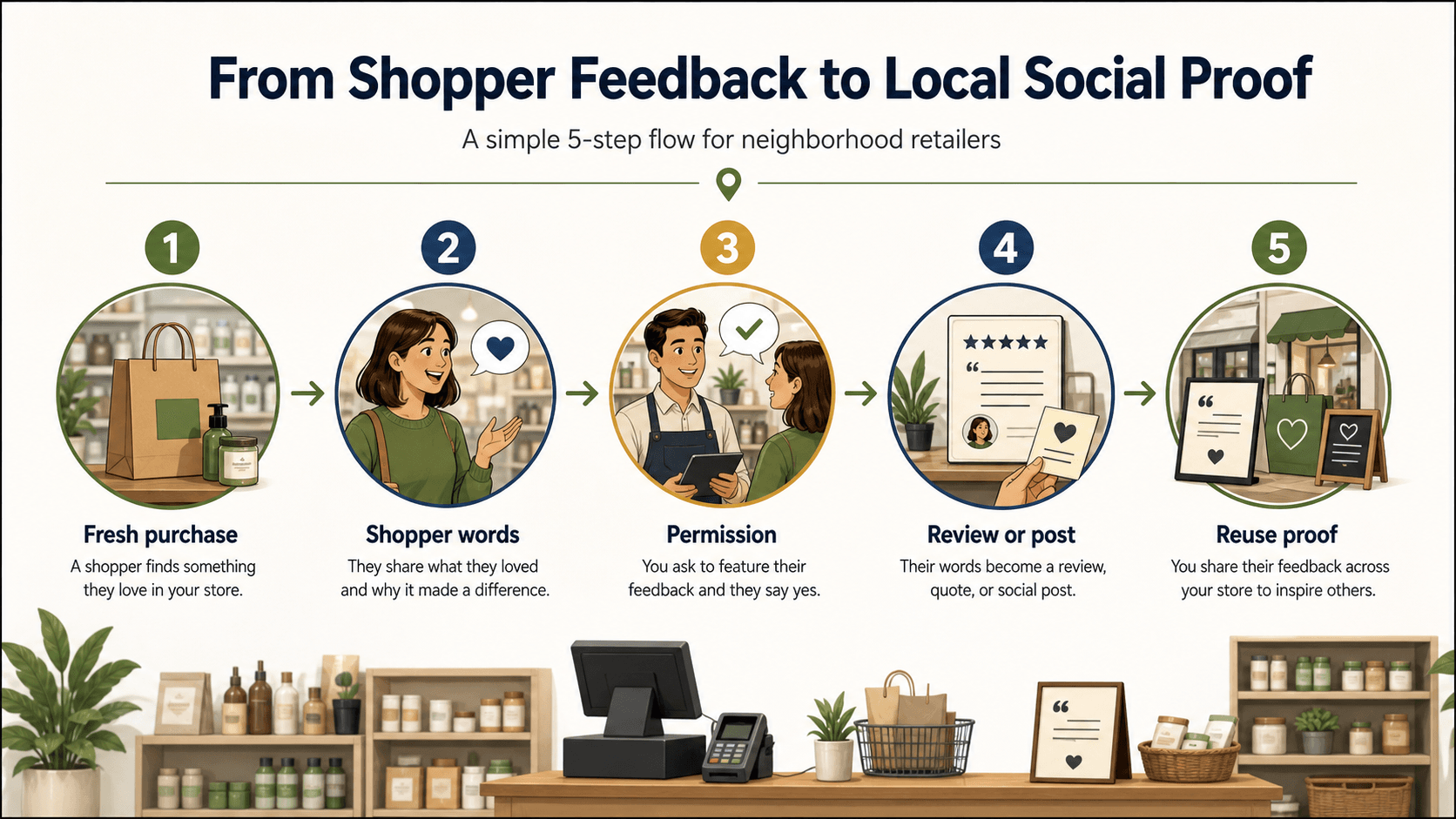
Turn one shopper comment into several useful assets
One piece of feedback can become more than one kind of social proof, as long as the business keeps the meaning and permission intact. The goal is not to stretch one comment into fake volume. The goal is to reuse real customer language in the right context.
A shopper comment such as "The staff helped me find a birthday gift in ten minutes" could become:
- A public review, if the customer chooses to post it
- A website testimonial about gift help
- A short social caption about last-minute gift shopping
- A staff training note about what customers value
- A product category quote near gift items
- A seasonal email line, if the customer approved that use
- A reminder to stock similar products for future gift occasions
The comment should not become:
- A claim that every gift can be solved in ten minutes
- A guarantee that staff will always pick the perfect item
- A testimonial attached to a product the customer did not buy
- A fake review posted by the business
- A paid endorsement with no disclosure
This is where context protects trust. Save the original wording, the edited wording, the product or visit context, the customer's permission choice, and the channels where the quote may appear.
A practical workflow for busy retail teams
A feedback workflow only works if staff can use it during a normal day. It should not require a marketing meeting every time a customer says something kind.
1. Capture the comment
Train staff to notice moments that already happen:
- "I love how you arranged this."
- "Thanks for helping me compare sizes."
- "I did not know you carried this locally."
- "This is perfect for my friend's housewarming."
- "I always come here because you remember what I like."
The staff member can invite feedback with a low-pressure line:
That is helpful to hear. If you are comfortable sharing it, we have a quick way to leave feedback or keep it private for the team.
2. Let the shopper choose what the visit was about
Experience keywords help customers move from a vague compliment to a useful review or quote.
For a retail store, useful keywords might include:
- Helpful staff
- Local product selection
- Gift recommendation
- Easy checkout
- Size or fit help
- Product knowledge
- Store atmosphere
- Clean layout
- Special order
- Repeat visit
- Fast pickup
- Friendly return
The shopper should choose only what matches the real visit.
3. Draft from the customer's input
Once a shopper gives feedback, the store can use that input to create a cleaner version for review, approval, or reuse.
For example:
Customer input:
I came in for a gift and had no idea what to get. The person at the counter asked a few questions and helped me pick something that felt personal.
Possible testimonial:
"I came in looking for a gift and had no idea what to get. The team asked a few questions and helped me choose something that felt personal."
That is light editing. It keeps the customer's meaning.
Risky rewrite:
The best gift shop in town, with perfect recommendations for everyone.
That changes one shopper's experience into a broad claim.
4. Ask for permission and attribution
Before reuse, ask where the comment may appear:
- Public review
- Website quote
- Social post
- Email newsletter
- In-store display
- Anonymous internal feedback only
Then ask how the shopper wants to be identified:
- First name
- First name and last initial
- Initials
- Anonymous local customer
- Product category only, such as "gift shopper" or "pet supply customer"
This step is especially important for independent retailers because the customer relationship is personal. A regular customer may be happy to help, but still prefer not to have their full name attached to a quote.
5. Reuse the proof where it belongs
Place the quote near the thing it actually supports.
A comment about gift wrapping belongs near gift content. A comment about staff product knowledge belongs near service or category pages. A comment about easy pickup belongs near order pickup instructions. A comment about a specific product should not be used to promote a different category.
The closer the quote stays to its original context, the more useful and trustworthy it becomes.
Where Vibpost fits in the retail workflow
Vibpost is an AI marketing assistant for local businesses that uses a smart review QR code workflow to help customers turn real experiences into review drafts, social posts, testimonials, and video scripts.
For retail stores, the useful part is not simply generating nicer sentences. The useful part is creating a repeatable workflow around real shopper moments.
A store can use Vibpost's smart review QR code workflow, called a Seeding Code inside the product, like this:
- Place the smart review QR code at checkout, near pickup, or in a follow-up message.
- Invite shoppers to describe what helped them during the visit.
- Let them choose experience-based keywords such as "helpful staff," "gift recommendation," or "easy pickup."
- Use AI to shape the shopper's own input into a review draft, social post, testimonial, or short video script.
- Keep the shopper in control of what they post or approve.
- Store the context so the business can reuse the proof responsibly.
The boundary is important. Vibpost should not be used to invent customer experiences, pressure shoppers into positive reviews, hide incentives, or publish on behalf of customers without their control. It works best when the store already has real customer moments and needs a lighter way to capture, organize, and reuse them.
Handle negative and private feedback before asking for public proof
Not every comment should become a public review or testimonial. Some feedback is more valuable as a service recovery signal.
If a shopper says the checkout took too long, the size guidance was confusing, the return policy was unclear, or an item was hard to find, do not push them toward a public review request first. A better workflow is:
- Thank the shopper for saying it.
- Record the issue clearly.
- Fix what can be fixed.
- Follow up if appropriate.
- Ask for public feedback only if the customer voluntarily wants to share the final experience.
This protects trust and improves the business. A feedback workflow should not filter for praise only. It should help the team learn what customers actually experienced.
For testimonials, endorsements, and reused customer quotes, the FTC's Consumer Reviews and Testimonials Rule is useful background because it focuses on deceptive review and testimonial practices. A retail team does not need to turn every customer quote into a legal exercise, but it should avoid fake reviews, hidden relationships, misleading edits, and reuse that makes a quote mean more than the customer said.
Retail examples
Boutique clothing store
Customer input:
I was between sizes and the associate helped me find the one that actually felt comfortable.
Best use:
- Service page about fit help
- Social post about in-store styling support
- Staff training example
Avoid:
- Claims that every shopper will find the perfect fit
- Using the quote for a product the customer did not try
- Turning it into a body-related claim the customer did not make
Gift shop
Customer input:
I needed a last-minute birthday gift and they helped me put together something that felt personal.
Best use:
- Gift guide page
- Holiday social post
- Email about in-store gift help
Avoid:
- Guaranteed perfect gifts
- Fake urgency
- Reusing the quote without permission during every holiday campaign
Pet supply store
Customer input:
The staff explained the difference between two food options and did not rush me.
Best use:
- Category page about staff guidance
- Social post about thoughtful product help
- Internal training for customer questions
Avoid:
- Medical or health outcome claims
- Saying the product solved a pet condition
- Using the quote as professional advice
Home goods store
Customer input:
I brought in a photo of my shelf and they helped me pick something that matched the room.
Best use:
- Visual merchandising content
- Social post about design help
- In-store sign about bringing photos for guidance
Avoid:
- Claiming professional design service if the store does not provide it
- Showing the customer's home photo without separate permission
- Reusing the quote for unrelated products
A checklist before publishing shopper feedback
Before a retail store publishes or reuses shopper feedback, check:
- Did this come from a real customer experience?
- Do we have permission for this specific use?
- Does the customer know how they will be identified?
- Did we preserve the original meaning?
- Is the quote tied to the right product, service, or store visit?
- Are we avoiding incentives for reviews?
- Are we clear about any paid, employee, creator, family, or partner relationship?
- Do we still have the original wording saved?
- Would the customer recognize the final version as what they meant?
If a quote fails the checklist, the fix is usually simple. Use a smaller excerpt, ask again, add context, keep it private, or skip it.
Skipping one questionable quote is better than weakening the store's reputation.
The takeaway
Retail social proof works best when it sounds like the people who actually shop with you.
The strongest system is not complicated: capture feedback while the visit is fresh, help shoppers describe the real moment, ask permission, keep context attached, and reuse the proof only where it remains accurate.
For a neighborhood retailer, that turns everyday shopper appreciation into a library of local trust. Not fake praise. Not pressure. Just real customer language, saved before it disappears and reused in a way the shopper would still recognize.