

How Salons Can Turn Post-Appointment Praise Into Reusable Customer Proof
Salons can turn post-appointment praise into reusable customer proof by capturing the moment while it is still fresh, helping the client describe what they liked, and keeping the client in control of what becomes public. The best workflow is not a pushy review request. It is a simple feedback path that starts after a real service, turns specific praise into an editable draft, and lets the salon reuse approved words as reviews, testimonials, social posts, or video ideas.
This matters because salon praise often disappears fast. A client loves the color blend, compliments the stylist at checkout, says the blowout made them feel confident, or mentions that the consultation finally helped them explain what they wanted. Ten minutes later, that detail is gone. By the time the client gets home, writing a useful review may feel like work.
A better salon feedback workflow gives that happy client a small next step before the moment fades.
Start with the praise clients already give you
The best customer proof starts with a real client moment, not a generic marketing request. In a salon, that moment usually happens when the client sees the result, pays, rebooks, takes a mirror photo, or tells the stylist what they liked about the appointment.
Many salons ask for reviews too late or too broadly. A sign at the front desk can help, but it does not capture the actual sentence the client just said. A follow-up text can work, but it may arrive after the client has moved on. The strongest opportunity is the moment when the client is already expressing satisfaction.
Common salon praise moments include:
- "I love how natural the color looks."
- "This is exactly what I was trying to explain."
- "The consultation helped a lot."
- "My hair feels so much healthier."
- "The appointment was relaxing."
- "You really listened to what I wanted."
- "The shape is easy to style at home."
Each of those phrases can become useful customer proof. One client comment might turn into a Google review draft. Another might become a short testimonial for the salon's website. Another might become a social caption idea about balayage, bridal styling, color correction, curly hair care, or first-time client comfort.
The goal is to protect the original meaning of the client's words while removing the blank-page problem that keeps many clients from writing anything at all.
Build a low-pressure handoff after the appointment
A salon feedback request should feel like part of the service wrap-up. It should not feel like a demand for a five-star rating, a favor owed to the stylist, or a public performance while staff are watching.
The handoff can be short:
If you have a minute, this lets you share what stood out from today's appointment. You can keep it private, turn it into a review, or let us reuse it as a testimonial if you choose.
That script works because it does three things:
- It invites honest feedback.
- It gives the client options.
- It makes clear that the client decides what happens next.
Google allows businesses to ask customers for reviews and provides ways to create a review link or QR code, but review requests still need to reflect real customer experiences. Google Maps policies say contributions should represent a genuine experience, and its fake engagement policy allows businesses to encourage genuine reviews without incentives or attempts to influence the rating or content.
For a salon, the practical takeaway is simple: ask after a real appointment, do not ask only happy clients, do not pressure clients for a specific rating, and do not write the review on their behalf.
Use a feedback flow, not just a plain review link
A plain review link solves one problem: it gets the client to the right page. It does not solve the harder problem: helping the client remember what to say in a way that feels natural and honest.
That is where a structured feedback flow helps. The salon can ask the client to choose experience details before any draft is created.
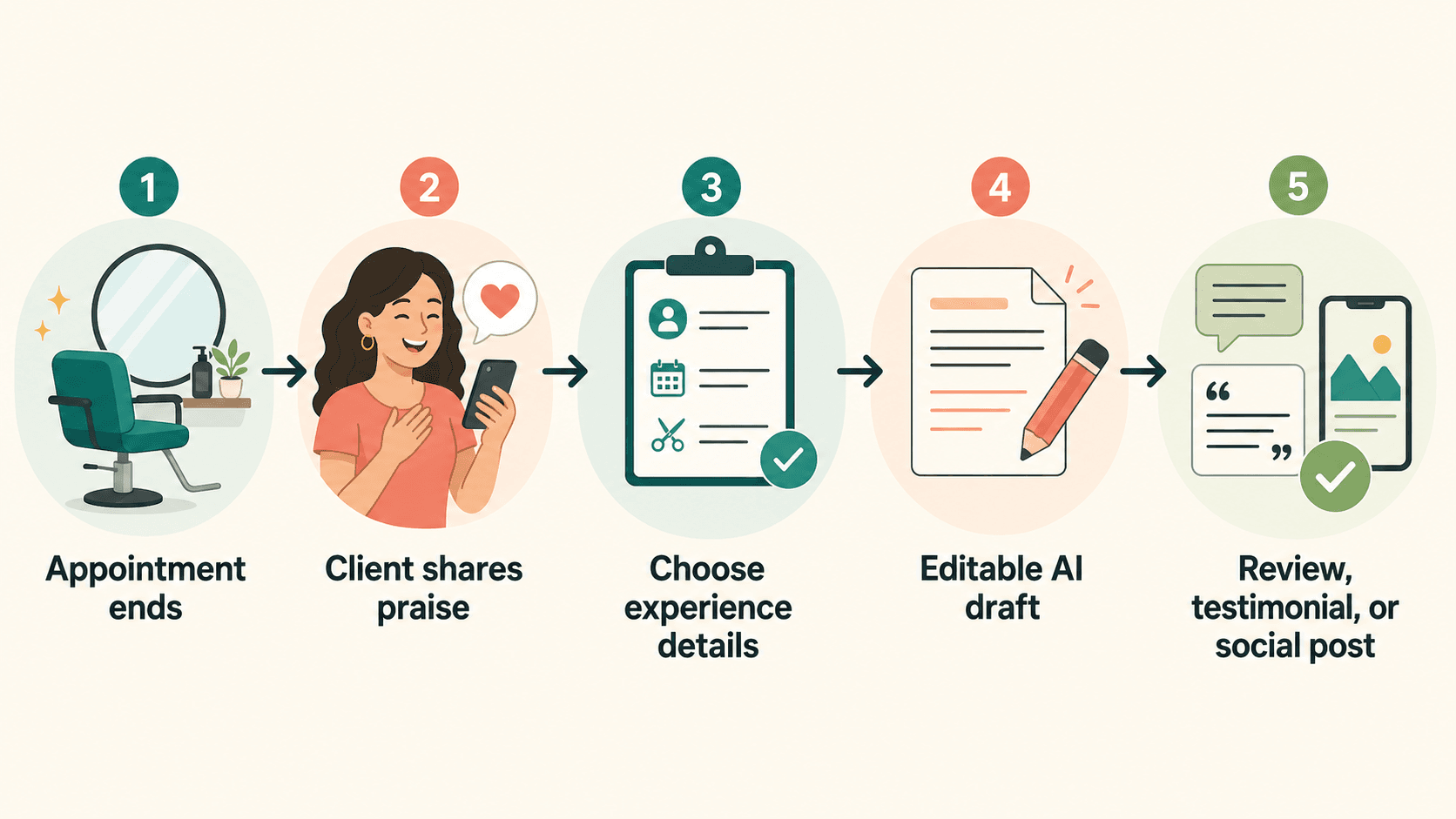
A practical salon flow looks like this:
- The appointment ends.
- The client shares praise or feedback.
- The client chooses experience details.
- An editable AI draft is created from those details.
- The client chooses whether it becomes a review, testimonial, or social post.
This is different from asking AI to invent a review. The client supplies the experience. The tool structures the draft. The client edits or rejects the result.
That distinction matters for trust. A salon should be collecting customer proof, not manufacturing it.
Give clients salon-specific detail choices
The more specific the prompt, the more useful the feedback becomes. A blank box often produces short reviews like "Great salon!" or no review at all. A few well-chosen detail prompts can help clients remember what actually made the appointment good.
Useful salon feedback prompts might include:
| Detail category | Client-friendly prompt | Why it helps |
|---|---|---|
| Consultation | What did the stylist understand well? | Captures listening, clarity, and trust |
| Result | What do you like about the final look? | Turns the outcome into specific proof |
| Comfort | How did the appointment feel? | Helps describe atmosphere and care |
| Skill | What technique or service stood out? | Supports service pages and social content |
| Convenience | Was booking, timing, or checkout smooth? | Captures operational trust |
| Education | Did you get helpful aftercare advice? | Shows expertise beyond the appointment |
| Private feedback | Is there anything we should improve? | Gives the salon a service recovery path |
For hair salons, prompt groups might include cut, color, styling, treatment, blowout, bridal, curls, extensions, consultation, or first visit. For nail salons or beauty studios, the groups might include shape, color, cleanliness, comfort, durability, design, timing, or staff care.
Do not turn these into rating instructions. The prompts should help clients describe what happened, not steer them toward a positive sentence.
Turn one client moment into several usable assets
One post-appointment praise moment can support more than one marketing use, as long as the salon keeps permission and context clear. A client review, private note, social caption, testimonial, and video script are related, but they are not interchangeable.
Here is how the same client input can be reused responsibly:
| Client input | Possible output | Salon use |
|---|---|---|
| "The stylist understood my reference photos." | Google review draft | Builds public trust for consultation quality |
| "My color looks natural, not flat." | Testimonial quote | Supports color service pages or email content |
| "I finally know how to style it at home." | Social caption idea | Creates helpful Instagram or TikTok content |
| "The salon felt calm and not rushed." | Website proof point | Shows experience quality, not just technique |
| "I had an issue with timing." | Private feedback note | Helps the manager fix operations before it becomes a bigger problem |
This is where Vibpost can fit naturally. Vibpost is an AI marketing assistant for local businesses that uses a smart review QR code workflow, called a Seeding Code inside the product, to help customers turn real experiences into review drafts, social posts, testimonials, and video scripts. For a salon, the workflow starts with the client selecting experience-based keywords after an appointment, then turns those inputs into editable customer proof.
The key is not that AI writes something polished. The key is that the salon captures the real moment before it disappears.
Keep testimonials permission-aware
Reviews and testimonials need different permission rules. A client can choose to publish a review on a public platform. If the salon wants to reuse that client's words in marketing, it should get clear permission for that use.
The FTC's Consumer Reviews and Testimonials Rule addresses fake, false, or deceptive reviews and testimonials. For a salon, that means the safest workflow is to preserve the customer's real experience, avoid misleading edits, and be clear about how submitted words may be used.
A permission-aware salon feedback flow should answer:
- Is this feedback private, public, or reusable in marketing?
- May the salon use the client's first name, initials, or no name?
- May the salon use the quote on its website, social media, print materials, or service pages?
- Did the client approve the final wording?
- Does the quote include sensitive personal details that should stay private?
Hair, beauty, wellness, and personal-care services can involve sensitive context. A client may mention hair loss, postpartum changes, wedding stress, gender expression, health-related concerns, confidence issues, or personal events. Even if the comment is positive, the salon should not reuse it publicly without clear permission.
The safest rule is this: if the feedback is going beyond the place where the client originally shared it, ask first.
Where salons should place the feedback invitation
Placement matters because salon appointments end in different ways. A high-end color appointment, a quick blowout, a nail service, a spa add-on, and a first consultation may need different handoffs.
Good placements include:
| Placement | Best for | How to use it | Risk to avoid |
|---|---|---|---|
| Checkout counter card | Most salon visits | Staff mention it after payment or rebooking | Do not hover while the client responds |
| Mirror-side handoff | Cut, color, styling reveal | Invite feedback after the client sees the result | Do not ask before the service is complete |
| Follow-up text | Color, extensions, treatments, bridal | Send after the client has lived with the result briefly | Do not spam repeated reminders |
| Receipt or appointment card | Repeat clients | Include a low-pressure feedback link | Do not make it look like a reward offer |
| Post-service email | Longer services or consultations | Ask for details while the appointment is still memorable | Do not send generic marketing copy |
The best placement is usually the one staff can repeat without discomfort. If the request feels awkward to staff, it will feel awkward to clients. Keep the script short, optional, and honest.
What salons should avoid
The fastest way to lose trust is to make the review request feel manipulated. Salons should avoid any workflow that suggests the business wants praise more than honest feedback.
Avoid:
- Asking only visibly happy clients to leave public reviews
- Offering a discount or free service in exchange for a positive review
- Asking for a specific star rating
- Writing a review for the client to copy unchanged
- Publishing a client's words as a testimonial without permission
- Editing a client's feedback so much that it changes the meaning
- Turning private service recovery feedback into public marketing copy
- Pressuring clients while they are still in the chair
- Hiding negative feedback instead of responding to it
Google's review guidance and FTC review rules are not there to stop salons from asking for feedback. They are there to protect the difference between genuine customer proof and manipulated reviews. A salon can ask. It just needs to ask in a way that keeps the client's real experience at the center.
Measure the first week by behavior, not promises
A salon does not need to promise more reviews, higher rankings, or guaranteed bookings to know whether its feedback workflow is working. Start with a one-week test and measure the behavior around the request.
Track:
- How many completed appointments included the feedback invitation
- How many clients scanned or opened the flow
- Which services received the most feedback
- Which detail prompts clients selected most often
- How many clients chose public review, private feedback, testimonial, social post, or no reuse
- How often clients edited the draft
- How often staff remembered to mention the request
- Whether clients seemed comfortable or pressured
- What private feedback revealed about the appointment experience
These numbers help the salon improve the workflow without making fake outcome claims. If scans are low, the placement or staff script may be weak. If clients scan but do not finish, the prompt may be too long. If clients heavily edit the draft, the keyword choices may not match the actual service. If private feedback is common, the salon may have valuable service recovery work to do.
The most useful metric is not just review count. It is whether the salon is learning from real clients and turning appropriate praise into reusable proof with consent.
When Vibpost makes sense for a salon
Vibpost makes sense when a salon needs more than a static review QR code. A static QR code can take a client to a review page. Vibpost is for the step before that: helping the client turn a real salon experience into clear, editable customer proof.
It is especially useful when the salon wants to:
- Capture praise immediately after appointments
- Help clients describe specific service details
- Create review drafts from customer-selected keywords
- Reuse approved feedback as testimonials or social content
- Support staff with a repeatable, low-pressure handoff
- Generate review drafts, social posts, testimonials, and video scripts from one real customer moment
- Build customer proof without hiring a full-time marketer
Vibpost is not a shortcut for fake reviews. It does not replace a good appointment, honest client input, or permission. It gives a salon a lighter way to capture the praise clients already give and turn it into something useful before it fades.
FAQ about salon customer proof
Should salons ask every client for a review?
Salons can invite clients to share feedback, but the request should be neutral and optional. Do not ask only happy clients, do not ask for a specific rating, and do not make the client feel watched while responding.
Is it okay to use AI to help a client write a review?
AI can help structure a draft when the client supplies the real experience details and keeps control of the final wording. It becomes risky when AI invents the experience, writes on behalf of the client, or pressures the client to publish unchanged text.
Can a salon reuse a Google review as a testimonial?
Do not assume every review can be reused anywhere without context. If the salon wants to place a client's words on its website, social media, print material, or service pages, the safer approach is to get clear permission and preserve the meaning of the original feedback.
What should a salon do with negative feedback?
Give clients a private way to explain issues, respond quickly, and use the feedback to improve the service. Do not use private feedback as a way to block honest public reviews. The client should remain free to share their real experience.
What is the simplest first step?
Pick one service, one handoff moment, and five experience prompts. Test the workflow for a week. Watch whether clients understand the request, whether staff can repeat the script naturally, and whether the feedback becomes specific enough to reuse responsibly.
Salons do not need a complicated marketing system to start capturing customer proof. They need a clean moment, an honest ask, a few specific prompts, and a workflow that respects the client's control. When the praise is real and the permission is clear, one appointment can become more than a nice comment at checkout. It can become proof future clients can trust.