How Spas Can Turn Client Experiences Into Testimonials
Spas can turn client experiences into testimonials by capturing the client's own words soon after the visit, asking permission for public reuse, keeping the service context attached, and editing only for clarity, not for exaggerated claims.
That matters because spa marketing is built on trust. A new client does not only want to know that your menu includes facials, massage, body treatments, waxing, or wellness services. They want to know what the experience feels like. Was the room calm? Did the esthetician explain the steps? Did the client feel listened to? Was the appointment easy to book? Did the staff make a nervous first-time visitor comfortable?
Those details are hard to invent from inside the business. They are much stronger when they come from a real client.
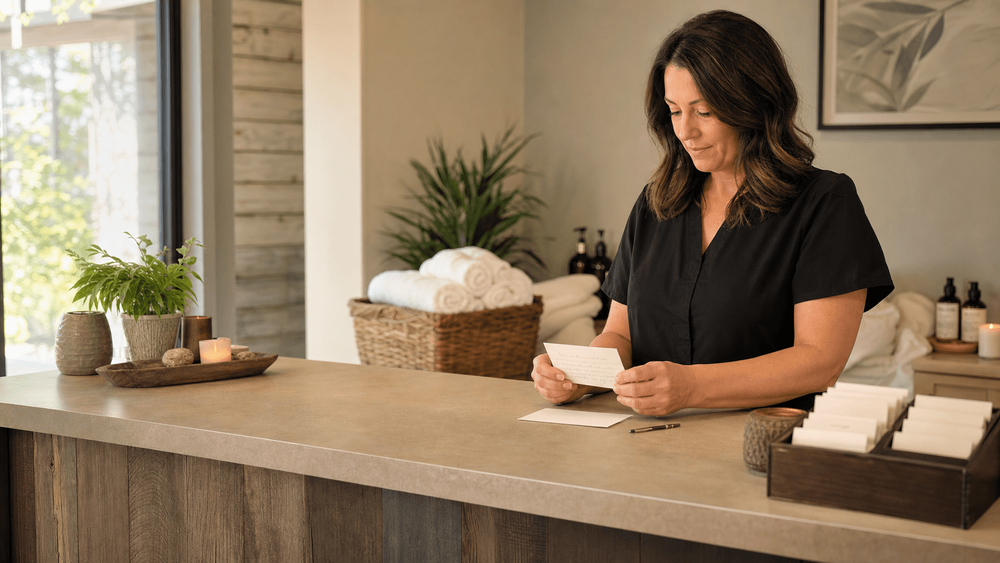
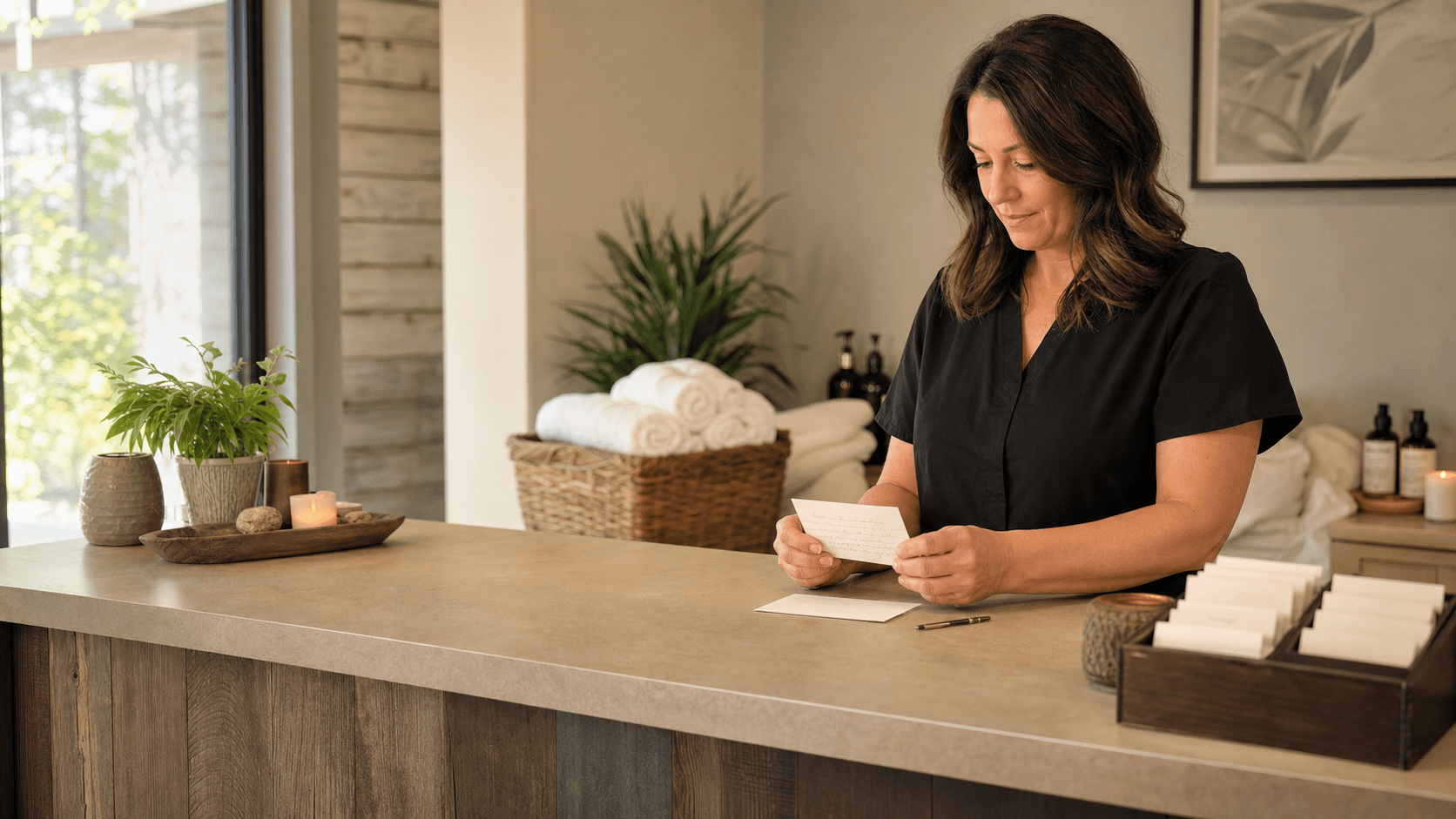
The challenge is that spa client feedback often disappears. A client says "that was exactly what I needed" at the front desk, then leaves. A regular customer texts a kind note after a facial, but nobody saves it. A first-time visitor mentions that the staff made the experience feel less intimidating, but the comment never becomes a review, testimonial, social post, or video script.
A simple testimonial workflow helps a spa protect those moments without pressuring clients, fabricating praise, or turning one person's experience into a promise for everyone.
What counts as a useful spa testimonial
A useful spa testimonial is a real client's statement about a real experience with your business.
For a spa, that might include:
- A public review after a massage, facial, body treatment, or waxing appointment
- A private feedback form after a service
- A text message from a regular client
- A short client comment after checkout
- A social media comment about the atmosphere or staff
- A video clip where a client explains why they returned
- A quote from a client who tried a service for the first time
The best testimonials are not always the most dramatic. In spa marketing, specific details usually work better than broad praise.
"Amazing spa" is nice.
"The esthetician explained every step before my first facial, so I felt relaxed instead of nervous" is more useful.
The second quote gives a future client something concrete to recognize. It tells them what kind of experience they might expect. It also stays close to what the client actually experienced.
The moments spas should capture
Most spas already hear testimonial-worthy comments during the day. The missing piece is a light capture system.
Good moments to ask for feedback include:
- After checkout, while the visit is still fresh
- After a first appointment, when the client can describe what helped them feel comfortable
- After a package or series, when the client can explain why they returned
- After a makeup, brow, lash, skincare, massage, or body treatment appointment
- After a problem was handled well, such as a reschedule or service adjustment
- After a client compliments a staff member, product recommendation, or room experience
The request should feel like a normal part of service, not a demand for praise.
Instead of asking, "Can you write us a five-star review?" try:
If anything about today's visit stood out, we would love to hear it. You can keep it private, or let us know if we may share a short quote later.
That small shift changes the tone. The client is invited to describe the experience honestly. The spa is not scripting the outcome.
Ask questions that produce real details
Testimonials become more useful when the prompt is specific but not leading.
Good spa feedback questions include:
- What brought you in today?
- What part of the appointment helped you feel most comfortable?
- Was there anything the staff explained clearly?
- What would you tell a friend who is considering this service?
- Which part of the visit would you want to remember or repeat?
- Is there anything we should improve before your next visit?
Avoid prompts that push the client toward a predetermined claim:
- Tell us why we are the best spa in town.
- Write a five-star review for your facial.
- Say that your skin looks perfect.
- Mention that the service was life-changing.
- Tell people they need to book today.
The first group collects client language. The second group tries to manufacture marketing language.
For a spa, the difference matters. Clients may be describing comfort, care, professionalism, atmosphere, staff communication, or a personal feeling after an appointment. Those are valid testimonial themes. But the business should be careful with claims that sound like medical outcomes, guaranteed results, or universal promises.
Get permission before turning feedback into marketing
A client can be happy with a service and still not want their words used everywhere.
A public Google review, a private feedback form, a social caption, a website quote, an email campaign, and a printed sign are different contexts. A client may be comfortable with one and not another.
For low-risk testimonial reuse, ask plainly:
Would it be okay if we shared this quote on our website or social channels? We can use your first name, initials, or keep it anonymous.
Give the client choices:
- Website testimonial
- Social media quote
- Email newsletter
- Printed in-spa material
- Anonymous quote only
- Private feedback only
Also ask about attribution:
- First name
- First name and last initial
- Initials
- Anonymous client
- Service category only, such as "first-time facial client"
This is especially important for spas because personal care can feel sensitive. A client may not want their name attached to a massage, waxing, skincare concern, body treatment, or wellness service. Even a positive quote can reveal more than the client meant to share.
Keep the service context attached
Context makes a testimonial stronger and safer.
If a client says, "I felt comfortable the whole time," that is good feedback. But a future client may need more context. Was this a first facial? A prenatal massage? A brow appointment? A birthday gift card visit? A regular monthly service?
You do not need to reveal private details. You do need enough context to avoid misleading the next reader.
Useful context fields include:
- Service type
- Visit type, such as first visit or returning client
- Location, if you have more than one spa
- Staff role, if relevant
- Date or season, if the quote is tied to a promotion or package
- Permission status
- Approved attribution
- Original wording
- Edited wording
- Where the quote has been used
This record prevents accidental misuse later. A quote from a first-time facial client should not be used to promote a massage package unless the quote clearly applies. A review from one location should not imply every location delivered the same experience. A comment about a calm room should not become a claim about treatment results.
Edit for clarity, not exaggeration
Spa testimonials often need light editing. Clients write quickly. They may use sentence fragments, repeat themselves, or include personal details you should remove.
Safe editing makes a quote easier to read while preserving the meaning.
Risky editing changes the claim.
| Client words | Safer testimonial | Risky rewrite |
|---|---|---|
| "It was my first facial and she explained everything." | "It was my first facial, and she explained everything." | "Perfect facials for every first-time client." |
| "The room was quiet and I felt comfortable." | "The room was quiet, and I felt comfortable." | "Guaranteed stress relief from the moment you arrive." |
| "They helped me choose a product that fit my routine." | "They helped me choose a product that fit my routine." | "Our products solve every skincare concern." |
| "I liked that nobody rushed me." | "I liked that nobody rushed me." | "The most relaxing spa experience in the city." |
The risky rewrites are not just more polished. They turn one person's experience into a broader promise.
The better test is simple:
Would the original client still recognize this as what they meant?
If the answer is no, make the quote smaller, add context, or do not use it.
Build a testimonial workflow your staff can actually use
A testimonial system should be easy enough for front-desk staff, service providers, and owners to follow on a busy day.
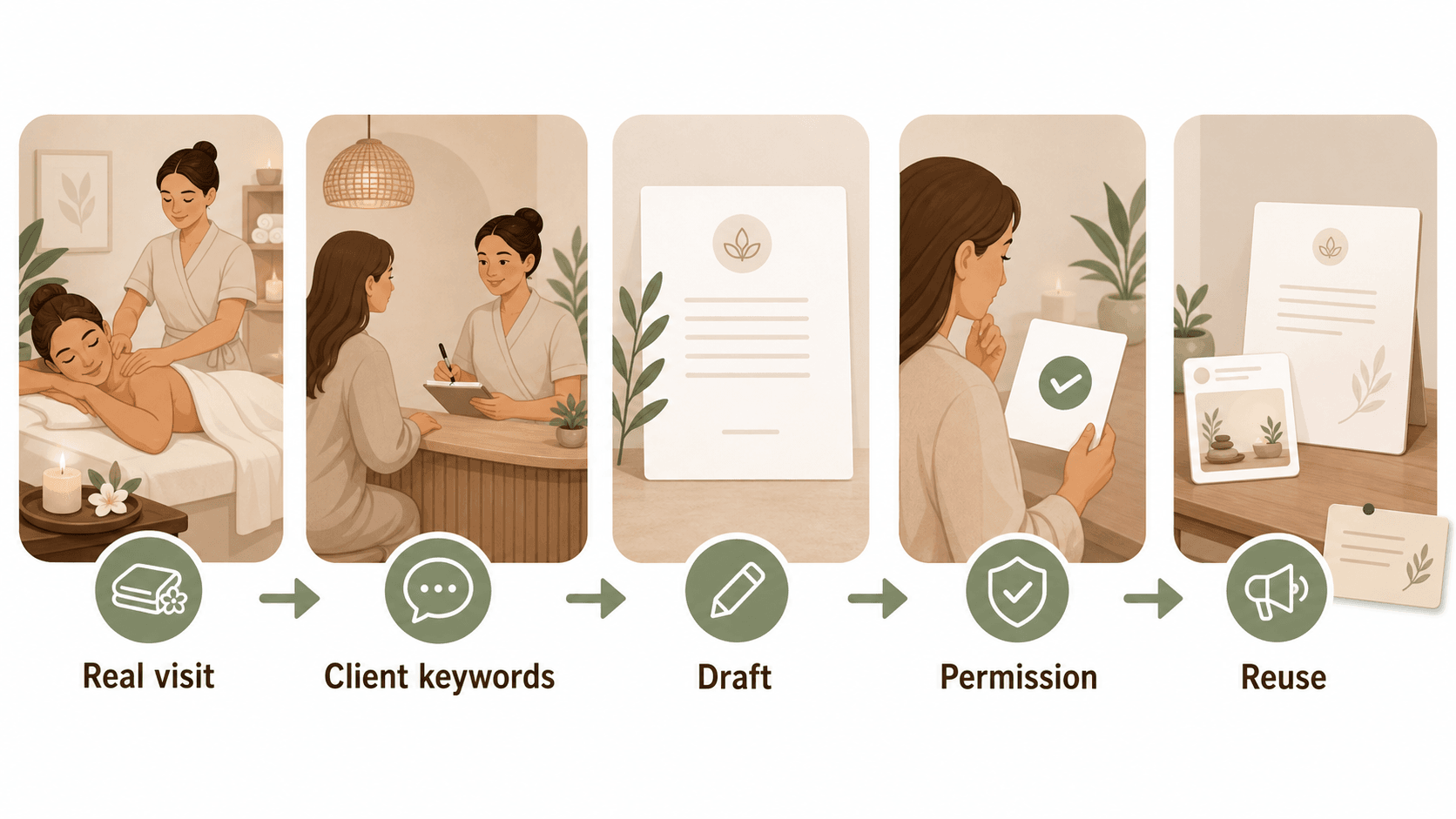
Here is a practical workflow for spas.
1. Capture the experience while it is fresh
Place the feedback request where it fits naturally:
- At checkout
- In a follow-up message
- On a small counter card
- In a post-appointment email
- After a package or membership visit
- After a client compliments the service in person
Keep the request low-pressure. The goal is honest customer input, not forced praise.
2. Let the client choose experience keywords
Many clients know what they felt but do not know how to write a testimonial from scratch.
Experience keywords can help. For a spa, useful keywords might include:
- Relaxing atmosphere
- Clear explanation
- First-time comfort
- Gentle service
- Professional staff
- Easy booking
- Clean environment
- Product guidance
- Not rushed
- Private and respectful
The client should choose what genuinely matches the visit. Keywords should guide memory, not script the testimonial.
3. Draft the testimonial from the client's input
Once the client gives feedback, the business can turn it into different content formats:
- A short website testimonial
- A social media caption
- A review draft the client can edit and publish
- A video script for a voluntary client story
- A staff training note about what clients value
- A service-page quote tied to the right treatment
AI can help structure the wording, but the source should still be the client's real experience.
4. Ask for approval and attribution
Before public reuse, confirm:
- May we use this quote?
- Where may we use it?
- How should we attribute it?
- Should any detail be removed?
- Is this quote still accurate after editing?
This step is not just legal caution. It is good relationship management. A spa is a trust-based business. Clients should not feel surprised by how their words are used.
5. Store the testimonial with context
Do not save testimonials as random screenshots.
Create a simple record with:
- Original feedback
- Edited testimonial
- Service category
- Permission
- Attribution
- Date
- Channel approved
- Usage history
- Any incentive or relationship disclosure, if relevant
If the quote later appears on a website page, social post, printed card, or email, your team can see why it was approved and where it belongs.
Where Vibpost fits in a spa testimonial workflow
Vibpost is an AI marketing assistant for local businesses that helps turn real customer moments into review drafts, social posts, testimonials, and video scripts through a smart review QR code workflow.
For spas, the value is not just writing prettier sentences. The value is capturing client feedback while the experience is still fresh, giving clients easy experience keywords to choose from, and helping the business turn that input into usable customer proof without starting from a blank page.
A spa can use Vibpost's smart review QR code workflow, called a Seeding Code inside the product, like this:
- The spa places a smart review QR code at checkout or in a follow-up message.
- A client scans after a real appointment.
- The client selects experience-based keywords or describes what stood out.
- Vibpost helps shape that input into a review draft, testimonial, social post, or video script.
- The client or business reviews the wording before public reuse.
- The spa keeps permission and service context attached to the testimonial.
The boundary is important. Vibpost should not be used to invent client experiences, create fake reviews, pressure clients into positive statements, or make treatment claims the client did not make. It works best when the spa already has real client moments and needs a repeatable way to capture and reuse them responsibly.
What spa testimonials should not claim
Spa testimonials can describe how a client felt, what they noticed, and why they appreciated the service. They should be more careful when they start sounding like guaranteed outcomes.
Be cautious with claims such as:
- Cured pain
- Fixed skin permanently
- Guaranteed results
- Best spa in the city
- Works for every client
- Medical or therapeutic outcomes that the business cannot support
- Results that depend on a specific person's body, condition, routine, or treatment plan
Safer testimonial language keeps the experience personal:
- "I felt relaxed after the appointment."
- "The room was calm, and I did not feel rushed."
- "The esthetician explained the steps before starting."
- "The team helped me choose a routine I could actually follow."
- "I felt comfortable asking questions."
If a testimonial involves incentives, paid creators, employee relationships, or other connections a reader would want to know about, disclose the connection or do not use it as ordinary client proof. The FTC's Endorsement Guides and Consumer Reviews and Testimonials Rule are useful background for understanding why hidden relationships, bought reviews, and misleading testimonial practices create risk.
You do not need to turn every spa testimonial into a legal memo. You do need a habit that keeps client words honest.
Practical examples for spa teams
First-time facial client
Client feedback:
I was nervous because it was my first facial, but she explained everything and checked in with me.
Safer testimonial:
"It was my first facial, and she explained everything and checked in with me."
Best use:
- First-time facial page
- New client email
- Social post about what to expect
Avoid:
- Claims that every first-time client will feel the same
- Before-and-after promises
- Using the quote for unrelated services
Returning massage client
Client feedback:
I liked that the room was quiet and I did not feel rushed before or after the appointment.
Safer testimonial:
"The room was quiet, and I did not feel rushed before or after the appointment."
Best use:
- Service page about the appointment experience
- Retention email for regular clients
- Staff training example
Avoid:
- Medical claims
- Guaranteed relaxation claims
- Implying every massage has the same result
Product guidance after a skincare service
Client feedback:
They helped me pick one product that fit my routine instead of pushing everything.
Safer testimonial:
"They helped me pick one product that fit my routine instead of pushing everything."
Best use:
- Retail product guidance page
- Post-service follow-up
- Social post about consultation style
Avoid:
- Product performance guarantees
- Claims about solving all skin concerns
- Using the quote beside a different product category
A simple checklist before publishing
Before your spa publishes a testimonial, check:
- Is this from a real client experience?
- Did the client approve this use?
- Does the attribution match the client's preference?
- Did we preserve the original meaning?
- Does the quote match the service, location, or offer nearby?
- Are we avoiding unsupported treatment or result claims?
- Are any incentives, creator relationships, or staff connections clear?
- Do we still have the original wording saved?
If a quote fails the checklist, the fix is usually simple. Use a smaller excerpt, add service context, ask for permission again, or skip the quote.
Skipping one questionable testimonial is better than weakening client trust.
The takeaway
Spa testimonials work best when they sound like real clients, not polished advertising.
The strongest system is simple: capture the client's own words while the visit is fresh, ask permission, keep the service context, edit lightly, and reuse the quote only where it remains accurate.
For spa owners and managers, that turns everyday client appreciation into a dependable library of customer proof. Not fake praise. Not pressure. Just real experiences, saved before they disappear, and reused in a way the client would still recognize.