

How to Ask Customers for Reviews Without Putting Them on the Spot
Asking for customer reviews is not the hard part. Asking at the right moment, with the right tone, and without making the customer feel watched is where many local businesses get stuck.
A review request can feel natural when it grows out of a real customer moment. A guest compliments the service. A client says the appointment helped. A parent thanks the front desk after class. A shopper mentions that your staff made the decision easier.
That is the moment worth preserving.
For a restaurant, cafe, salon, spa, gym, pet shop, retail store, or education center, the goal is not to pressure every customer into saying something positive. The goal is to make it easy for real customers to share honest feedback in their own words.
The simplest version looks like this:
- Notice the genuine customer moment.
- Thank the customer first.
- Make the review optional.
- Give them an easy path.
- Let them decide what to publish.
If the customer feels in control, the request feels helpful. If the customer feels cornered, even a friendly ask can turn awkward.
Why reviews are worth asking for
Customer reviews do more than fill a star rating. They help future customers understand what visiting your business actually feels like.
A website can describe your menu, services, products, classes, or hours. A review can describe the human details that people care about before they choose:
- Was the staff patient?
- Did the appointment start on time?
- Was the space clean?
- Did the meal, treatment, class, repair, or purchase match expectations?
- Did the customer feel comfortable coming back?
Those details are especially important for local businesses. People often choose a neighborhood business because they trust other people who have already been there.
Reviews also help your team learn. A customer might mention the front desk, a stylist, a server, a coach, a teacher, a product recommendation, or a small service detail that would otherwise disappear after the visit. Capturing that feedback gives you a better picture of what customers notice.
Still, the value of reviews depends on trust. If the request sounds scripted, rewarded, filtered, or forced, the review profile loses credibility. A strong review workflow should make honest feedback easier, not manufacture praise.
Start with the moment, not the review link
Many review requests feel pushy because the business starts with the link.
"Can you review us?"
"Please scan this."
"Leave us five stars."
That puts the work on the customer before the customer knows why the request matters.
A better approach starts with what just happened. If the customer says something positive, acknowledge it before asking for anything.
Try:
I really appreciate you saying that. If you ever want to share that experience in a review, it helps other local customers know what to expect.
This works because it is tied to a real interaction. You are not interrupting the customer with a generic marketing request. You are giving them a way to share something they already expressed.
The same idea works after a successful appointment, class, pickup, checkout, or meal. Ask near the experience, but not in a way that traps the customer in the moment.
Good timing usually includes:
- After a customer gives a compliment.
- After a completed service or purchase.
- In a short thank-you message after the visit.
- In a receipt, table tent, counter card, or follow-up email.
- After a resolved issue, if the customer voluntarily says the problem was handled well.
Bad timing usually includes:
- Asking before the service is complete.
- Asking while the customer is still paying.
- Standing over the customer while they write.
- Asking only customers who seem happy.
- Asking for a rating instead of honest feedback.
If saying no would feel uncomfortable for the customer, the timing needs work.
How to ask over the phone
Phone review requests should be brief. A call is already more personal than a text or email, so the customer should not feel like they are being talked into anything.
Use the call to thank them, confirm the experience, and offer a low-pressure path.
Example:
Thanks again for visiting us today. If you would like to share your experience, I can send a quick review link by text. No pressure either way. Honest feedback helps other customers know what to expect.
This script does three useful things:
- It asks permission before sending the link.
- It uses "if you would like" to keep the choice with the customer.
- It asks for honest feedback, not a specific rating.
Avoid turning the call into a performance check. Do not say:
Can you leave us a five-star review while I have you on the phone?
That puts the customer in an awkward social position. Even if they agree, the review may not feel voluntary.
How to ask by text message
Text works well because the customer can respond later. That makes the request feel less immediate than a face-to-face ask at the counter.
Keep it short:
Thanks for visiting us today. If you have a minute, your honest review would help future customers understand the experience: [review link]
For appointments or classes:
Thank you for coming in today. If you would like to share feedback, this link makes it easy to leave an honest review in your own words: [review link]
For a customer who gave a compliment:
We appreciate what you said today. If you ever want to share that experience publicly, this link makes it easy: [review link]
Text messages should not sound like a demand. Avoid urgency unless there is a real service reason. Also avoid sending repeated reminders. One thoughtful follow-up usually feels better than a series of nudges.
How to ask in person
In-person review requests work best when they feel like part of a normal customer conversation.
The safest opening is appreciation:
Thank you for coming in today. If you would ever like to share your experience, this card makes it easy to leave an honest review later.
The word "later" matters. It tells the customer they do not have to write under your supervision.
In-person asks are especially useful when the customer has already said something positive. For example:
I am glad the haircut turned out the way you wanted. If you want to share that feedback, it helps other customers who are deciding where to book.
Or:
Thanks for telling us the class helped. If you would like to leave a review later, it helps other parents understand what the program is like.
Do not over-explain. A long script can make the request sound rehearsed. A short, optional invitation usually feels more natural.
How to ask by email
Email gives you more room, but that does not mean the message should be long. A review email should be clear, polite, and easy to act on.
Subject line ideas:
- Thank you for visiting us
- We would appreciate your feedback
- How was your experience?
Body example:
Thanks for choosing us today. We hope the visit was helpful.
If you would like to share your experience, this link makes it easy to leave an honest review. Your feedback helps future customers understand what to expect, and it helps our team keep improving.
[Leave an honest review]
This works because it connects the review to two honest reasons: future customer trust and internal improvement. It does not ask for five stars, mention a reward, or tell the customer what to say.
For service businesses, you can add one sentence that reminds the customer of the specific visit:
Whether you want to mention the appointment, the staff, the space, or anything we could improve, your words are welcome.
That sentence opens the door to real feedback instead of only praise.
How to ask on your website
Your website can support review collection without interrupting customers.
Useful placements include:
- A "Share your experience" link on a thank-you page.
- A review link in a post-purchase or post-booking flow.
- A small feedback section on a customer support page.
- A QR-based review prompt on printed materials that points customers to the right review path.
Google Business Profile lets businesses create a review link or QR code from their profile, which means a local business can give customers a simple way to reach the review form without asking them to search manually.
The wording around the link still matters. A safe website prompt might say:
Had a recent visit? Share your honest experience to help future customers know what to expect.
Avoid:
Loved us? Leave five stars.
The second version filters the emotional path before the customer even reaches the review page. The safer version invites honest feedback.
How to ask on social media
Social media review requests should feel conversational, not desperate.
Instead of posting:
We need more reviews. Please leave us five stars.
Try:
If you have visited us recently, your honest review helps other local customers know what to expect. Thank you for supporting a local business.
You can also use existing reviews as inspiration for social posts, as long as you have the right to reuse the content and you do not change the meaning. For example, a restaurant might quote a public review about friendly service or a favorite dish. A salon might turn a testimonial into a short post about the customer experience.
The useful part is not just showing praise. It is showing future customers what a real visit can feel like.
If you use customer words in social content, keep the wording accurate, avoid private details, and do not imply results that the customer did not state.
What not to say when asking for reviews
Small wording changes can change the tone of the whole request.
| Avoid saying | Say this instead |
|---|---|
| "Can you leave us a five-star review?" | "If you would like, you can leave an honest review here." |
| "Show us your review for a discount." | "Your honest feedback helps future customers." |
| "Only review us if you had a great experience." | "We welcome honest feedback from customers." |
| "Please mention these exact words." | "Share what stood out in your own words." |
| "Do it before you leave." | "You can use this link later if you prefer." |
| "We really need more reviews." | "Your feedback helps other people know what to expect." |
The safer version keeps the customer in control of rating, wording, and timing.
That matters because review platforms care about authenticity. Google's Maps user-generated content policies warn against fake engagement, manipulated ratings, incentivized content, and contributions that do not reflect genuine experiences. A local business should build review habits around real customer input, not pressure or reward systems.
A simple workflow for non-pushy review requests
The strongest review requests are not one-off scripts. They are repeatable workflows.
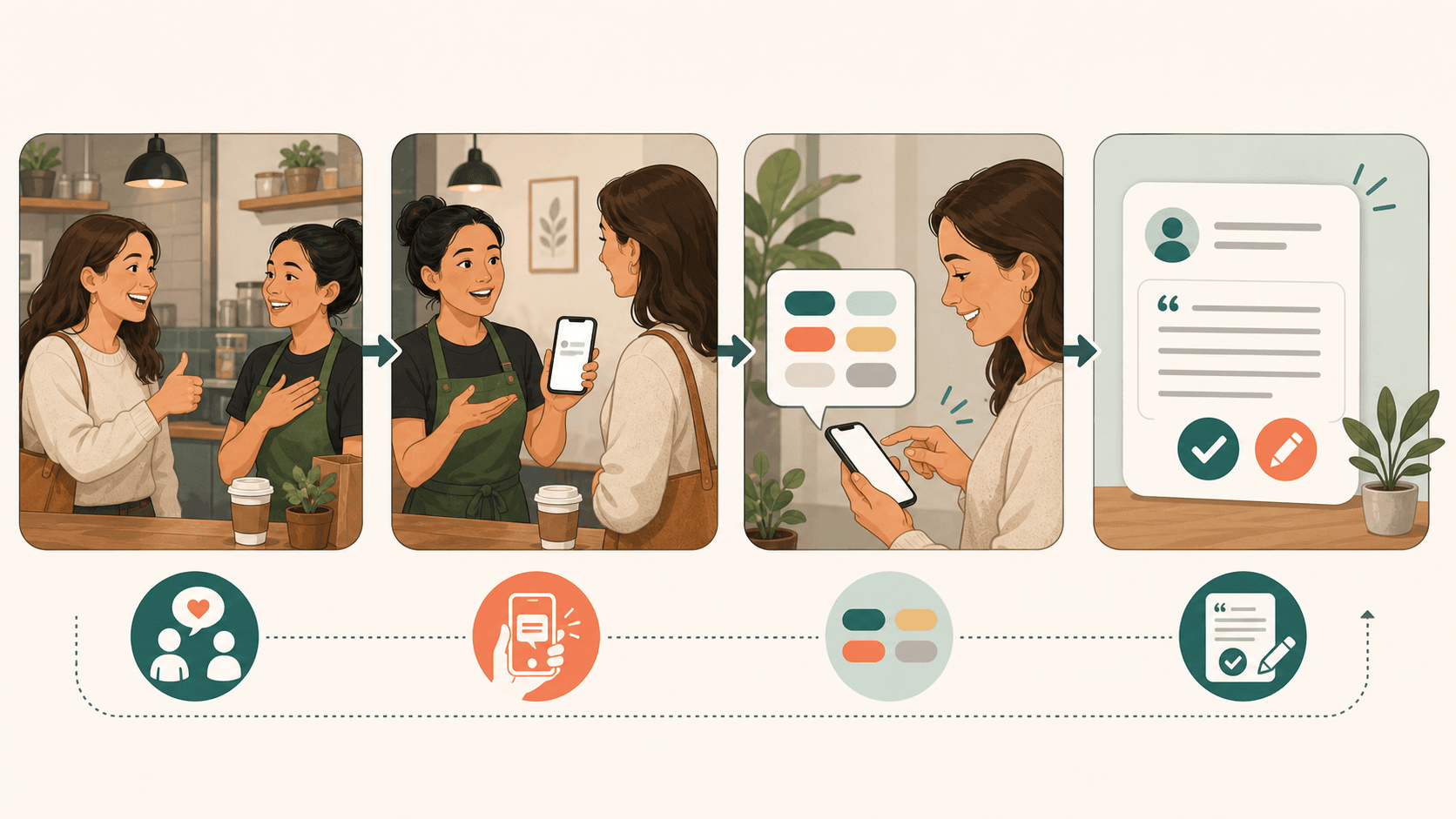
A practical workflow can look like this:
- A real customer moment happens.
- The team thanks the customer and offers an optional review path.
- The customer chooses the experience details that feel accurate.
- The customer gets help turning those details into draft wording.
- The customer reviews, edits, publishes, ignores, or saves the draft.
- The business reuses genuine feedback as social proof when appropriate.
This works because the business is not asking the customer to invent something. It is helping the customer capture what already happened.
For a cafe, the moment might be a compliment about the drink and service. For a salon, it might be the mirror check after a haircut. For a gym, it might be a member saying the class helped them get started. For a pet shop, it might be a customer thanking the team for patient advice.
The workflow should fit into the customer journey without becoming a checkpoint.
Where Vibpost fits
Vibpost is an AI marketing assistant for local businesses. It uses a smart review QR code workflow, called a Seeding Code inside the product, to help customers turn real experiences into review drafts, social posts, testimonials, and video scripts.
The useful part is not only the QR code. A plain review QR code sends a customer to a blank page. That can work, but many customers do not know what to write even when they had a good visit.
Vibpost focuses on the missing middle:
- A business places a smart review QR code where real customer moments happen.
- The customer scans from their own phone.
- The customer selects experience-based keywords that match the visit.
- AI helps turn those inputs into a review draft, social post, testimonial, or video script.
- The customer or business reviews the output before it is published, shared, or reused.
For small local teams without a full-time marketer, this turns review asking from an awkward staff script into a more repeatable customer proof workflow.
The boundaries still matter:
- Reviews should reflect genuine customer experiences.
- Customers should control what they publish.
- The business should not offer rewards for positive reviews.
- The workflow should not filter unhappy customers away from public review paths.
- AI should reduce friction, not replace the customer's real opinion.
Used correctly, a smart review QR code workflow makes the request easier because the customer gets a simple path, a few helpful prompts, and final control.
Review request templates by business type
Restaurants and cafes
Thanks for coming in today. If you would like to share your experience later, this link makes it easy to leave an honest review.
Salons and spas
I am glad you are happy with the result. If you ever want to share your experience, your review helps other customers decide where to book.
Gyms and fitness studios
Thanks for joining class today. If you would like to leave honest feedback, it helps new members understand what the experience is like.
Retail stores
We appreciate you shopping with us. If our team helped today, you are welcome to share your experience in your own words.
Pet shops and pet services
Thank you for trusting us today. If you would like to share feedback about the visit, this link makes it simple.
Education centers
Thanks for coming in today. If you would like to share feedback about your experience, it helps other families understand what to expect.
Each template is short, optional, and tied to a real experience. That is the pattern to keep.
The request should feel like a doorway
The best review request does not push the customer through a funnel. It opens a door.
If the customer wants to share, the path is easy. If the customer wants to wait, edit, skip, or say something critical, they can. That is what makes the review useful.
For local businesses, the goal is not to collect perfect praise. It is to build a steady habit of turning real customer moments into honest, reusable proof.
Ask naturally. Make the next step simple. Let the customer stay in control.