How to Ask Customers for Reviews Without Sounding Pushy
Asking for reviews can feel awkward because the timing is personal. A customer just finished a meal, haircut, class, spa visit, repair, or shopping trip. You know their feedback can help future customers trust your business, but you do not want the request to feel like a sales script.
The good news: customers do not usually mind being asked when the request is short, optional, and connected to a real experience. The problem is not asking. The problem is asking in a way that pressures the customer, tells them what to say, or makes the review feel like a transaction.
For local businesses, the best review request has three parts:
- A natural moment.
- A neutral message.
- An easy path for the customer to use their own words.
That is the difference between a review workflow that builds trust and a review request that makes people uncomfortable.
Why customer reviews matter for local businesses
Reviews help people decide whether your business feels safe, credible, and worth visiting. For a restaurant, cafe, salon, spa, gym, pet shop, retail store, or education center, a review often does more than describe the service. It tells future customers what the experience feels like.
A useful review can answer questions your website may not:
- Was the staff friendly?
- Was the appointment on time?
- Was the food, service, treatment, class, or product worth it?
- Did the business handle details well?
- Would another local customer come back?
Reviews also give your team feedback that is hard to capture in the moment. A customer may compliment the front desk, a stylist, a menu item, a class instructor, or a clean environment. If that feedback disappears after the customer leaves, your business loses both a learning signal and a piece of social proof.
That does not mean you should chase reviews at all costs. A review profile is valuable because customers believe it reflects real experiences. If the request feels scripted, rewarded, filtered, or pressured, the trust value drops.
When to ask for a review
The best time to ask is soon after a real customer moment, while the experience is still fresh and the customer still remembers what stood out.
For a local business, good timing often looks like this:
- After a customer gives a verbal compliment.
- After a successful appointment, class, meal, treatment, repair, or purchase.
- At checkout, if the customer is relaxed and not being rushed.
- In a thank-you email or text after the visit.
- After a resolved issue, if the customer voluntarily says the problem was handled well.
- After a repeat customer has had several good visits.
The key is to ask near the experience, not in the middle of it. A customer should not feel watched, trapped, or required to write something before they can leave.
Poor timing usually creates the pushy feeling:
- Asking while the customer is still paying.
- Standing over the customer while they write.
- Asking only customers who seem happy.
- Asking immediately after a complaint before the issue is handled.
- Making the review feel like part of checkout.
- Asking for a rating instead of honest feedback.
If the customer would feel awkward saying no, the timing is probably wrong.
How to ask without sounding pushy
A non-pushy review request is not complicated. It is short, specific, and customer-controlled.
1. Start with appreciation, not a demand
Open with a thank-you. The customer should hear that you appreciate the visit before you ask for anything.
Instead of:
Can you leave us a five-star review?
Try:
Thanks for visiting today. If you would like to share your experience, this link makes it easy to leave an honest review.
That small change matters. You are not asking for praise. You are inviting honest feedback.
2. Keep the review optional
Words like "if you would like" and "when you have a moment" reduce pressure. They remind the customer that the choice is theirs.
Good review requests do not sound urgent unless there is a real reason. They also do not create a debt, as if the customer owes the business a public comment.
Try:
If you have a minute later, your honest review would help future customers know what to expect.
Avoid:
We need you to review us before you leave.
3. Ask for honesty, not a specific rating
A review request should not tell the customer to leave five stars, mention certain words, name a staff member, or describe only positive details.
Google's review policies warn businesses not to offer incentives for reviews, discourage negative reviews, selectively solicit positive reviews, pressure customers to write while on the premises, or request specific review content. A safer review workflow asks for honest feedback and lets the customer decide what to say.
Use wording like:
Your honest feedback helps other local customers decide if we are a good fit.
Avoid wording like:
Please mention our service and leave five stars.
4. Make the next step easy
Many happy customers do not leave reviews because they do not know what to write or where to go. The easier you make the next step, the less the request feels like homework.
You can use:
- A review link in a thank-you text.
- A review QR code on a receipt, counter card, or table tent.
- A short follow-up email.
- A simple staff script.
- A smart review QR code workflow that helps the customer turn their own experience into a draft.
Google Business Profile guidance allows businesses to remind customers to leave reviews with a link or QR code. The access method is not the issue. The surrounding behavior is what matters.
5. Let customers keep control of the final words
If AI helps with the blank page, it should still start from the customer's real experience. The customer should choose, edit, approve, or ignore the draft.
That is especially important for local businesses using review tools. A tool can reduce friction, but it should not manufacture a review, write on behalf of a customer without input, or make the customer feel that only one answer is acceptable.
Review request examples you can adapt
The right wording depends on where the customer is in the journey. A table-side script should be shorter than an email. A salon follow-up should feel different from a retail receipt.
At checkout
Thanks for stopping in today. If you would like to share your experience, this card makes it easy to leave an honest review later.
Why it works: it is short, optional, and does not ask for a rating.
After a verbal compliment
I really appreciate you saying that. If you ever want to share those thoughts in a review, it helps other local customers know what to expect.
Why it works: it builds on a real customer moment instead of forcing a review out of nowhere.
In a thank-you text
Thanks again for visiting us today. If you have a minute, your honest review would help future customers learn what the experience is like: [review link]
Why it works: it gives the customer space to respond later, away from the counter or front desk.
In an appointment follow-up email
Thank you for coming in today. We hope the visit was helpful. If you would like to share feedback, this link makes it easy to leave an honest review. Your words help other customers decide whether we are the right fit.
Why it works: it connects the review to customer usefulness, not business pressure.
On a table tent, receipt, or counter card
Want to share your experience? Scan here later to leave an honest review in your own words.
Why it works: it does not interrupt the customer, and it makes the request available without forcing a conversation.
A simple review workflow that does not feel pushy
The strongest review requests are not one-off scripts. They are small workflows that fit naturally into the customer journey.
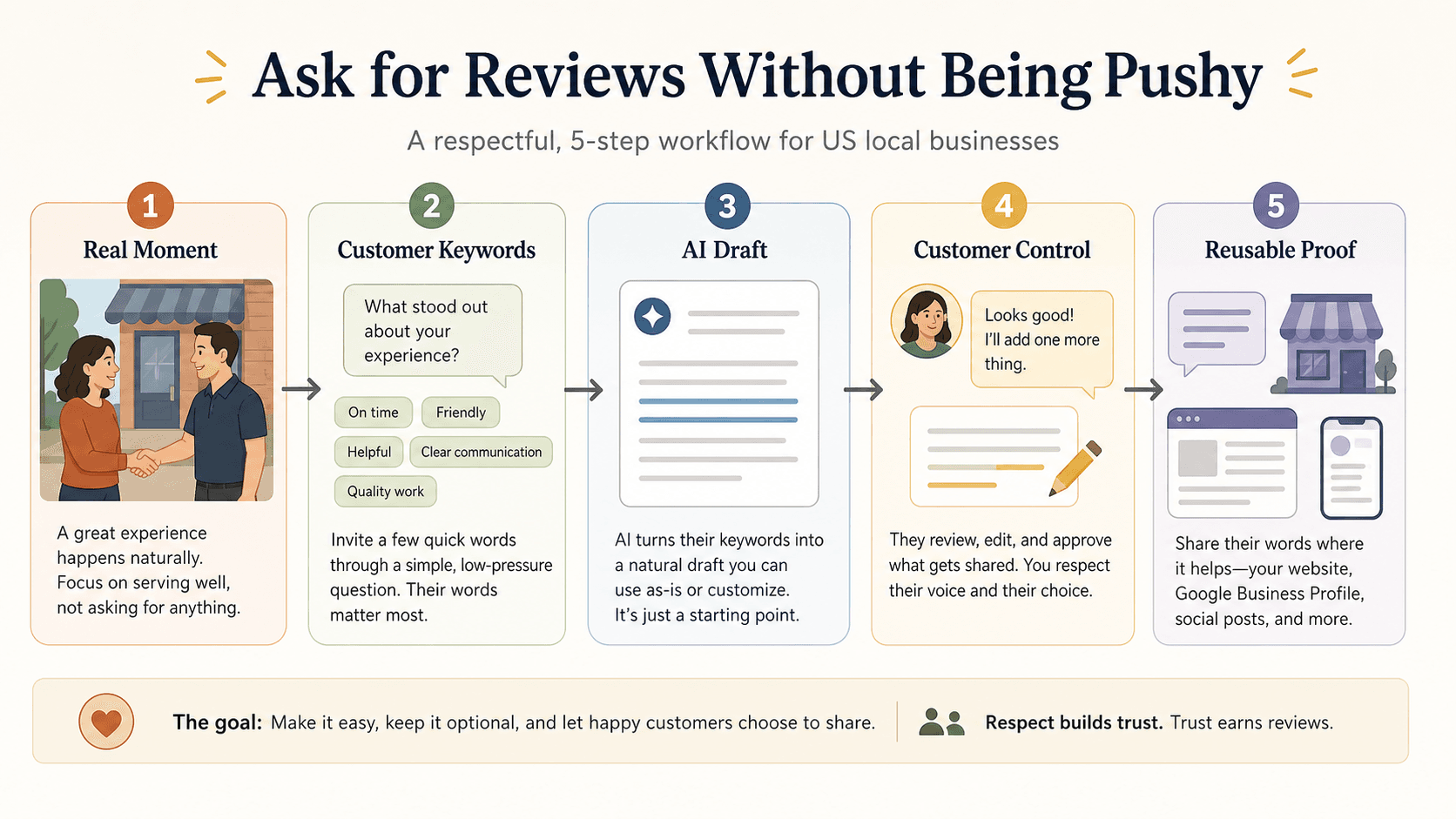
A practical workflow can look like this:
- Choose the right moment in the visit.
- Give the customer a neutral review path.
- Help them remember what stood out.
- Let them write, edit, or skip the review.
- Reuse genuine customer feedback as social proof when appropriate.
For a cafe, that moment might be after a regular customer compliments the drink or atmosphere. For a salon, it might be after the mirror check. For a gym, it might be after a member reaches a milestone. For a pet shop, it might be when a customer mentions how helpful the staff was.
The request should feel like a helpful doorway, not a checkpoint.
Where Vibpost fits into the review request workflow
Vibpost is an AI marketing assistant for local businesses. It uses a smart review QR code workflow, called a Seeding Code inside the product, to help customers turn real experiences into review drafts, social posts, testimonials, and video scripts.
The useful part is not just the QR code. A plain review QR code can send a customer to a blank page, but many customers freeze because they do not know what to write. Vibpost is built for the missing middle between a real customer moment and a useful piece of customer proof.
The workflow is simple:
- The business places a smart review QR code where real customer moments happen.
- The customer scans from their own phone.
- The customer selects experience-based keywords that match what happened, such as friendly service, clean environment, helpful staff, great meal, or smooth appointment.
- AI helps turn those inputs into a review draft, social post, testimonial, or video script.
- The customer or business reviews the output before it is published, shared, or reused.
Vibpost is designed for local teams that do not have a full-time marketer but still need a repeatable way to capture customer proof. The product supports review drafts, video scripts, multi-language content, customization, data analytics, and ongoing generation for local business use cases.
It should still be used with the same trust boundaries:
- Reviews should reflect genuine customer experiences.
- Customers should control what they publish.
- The business should not offer rewards for positive reviews.
- The workflow should not filter unhappy customers away from public review paths.
- AI should reduce friction, not replace the customer's real opinion.
Used correctly, a smart review QR code can make the review request feel less pushy because the customer is not being cornered into writing on the spot. They get a clear path, a few helpful prompts, and control over the final message.
What not to say when asking for reviews
Small wording choices can change the whole tone of the request.
| Avoid saying | Say this instead |
|---|---|
| "Can you leave us a five-star review?" | "If you would like, you can leave an honest review here." |
| "Show us your review for a discount." | "Your honest feedback helps future customers." |
| "Only review us if you had a great experience." | "We welcome honest feedback from customers." |
| "Please mention these exact words." | "Share what stood out in your own words." |
| "Do it before you go." | "You can use this link later if you prefer." |
| "We really need more reviews." | "Your feedback helps other people know what to expect." |
The safer version gives the customer space. It does not control the rating, content, or timing.
Review request templates for common local businesses
You can adapt these without making them sound scripted.
Restaurant or cafe
Thanks for dining with us. If you would like to share what stood out, this link makes it easy to leave an honest review.
Salon or spa
Thank you for coming in today. If you are comfortable sharing your experience, your honest review can help other customers choose the right service.
Gym or fitness studio
Great work today. If you ever want to share your experience with the studio, this review link is here when you need it.
Retail boutique
Thanks for shopping with us. If the visit was helpful, an honest review would help other local shoppers know what to expect.
Pet service business
We loved seeing you and your pet today. If you would like to share your experience, this link makes it easy to leave a review in your own words.
Education center or class-based business
Thank you for joining us today. If you would like to share feedback about the class, your review helps other families and students understand the experience.
Frequently asked questions
Can I ask customers for Google reviews?
Yes. Businesses can remind customers to leave reviews and can make the path easier with a link or QR code. Keep the request honest, optional, and neutral.
Is a QR code review request pushy?
Not by itself. A QR code is only a path. It becomes pushy if staff pressure the customer, ask for a specific rating, watch the customer write, or show the code only to customers who seem happy.
Can AI help customers write reviews?
AI can help with the blank page when the draft is based on the customer's real experience and the customer remains in control. It should not create fake reviews, replace customer input, or publish without approval.
Should I offer a discount for a review?
Be careful. Incentives can create trust and compliance problems, especially if the reward is tied to posting a review, changing a review, removing a negative review, or leaving positive sentiment. The safer path is to ask for honest feedback without a reward.
What should I do if a customer is unhappy?
Listen, fix what you can, and invite feedback honestly. Do not use private feedback as a gate that prevents unhappy customers from choosing a public review path. A fair workflow gives customers control.
How often should I ask?
Ask after meaningful customer moments, not constantly. A repeat customer who visits weekly should not feel chased every time. Build a light, respectful system instead of asking randomly.
The takeaway
The best review request does not sound like a request for praise. It sounds like a respectful invitation.
Ask at the right moment. Keep the wording neutral. Make the next step easy. Let the customer control the final words. If you use AI, use it to help customers express real experiences, not to manufacture opinions.
For a local business, that is the review workflow worth building: real customer moments, honest customer words, and reusable proof that future customers can trust.