

How to Collect Reviews After a Customer Compliment Without Sounding Pushy
The best time to ask for a review is often right after a customer gives a real compliment, but the safest ask is still light, optional, and customer-controlled. Thank the customer first, connect the review request to helping future customers, offer an easy path, and leave the wording, rating, and decision fully in the customer's hands.
For a restaurant, cafe, salon, spa, gym, retail store, or local service business, this moment matters because the customer has already volunteered something positive. You are not trying to manufacture praise. You are simply helping that real experience become easier to share before the moment disappears.
Google allows businesses to create and share a review link or QR code, including on receipts, thank-you emails, chat interactions, and in-store displays. The boundary is just as important: reviews should reflect genuine experiences, and Google treats incentives for posting, changing, or removing reviews as fake engagement under its Business Profile review guidance. That means the ask should invite honest feedback, not a specific rating.
Start with the compliment, not the script
When a customer says, "That was amazing," the wrong move is to jump straight into a rehearsed review pitch. The better move is to respond like a person first, then offer a low-pressure next step.
A good compliment handoff has three parts:
- Acknowledge the compliment.
- Explain why sharing it helps.
- Make the next step optional.
For example:
Thank you, that means a lot. If you ever want to share that experience publicly, this code makes it easy. No pressure at all, but it really helps other people know what to expect.
That line works because it does not ask for a five-star review. It does not tell the customer what to write. It gives the customer a reason, then gives them space.
The tone matters more than the exact words. Staff should sound grateful, not transactional. If the customer seems rushed, distracted, upset, or already halfway out the door, the right move may be to say thank you and stop there.
Use a simple compliment-to-review handoff
A respectful review request does not need a long funnel. It needs a clear handoff from a real customer moment to an optional review path.
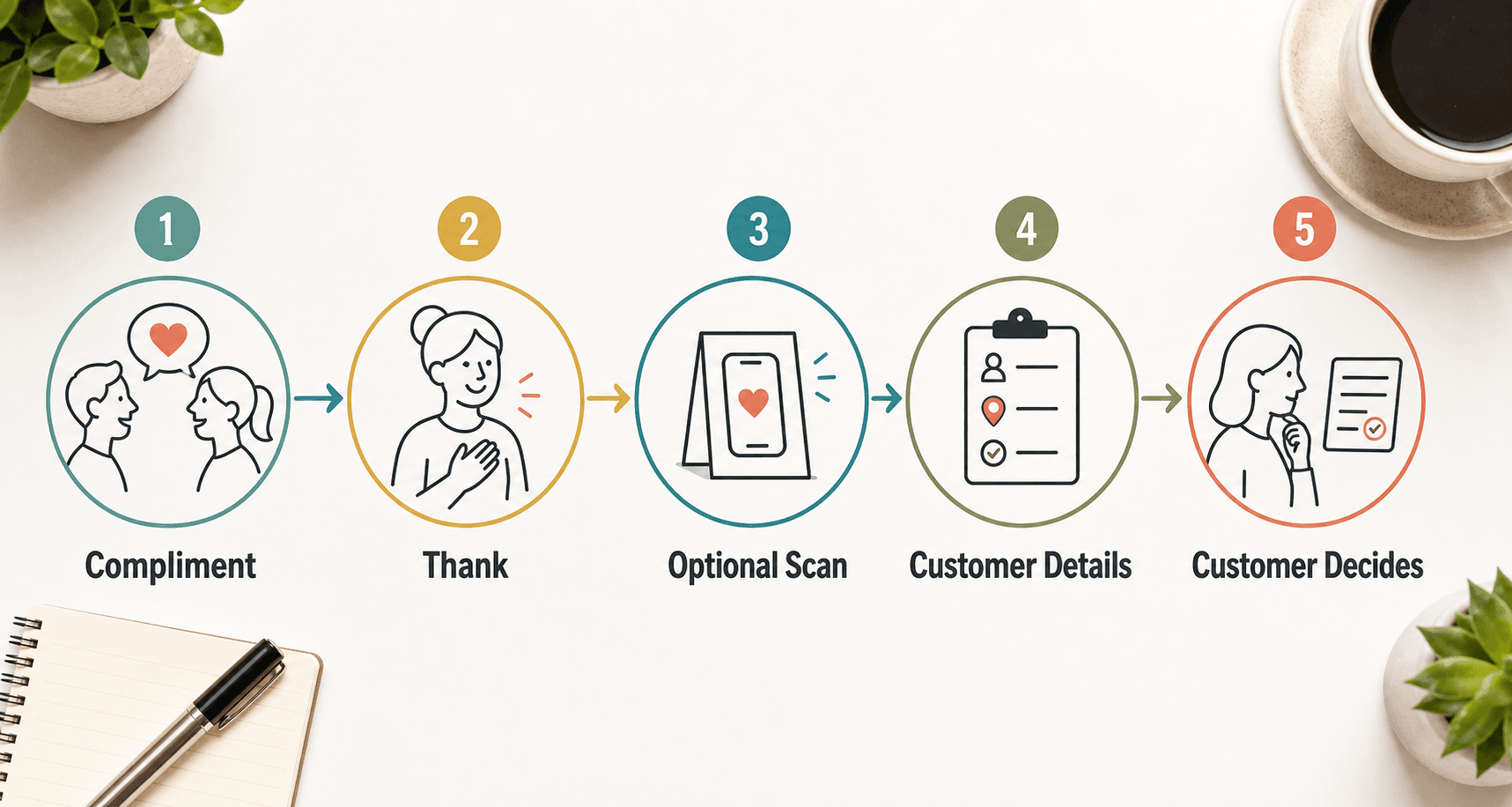
1. Hear the compliment clearly
Do not ask every customer in the same robotic way. Listen for a real positive signal:
- "The service was great."
- "This haircut is exactly what I wanted."
- "That class was really helpful."
- "The staff was so patient with my dog."
- "I am definitely coming back."
The compliment gives context. It also keeps the request tied to something the customer actually experienced.
2. Thank the customer before asking anything
Lead with appreciation. The customer gave you a small gift: honest praise in the moment. If you turn that immediately into a demand, the exchange can feel extractive.
Use language like:
- "I really appreciate you saying that."
- "That is great to hear, thank you."
- "I am glad the visit went well."
- "Thanks for telling us. That kind of feedback helps the team."
Then pause. If the customer continues the conversation, you can offer the review path. If not, do not force it.
3. Offer the review path as an option
The safest phrasing is short and neutral:
- "If you want to share that publicly, this review link makes it easy."
- "No pressure, but if you have a minute, you can scan this to share honest feedback."
- "If you would like, you can leave a review in your own words. It helps future customers decide."
- "You can skip it, of course. We just appreciate the feedback."
Avoid language that tries to control the outcome:
- "Can you leave us a five-star review?"
- "Make sure you mention my name."
- "Show me the review before you go."
- "You get a discount if you post it."
- "Only scan this if you are happy."
Google's Maps user-generated content policy says reviews should reflect a genuine experience, and it specifically warns merchants not to selectively solicit positive reviews, pressure users to write reviews on the premises, or request specific review content. Keep the invitation broad and voluntary.
4. Help customers remember details without writing for them
Many happy customers do not leave reviews because they do not know what to say. A blank review box can feel like work, especially on a phone.
The solution is not to hand them a script. It is to give them memory prompts they can accept, ignore, edit, or replace.
| Business type | Compliment you might hear | Neutral prompt you can offer |
|---|---|---|
| Restaurant | "The pasta was excellent." | "You can mention the dish, the service, or the atmosphere if that feels helpful." |
| Cafe | "The staff is always friendly." | "A quick note about the service or your usual order is enough." |
| Salon | "I love how the color turned out." | "You can share what you liked about the consultation or final result." |
| Gym | "That class was beginner-friendly." | "You can mention the coach, the pace, or what made it comfortable." |
| Pet service | "My dog was so calm afterward." | "You can share what made the visit feel safe or easy." |
These prompts are not review copy. They simply reduce the friction between a real compliment and a specific review.
When AI helps, keep it in the assistant role
AI can be useful after a compliment because it can turn rough customer input into a clearer draft. It should not invent the experience, choose the rating, post the review, or write from the business's point of view.
This is where Vibpost fits naturally. Vibpost is an AI marketing assistant for local businesses that uses a smart review QR code workflow, called a Seeding Code inside the product, to help customers turn real experiences into review drafts, social posts, testimonials, and video scripts. The customer starts from their own visit and selected keywords; AI helps organize the wording.
That distinction matters. Generic AI starts from a prompt. A customer proof workflow starts from a real customer moment.
In a compliment-based workflow, the AI step should follow four rules:
- Use the customer's own details as the source.
- Make the draft editable.
- Let the customer decide whether to post.
- Never imply the business is writing the review for them.
If the customer changes the wording, that is a good sign. It means the review still belongs to them.
Give staff a one-sentence script, not a sales pitch
Front-desk staff, servers, stylists, coaches, and checkout teams do not need a long review script. Long scripts sound unnatural and are hard to repeat during real service.
Give them one sentence they can adapt:
Thank you for saying that. If you want to share it in your own words, this code makes it easy, and it helps other customers know what to expect.
Then teach them when not to ask.
Do not ask when:
- the customer is in a hurry
- the customer has a complaint
- the customer looks uncomfortable
- staff would have to pressure them to scan
- the request would interrupt payment, tipping, or a private conversation
The goal is not to turn every compliment into a review. The goal is to make the natural moments easier to capture.
Keep unhappy feedback visible, not hidden
A review workflow becomes risky when it only works for happy customers. If a customer gives a mixed comment, a complaint, or a quiet signal that something went wrong, do not route them away from public review options just to protect your rating.
A better response is:
I am sorry that part did not go as expected. If you are open to it, I can share this with the manager, and you are also free to leave public feedback in your own words.
That approach respects the customer and protects the credibility of the review process. It also aligns with the broader direction of US review rules. The FTC's Consumer Reviews and Testimonials Rule, which went into effect on October 21, 2024, targets fake, false, or deceptive reviews and testimonials, including practices that suppress or distort honest feedback.
Private feedback can be useful. It should not become a filter that hides the public review path from people who are not fully happy.
Place the review path where the compliment naturally happens
The best placement depends on where customers usually say positive things.
For restaurants and cafes, compliments often happen at the table, at the register, or during pickup. A small counter card, receipt footer, or post-visit message can work. Avoid having staff stand over the customer while they write.
For salons, spas, and wellness businesses, compliments often happen after the final result or at checkout. A front-desk card or follow-up text can feel more comfortable than asking while the customer is still in the chair.
For gyms, classes, and education centers, compliments often happen after a session, milestone, or parent conversation. A follow-up message may give the customer more space than an in-person ask.
For pet services and local retail, compliments often happen at pickup or checkout. A simple "share your experience if you would like" card can work better than a long explanation.
The review path should be easy to find, but not impossible to avoid.
What to measure in the first week
Do not judge the workflow only by the number of new reviews. A better first-week test asks whether the process feels natural and trustworthy.
Track:
- how many staff members actually use the handoff
- which customer moments produce the least awkward asks
- how many customers scan or open the review path
- whether customers start but abandon the draft
- whether customers edit AI-assisted wording
- whether private feedback reveals unresolved service issues
- whether any staff member is asking for ratings, keywords, or incentives in the wrong way
If scans are low, the placement or timing may be wrong. If people scan but do not finish, the page may ask for too much. If staff avoid the script, rewrite it until it sounds like something a real person would say.
The most useful review workflow is one your team can repeat without feeling like they are begging for praise.
Compliment request FAQ
Is it okay to ask for a review after a customer compliments us?
Yes, if the request is optional, neutral, and based on a genuine customer experience. Thank the customer first, invite honest feedback, and leave the rating and wording to them.
Should staff ask for five-star reviews?
No. Ask for honest feedback, not a specific rating. A five-star request can make the customer feel pressured and can create policy risk.
Can we offer a discount for leaving a review?
Do not tie a discount, free item, loyalty points, or any other reward to posting, changing, or removing a review. Google treats incentives for reviews as fake engagement.
Can AI write the review for the customer?
AI can help draft wording from the customer's own experience and selected details, but the customer should stay in control. The customer should be able to edit, reject, or choose not to post.
What if a customer gives a compliment but seems busy?
Say thank you and let the moment end. A good review request should never interrupt the customer's experience or make them feel trapped.
Make the ask easy to accept and easy to decline
The least pushy review request is the one a customer can comfortably decline.
When a customer gives a real compliment, you have a useful moment. Do not waste it with a hard sell. Thank them, offer a simple optional path, help them remember specific details, and keep the final decision in their hands.
That is how a local business can turn private praise into public proof without sounding desperate, scripted, or manipulative.