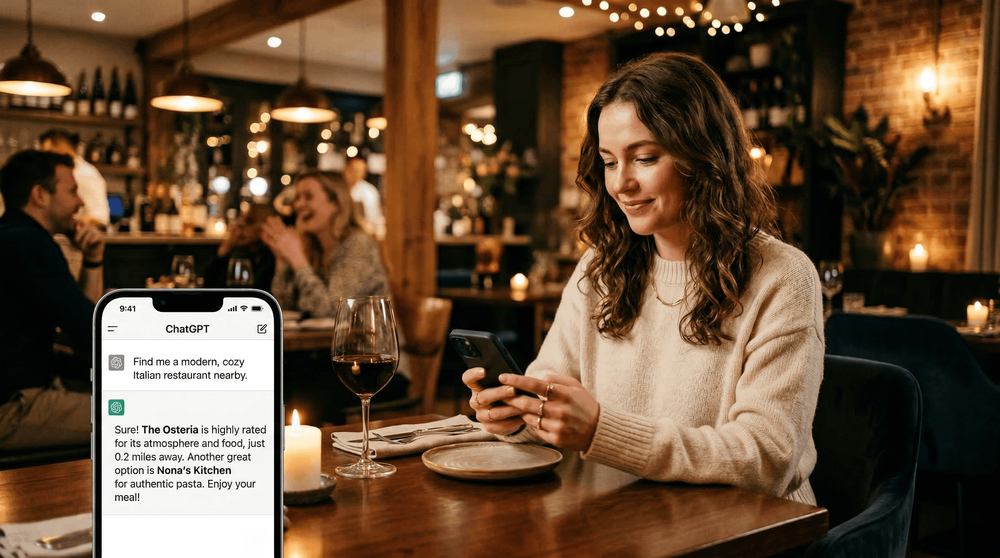
The Short Answer
If you want ChatGPT to recommend your restaurant, you need three things: a high volume of recent Google reviews, consistent business information across 60+ online platforms, and an active first-party website with structured data. Star ratings above 4.4 barely matter — review volume is what AI models care about.
Here's the data behind that claim, and exactly what to do about it.
AI Search Is Already Replacing Google for Restaurant Discovery
This isn't a prediction. It's already happening.
According to the Food Institute, 1 in 5 U.S. consumers now use AI tools like ChatGPT for venue discovery. Among Gen Z, that number hits 40% — they're asking chatbots for restaurant recommendations before they ever open Google Maps.
The shift matters because AI doesn't rank results the way Google does. There are no ads, no local pack, no SEO tricks. ChatGPT reads your entire digital footprint — reviews, website, business listings, social media mentions — and makes a judgment call about whether to recommend you.
If your digital presence is thin, you don't exist to AI search.
What ChatGPT Actually Looks At
A PRWeb research study analyzed which restaurants ChatGPT recommends and found a striking pattern:
- AI-recommended restaurants average 3,424 Google reviews
- Non-recommended comparable restaurants average 955 reviews
- Star ratings above 4.4 had minimal impact on recommendation likelihood
That's a 3.6x gap in review volume. The study suggests that review count — not rating — is the dominant signal in AI-powered restaurant discovery.
Where does ChatGPT actually pull its information from?
- 41.6% of citations come from third-party listings (Yelp, Google Business Profile, DoorDash)
- 39.8% come from first-party websites
- 13% come from reviews and social media
This tells you exactly where to focus your effort.
A Critical Detail Most Restaurants Miss
ChatGPT uses Bing's search index, not Google's.
Most restaurant owners spend all their time optimizing for Google and completely ignore Bing. But if your restaurant isn't properly indexed on Bing, ChatGPT literally cannot find you. This is the single easiest win most restaurants are leaving on the table.
Action step: Go to Bing Webmaster Tools and submit your website. It takes 10 minutes.
The 5-Step Playbook for AI Discoverability
1. Fix Your NAP Consistency
NAP stands for Name, Address, Phone number. When this information is identical across 60+ authority platforms — Google Business Profile, Yelp, TripAdvisor, Apple Maps, Foursquare, DoorDash — you build what the industry calls "Data Legitimacy."
AI models treat NAP consistency as a trust signal. If your phone number is different on Yelp than on Google, AI systems flag that inconsistency and may skip your restaurant entirely.
Audit your listings on these platforms first:
- Google Business Profile
- Yelp
- TripAdvisor
- Apple Maps
- Bing Places
- DoorDash / Uber Eats / Grubhub
2. Build Review Volume (Not Just Ratings)
The data is clear: volume matters more than perfection. A restaurant with 2,000 reviews at 4.3 stars will likely get recommended over a restaurant with 200 reviews at 4.8 stars.
The most effective strategy for building review volume is to ask at the point of experience — when the customer is still in your restaurant and the experience is fresh. QR codes on tables or receipts that link to a review workflow dramatically increase completion rates.
Tools like Vibpost automate this by letting customers scan a QR code, select keywords describing their experience, and generate a personalized review draft that they can edit and submit. This removes the biggest friction point: the blank text box.
3. Invest in Your Website
With nearly 40% of AI citations coming from first-party websites, your restaurant website isn't just a digital brochure — it's an AI citation source.
Your website should include:
- Unique location pages with embedded reviews, menus, hours, and NAP data
- Schema markup (LocalBusiness, Restaurant, Menu types)
- Fresh content — blog posts, seasonal menu updates, event announcements
- Fast load times — under 3 seconds
4. Get Listed Everywhere That Matters
Since 41.6% of AI citations come from third-party listings, being present on major platforms is non-negotiable. Don't just create the listing — keep it updated with current photos, hours, and menu links.
The platforms that matter most for AI citation:
- Google Business Profile
- Yelp (heavily weighted by AI models)
- TripAdvisor
- DoorDash / Uber Eats
- OpenTable / Resy
- Local food blogs and directories
5. Generate Fresh Content Regularly
AI models favor recency. A Malou.io analysis found that restaurants updating their online presence consistently see results within 2-3 months of starting. This includes:
- Responding to reviews (both positive and negative)
- Posting on social media with location tags
- Updating Google Business Profile posts weekly
- Publishing blog content on your website
What NOT to Do
Don't buy fake reviews. Google's AI detection is flagging and deleting reviews at unprecedented rates in 2026 — deletions surged 600% in the past year. Fake reviews will be caught and removed, potentially damaging your profile.
Don't keyword-stuff your business description. AI models are sophisticated enough to detect unnatural language patterns.
Don't ignore Bing. It's ChatGPT's source of truth. If you're not on Bing, you're invisible to the largest AI search engine.
The Timeline
Most restaurants see measurable changes in AI discoverability within 2-3 months of consistent optimization. This isn't an overnight fix, but the restaurants that start now will have a significant advantage over competitors who are still only thinking about traditional Google SEO.
How Vibpost Helps You Get Recommended by AI
Everything above boils down to two things: review volume and digital consistency. Vibpost is built to solve both — specifically for restaurants.
Build review volume on autopilot. Vibpost generates a branded QR code for your restaurant. Customers scan it at the table, select keywords like "amazing pasta" or "great service," and Vibpost's AI drafts a personalized review they can post to Google with one tap. No blank text box, no friction. Restaurants using this workflow report 3-5x more reviews per month.
AI-powered review responses. Vibpost's reply assistant drafts personalized responses to every review — positive and negative — in your brand voice. This keeps your response rate above 80% and signals to both Google and AI search engines that your business is active and engaged.
Multi-platform content from one visit. Every customer interaction also generates ready-to-post social media content and video scripts — feeding the fresh content signals that AI models use when deciding which restaurants to recommend.
Free to start. Vibpost offers a free tier with 50 AI generations per month. Paid plans start at /mo — a fraction of what platforms like Birdeye (/mo) or Podium (/mo) charge.
→ Create your free Vibpost account
FAQ
Does ChatGPT recommend restaurants in real time?
ChatGPT with browsing enabled can access current web data through Bing. Without browsing, it relies on its training data, which has a knowledge cutoff. For real-time recommendations, the browsing version pulls live data from Bing's index.
Do I need to pay to get recommended by AI?
No. There's no paid placement in AI recommendations. AI models recommend based on the quality and consistency of your digital footprint — reviews, listings, website content.
How important are Google reviews vs. Yelp reviews for AI?
Both matter, but differently. Google reviews contribute to your overall review volume signal, while Yelp listings are one of the most-cited third-party sources in AI responses. Optimize for both.
Can I track whether ChatGPT is recommending my restaurant?
Currently there's no official analytics tool for this. You can manually test by asking ChatGPT for recommendations in your category and area. Some reputation management platforms are beginning to add AI visibility tracking features.