

Podium vs Birdeye vs Vibpost for Small Local Businesses
If you run a small local business, the right review tool depends less on which platform has the longest feature list and more on what job you need the workflow to do.
Choose Podium if your biggest problem is missed leads, slow replies, calls, texts, appointments, and reviews that need to live in one customer conversation system. Choose Birdeye if you manage multiple locations and need a broader reputation suite for reviews, listings, social, responses, reporting, and local visibility. Choose Vibpost if you want a lighter smart review QR code workflow that helps real customers turn in-the-moment feedback into review drafts, testimonials, social posts, and other reusable proof without asking your staff to manage a heavy platform.
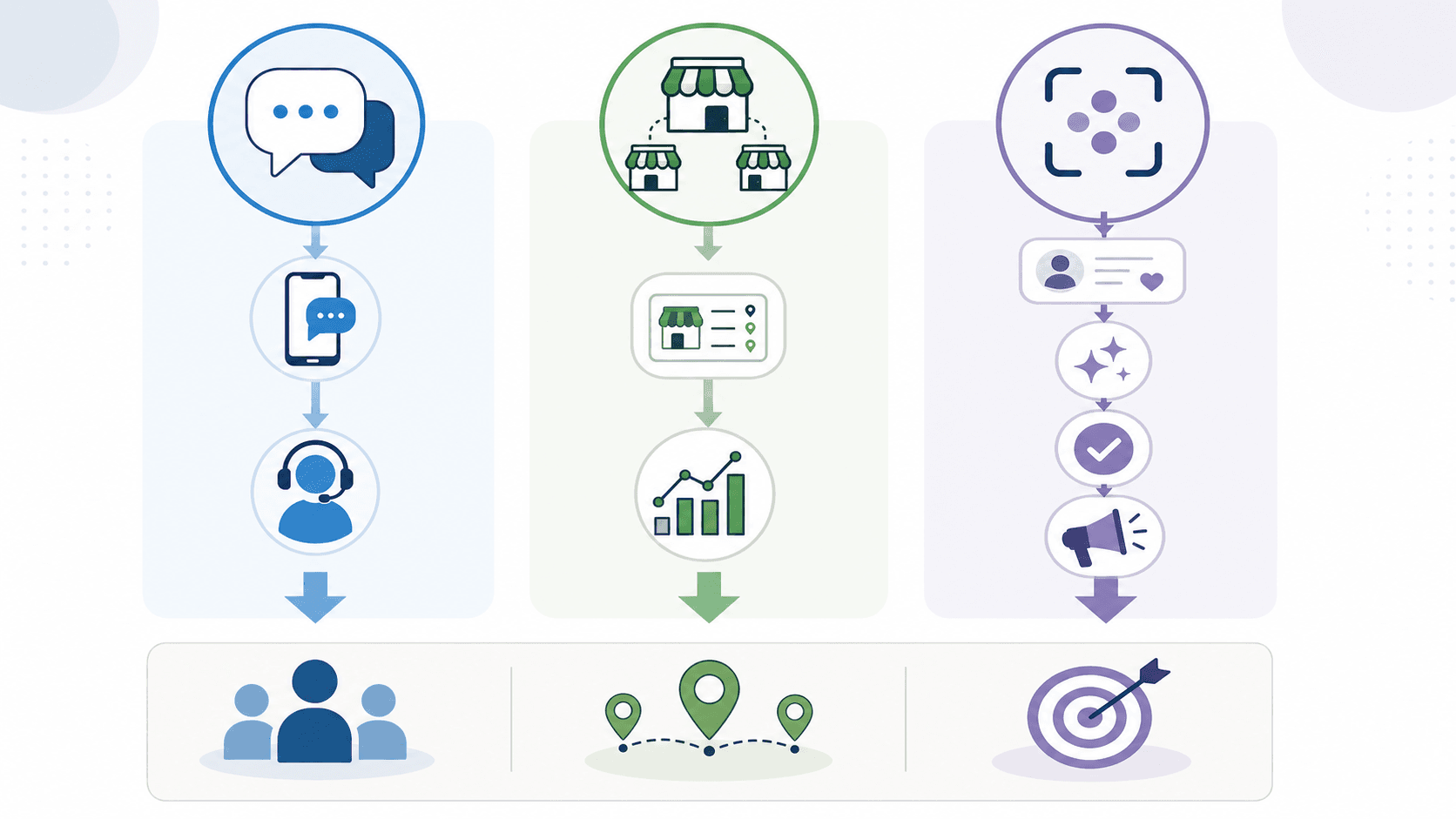
The practical difference is simple: Podium is strongest when reviews are part of lead conversion. Birdeye is strongest when reputation management needs scale across locations and sites. Vibpost is strongest when a local business wants to capture the customer moment before it disappears.
Compare the three options
| Tool | Best fit | Main workflow | Strongest when | Watch out for |
|---|---|---|---|---|
| Podium | Local service, retail, automotive, med spa, and appointment-based teams that depend on fast customer conversations | AI-assisted calls, texts, inbox, lead conversion, appointments, review requests, and review responses | You need to respond quickly, book more conversations, and keep customer communication centralized | It may be more platform than you need if you only want a simple customer proof capture flow |
| Birdeye | Multi-location brands, franchises, clinics, agencies, and operators managing reputation across many sites | Reviews, review response, listings, social, messaging, insights, and AI-assisted reputation workflows | You need location-level consistency, reporting, listing management, and broad reputation coverage | It can feel heavy for a single shop that mainly needs a review request and content reuse workflow |
| Vibpost | Restaurants, cafes, salons, spas, retail stores, gyms, pet shops, education centers, and other small teams without a full-time marketer | Smart review QR code, customer keyword selection, AI-assisted review draft, testimonial, social post, or video script | You want to turn real customer moments into reusable proof at the point of experience | It is not a full enterprise reputation suite or an automatic posting system |
For a one-location cafe, salon, spa, or boutique, the best first question is not "Which tool has the most features?" It is "Where do we lose the customer signal?"
If customers contact you but your team misses calls or texts, start by looking at a lead conversion platform. If customers already leave reviews across many locations but you cannot manage the volume, look at a reputation suite. If happy customers say nice things in person but never turn that moment into a review or social proof, a customer-moment workflow may be the better fit.
Where Podium fits
Podium is a better fit when reviews are part of a larger customer communication problem.
Its current product positioning centers on AI-assisted lead conversion, customer messaging, calls, web chat, inbox workflows, appointments, and review management. Podium's own review product page describes review invites, review reminders, an all-in-one inbox, reporting, contact profiles, and AI-assisted review invitations and responses.
That matters for businesses where the review request is not isolated. A home services company may need to answer calls, book jobs, text customers, collect payments, follow up, and ask for a review after service. A retailer may need to capture inbound questions, route them into one inbox, respond quickly, and keep the customer engaged before and after a visit.
Podium is usually worth evaluating when:
- Your business gets many leads through calls, texts, forms, chat, or third-party channels.
- Missed response time is a bigger pain than content creation.
- You need staff to work from one inbox.
- You want review requests connected to customer profiles and conversations.
- Appointments, sales follow-up, or customer messaging are part of the same operating workflow.
For a very small business, the tradeoff is scope. If your only goal is to make it easier for happy customers to turn a visit into a review or social proof, a full lead conversion platform may be more system than you need. If your staff already struggles with tools, adding a broad conversation platform can create more setup work before it creates value.
Where Birdeye fits
Birdeye is a better fit when reputation management has become an operating system across locations.
Birdeye's current Reviews AI page positions the product around review generation, review management, review marketing, review insights, listings, and AI agents for reputation workflows. Its broader site also emphasizes local listings, review responses, social, search, web, and multi-location brand management.
That makes Birdeye a strong candidate for businesses that need consistent reputation operations across several locations, service lines, or review sites. A dental group, multi-location wellness chain, automotive group, or franchise operator may care less about one QR code at the counter and more about standardizing location listings, monitoring review volume, responding consistently, and reporting across every branch.
Birdeye is usually worth evaluating when:
- You operate multiple locations.
- You need centralized dashboards and location-level reporting.
- Reviews, listings, social, messaging, and insights need to connect.
- You need help responding to reviews at scale.
- You want a broader reputation platform rather than a narrow review request tool.
The tradeoff is complexity. A single-location restaurant, cafe, or salon may not need a multi-location reputation suite on day one. If the real gap is "customers say nice things but do not write them down," a lighter workflow may reach the first useful outcome faster.
Where Vibpost fits
Vibpost is a better fit when the main problem is capturing customer proof at the moment it happens.
Vibpost is an AI marketing assistant for local businesses. It uses a smart review QR code workflow, called a Seeding Code inside the product, to help customers turn real experiences into review drafts, social posts, testimonials, and video scripts.
The difference is where the workflow starts. Podium often starts from inbound communication and lead conversion. Birdeye often starts from reputation management across review sites and locations. Vibpost starts from the customer moment itself: the meal just finished, the haircut looks good, the spa visit ended, the class went well, the shopper found something they loved, or the pet owner had a good experience.
A typical Vibpost flow looks like this:
- The business creates a smart review QR code for a store, table, receipt, counter sign, or follow-up touchpoint.
- The customer scans the code after a real visit.
- The customer chooses experience-based keywords, such as service, atmosphere, quality, staff, cleanliness, or value.
- AI helps turn those inputs into a review draft, testimonial, social post, or video script.
- The customer or business reviews the output before it is published, shared, or reused.
This is useful for small teams because it does not require a full-time marketer to chase every compliment. The goal is not to create fake praise. The goal is to help a real customer express a real experience while the memory is still fresh.
Vibpost is usually worth evaluating when:
- Customers often give verbal compliments that never become public proof.
- Staff do not have time to write posts, testimonials, or review prompts manually.
- You want a customer-friendly scan flow instead of a blank review link.
- You want customer-selected details before AI assists with drafting.
- You need reusable proof for reviews, social posts, testimonials, or video scripts.
The tradeoff is category scope. Vibpost is not positioned as a full review-site monitoring suite, a listings management platform, a call center, or a sales inbox. If you need those systems first, Podium or Birdeye may be a better starting point.
The decision framework: team size, location count, and workflow goal
For small local businesses, the choice becomes clearer when you separate three questions.
1. How much team capacity do you have?
If one owner or manager handles everything, simplicity matters. A tool that requires heavy setup, dashboards, campaigns, and cross-location governance may not fit the way the business actually operates.
If you already have front desk staff, a marketing coordinator, a location manager, or an agency partner, a broader platform may be easier to maintain. Podium can make sense when customer conversations already need structure. Birdeye can make sense when reputation data and responses already need central management.
For a lean local shop, Vibpost's advantage is that the workflow can be placed where the customer already is: the table, counter, receipt, appointment checkout, or follow-up message.
2. How many locations do you manage?
A single-location business usually needs repeatable behavior before it needs a complex reputation stack. The first milestone is often simple: ask at the right moment, make the action easy, collect useful detail, and keep the customer in control.
A multi-location business has a different problem. It needs consistency across stores, reporting by location, brand-safe responses, listing accuracy, and team accountability. That is where a platform like Birdeye becomes more relevant.
Podium sits between those use cases when the location's biggest bottleneck is communication: too many calls, too many text threads, too many missed appointment opportunities, or too much customer follow-up scattered across channels.
3. What do you want the review workflow to produce?
If you only want more review requests, many tools can send links. If you want a broader customer communication system, Podium is the more relevant comparison point. If you want a reputation platform across review sites and listings, Birdeye is the stronger lane. If you want to turn a real visit into a review draft, a testimonial, a social post, or a video script, Vibpost is closer to the job.
This matters because reviews are not just a count. A useful review usually contains specifics: what the customer bought, what service they received, what felt good, what problem was solved, and why someone else might trust the business.
A blank review link asks the customer to invent that detail from memory. A smart customer proof workflow gives the customer a lighter path: choose the details that match their real experience, then review the draft before using it.
Review compliance should shape the tool choice
Any review workflow must protect authenticity. This is not just a nice-to-have; it is a platform and trust boundary.
Google's Business Profile policies say contributions should reflect a genuine experience, and the fake engagement policy covers review activity that manipulates ratings or misrepresents a real experience. The FTC's consumer reviews and testimonials guidance also draws a clear line around fake reviews, misleading testimonials, undisclosed incentives, and review suppression.
That means a safe workflow should avoid:
- Writing reviews for customers without customer participation.
- Asking only happy customers to leave public reviews while routing unhappy customers elsewhere.
- Offering incentives only for positive reviews.
- Suppressing negative feedback to create a misleading impression.
- Publishing AI-generated testimonials as if they came from real customers.
- Claiming a customer said something they did not actually say.
The safer pattern is:
- Ask every eligible customer in a neutral way.
- Let the customer decide whether to leave a public review.
- Use AI only to help express the customer's own experience.
- Keep the customer or business in control of final approval.
- Reuse testimonials and social proof only with proper context and consent.
This is where Vibpost's customer keyword step matters. A customer selects the details before the draft is created. That does not automatically make every use compliant, but it creates a better starting point than generating praise from nothing.
For Podium and Birdeye, the same principle applies. Review automation is useful only when it supports real customer feedback. If a setup filters, gates, pressures, or manipulates reviews, the workflow becomes risky no matter which tool is used.
Which one should a small business choose first?
Use this practical rule:
- Choose Podium first if customer conversations are your bottleneck.
- Choose Birdeye first if multi-location reputation management is your bottleneck.
- Choose Vibpost first if capturing real customer proof at the point of experience is your bottleneck.
For a single-location restaurant, cafe, salon, spa, gym, or boutique, Vibpost is often the most direct fit when the team wants to capture more usable customer language without hiring a marketer. The owner can place a smart review QR code at the moment of service, let customers choose what they actually experienced, and turn that feedback into review drafts or social proof assets.
For a home services company, dealership, furniture retailer, med spa, or other business where leads arrive through many channels and speed-to-response matters, Podium deserves a close look because reviews sit inside a broader communication system.
For a dental group, franchise, healthcare group, multi-location retailer, or agency managing reputation at scale, Birdeye deserves a close look because the review workflow is only one part of a larger reputation, listings, insights, and social operation.
The mistake is buying a platform for a future operating model you do not have yet. A two-person local business does not need the same reputation stack as a 50-location brand. A multi-location brand should not rely on a casual QR sign and a spreadsheet. The right tool is the one your team can actually run every week.
A simple buying checklist
Before choosing between Podium, Birdeye, Vibpost, or any other review tool, answer these questions:
- What moment should trigger the review request?
- Who controls the final customer language?
- Can unhappy customers give private feedback without being blocked from public review options?
- Does the tool support the channels your customers already use?
- Does the workflow fit your staff's daily routine?
- Can you measure whether requests, scans, drafts, and published proof are improving over time?
- Does the platform solve today's bottleneck or only add features?
- Will the vendor explain current pricing, contract terms, onboarding work, integrations, and cancellation terms clearly before you commit?
Do not buy based only on a demo that shows the best possible version of the system. Ask what your first week will look like. Ask what staff must do every day. Ask what happens when a customer leaves critical feedback. Ask whether AI drafts are reviewed by the customer or your team before publication.
A practical setup for a small local business
If you are still unsure, start with the smallest workflow that can prove value without creating compliance risk.
For a restaurant, this might mean placing a smart review QR code on a table tent or receipt and asking staff to use a neutral line: "If you would like to share feedback about your visit, this code makes it easy." Customers who scan can choose what matched their experience and decide whether to turn it into a review or social post.
For a salon, the same workflow can happen at checkout after the appointment. Instead of asking the customer to write a polished review from scratch, the flow can help them turn details like haircut, color, stylist care, timing, cleanliness, or atmosphere into a draft they can review.
For a gym, spa, pet shop, or education center, the core idea is the same: capture the customer moment while it is fresh, use AI to reduce writing friction, and keep final control with the customer or business.
If that lightweight workflow works and your business later needs a larger communication or reputation system, you can evaluate broader platforms with clearer requirements. If the first problem is already missed leads or multi-location governance, start with Podium or Birdeye instead.
FAQ
Is Vibpost a Podium or Birdeye replacement?
Not exactly. Vibpost is not a full lead conversion platform like Podium and not a full multi-location reputation suite like Birdeye. It is better understood as a smart review QR code and customer proof workflow for local businesses that want to turn real customer experiences into review drafts, social posts, testimonials, and video scripts.
Is Podium better than Birdeye?
Podium is better when customer communication, lead response, inbox, appointments, and review requests need to work together. Birdeye is better when the business needs a broader reputation platform across reviews, listings, responses, social, and multi-location reporting. Neither is automatically better for every small business.
Is Birdeye too much for a single-location business?
It can be, depending on the business. A single-location shop with a dedicated manager, many review sites, and a serious reputation workflow may still benefit from a broad suite. But a small team that only needs to capture customer feedback after a visit may get to value faster with a lighter workflow.
Can AI help customers write reviews safely?
AI can help reduce writing friction, but the review should still reflect the customer's genuine experience. The safer workflow uses customer-selected details, clear approval, and no pressure to say something positive. Businesses should avoid fake reviews, review gating, undisclosed incentives, and review suppression.
What is the best first step for a local business?
Map the customer moment first. Decide when a customer is most likely to have useful feedback, how staff can ask without pressure, and what the customer should be able to create from that feedback. Once that workflow is clear, the tool choice becomes much easier.