

Review Gating: What It Is, Why It Hurts Local Trust, and How to Ask Fairly
Let's talk about a review shortcut that can hurt a local business more than a handful of one-star reviews: review gating.
You have probably seen the workflow. A customer finishes dinner, a haircut, a spa visit, a gym class, or a retail purchase. The business sends a quick satisfaction question first. Customers who sound happy get the public review link. Customers who sound unhappy get sent to a private feedback form.
At first glance, it feels efficient. Praise goes public. Complaints go private. The Google Business Profile looks cleaner. The average rating looks safer.
That is exactly the problem.
Review gating does not build trust. It filters trust. It gives future customers a review profile that looks more controlled than earned, and it can put the business on the wrong side of platform rules and consumer review expectations.
The safer path is not to stop asking for reviews. The safer path is to ask every real customer fairly, keep the request neutral, avoid rewards or pressure, and make it easier for customers to turn a genuine experience into useful feedback in their own words.
Here is what local businesses need to know about review gating, why it is risky, and how a smart review QR code workflow can support honest review requests without filtering customers.
Key Takeaways
- Review gating means filtering customers based on sentiment before giving them a public review path.
- Google does not allow merchants to discourage negative reviews or selectively solicit positive reviews.
- The FTC's Consumer Reviews and Testimonials Rule makes deceptive review practices and review suppression a serious compliance issue.
- The Fashion Nova settlement showed how expensive review suppression can become when a business hides lower-rated feedback.
- Private feedback is useful, but it should not replace the customer's equal opportunity to post publicly.
- A compliant review request workflow asks everyone, keeps the language neutral, avoids incentives, and lets the customer choose what to publish.
- Vibpost can fit this safer approach when it is used to help real customers turn real experiences into review drafts, social posts, testimonials, or video scripts, not to manufacture praise.
What Review Gating Actually Is
Review gating is the practice of filtering customer feedback so that positive customers are encouraged to leave public reviews while unhappy customers are redirected, delayed, or kept in a private channel.
The simple test is this:
If a customer's access to the public review option depends on whether they seem satisfied, the workflow may be review gating.
It does not matter whether the business calls it a "satisfaction survey," "customer recovery flow," "experience check," or "feedback routing." If happy customers get the Google review link and unhappy customers do not, the business is treating public review access as a reward for positive sentiment.
That creates a misleading review profile. Future customers are not seeing a fair picture of real experiences. They are seeing a filtered version of the happiest experiences.
The Most Common Review Gating Tactics
Most businesses do not set out to deceive customers. Review gating usually starts as a small operational shortcut.
These are the patterns to avoid:
- Asking "Were you satisfied?" before showing the public review link.
- Showing Google review links only to customers who select four or five stars in a private survey.
- Sending dissatisfied customers only to customer support while sending satisfied customers to public platforms.
- Training staff to ask for reviews only when a customer seems happy.
- Asking customers to leave a review only after they say something positive in person.
- Using software rules that hide the public review option after negative feedback.
- Offering a reward only if the customer leaves a positive review or changes a negative one.
The risky part is not private feedback itself. A local business should want to hear complaints early. The risky part is using that private feedback to decide who gets a fair public review opportunity.
Why Review Gating Violates Google Review Expectations
Google's Maps user-generated content policy is built around genuine experience, unbiased content, and rating manipulation prevention. In practical terms, merchants should not buy reviews, pressure customers, request specific content, discourage negative reviews, or selectively ask for positive reviews.
That means a review request should be:
- Based on a real customer experience.
- Voluntary.
- Neutral about rating and wording.
- Available to customers without sentiment filtering.
- Free of discounts, gifts, payments, or review-conditioned perks.
A safe message sounds like this:
If you would like to share honest feedback about your visit, this link makes it easy.
A risky message sounds like this:
If everything was perfect, please leave us five stars.
The first gives the customer control. The second steers the outcome.
The same rule applies to QR codes. A QR code at checkout, on a table tent, on a receipt, or in a follow-up message can be useful. But the QR code should not be shown only to customers who appear happy, and it should not be paired with a reward for praise.
The FTC Made Review Suppression More Serious
Review gating is not only a platform issue. It also overlaps with the broader consumer protection problem of review suppression.
The FTC's Consumer Reviews and Testimonials Rule, which went into effect on October 21, 2024, addresses deceptive and unfair conduct involving consumer reviews and testimonials. The rule allows courts to impose civil penalties for knowing violations, and FTC guidance specifically discusses fake reviews, sentiment-conditioned incentives, insider reviews, and review suppression.
For a local business owner, the lesson is simple: do not make your public review profile look more representative than it is.
If a business collects reviews or testimonials, customers should not be misled into thinking the visible feedback represents all or most customer opinion when negative feedback has been filtered, hidden, or discouraged.
That is why review gating is so dangerous. It does not just ask for reviews. It changes which voices are allowed to become visible.
The Fashion Nova Case: Why Local Businesses Should Pay Attention
Fashion Nova is not a neighborhood restaurant, salon, or pet shop. It is a major online retailer. But the FTC's Fashion Nova case matters because it shows how regulators view hidden negative feedback.
The FTC said Fashion Nova suppressed lower-rated reviews and gave shoppers a misleading picture of customer opinion. The settlement required the company to pay $4.2 million and stop misrepresenting customer reviews.
Small businesses should not read that case and think, "That only happens to big companies."
The better takeaway is this: a filtered review system can make a business look more trustworthy in the short term while making the review profile less trustworthy in reality. Whether the business is a national retailer or a local spa, the underlying issue is the same.
Do not hide the feedback that future customers would reasonably expect to see.
How Review Gating Gets Exposed
You do not need to know the inside of any platform's detection system to understand why review gating is fragile.
The pattern often reveals itself in ordinary ways:
- Customers notice that they were sent to a private form while happier friends were sent to Google.
- Staff members repeat risky scripts because managers told them to ask only happy customers.
- Review patterns look unusually polished, clustered, or one-sided.
- A third-party tool's routing logic becomes visible during a complaint.
- A customer, employee, competitor, or former vendor reports the workflow.
Even if no platform action happens immediately, the trust cost begins as soon as customers feel the business is controlling who gets heard.
Perfect-looking reviews can make a business look less believable. A healthy local review profile usually includes detail, variation, and the occasional complaint handled professionally. Real businesses have real operating days.
The Real Cost of Review Gating
The supposed benefit of review gating is a cleaner rating.
The cost is much larger:
- Customers may lose trust if they realize feedback was filtered.
- Staff may learn to chase ratings instead of fixing service issues.
- Negative experiences may stay hidden until they become public complaints.
- Public reviews may become less representative and less useful.
- Platform or regulatory problems may become harder to unwind later.
- The business may miss the operational insight that negative feedback provides.
Review gating treats criticism as a visibility problem. Most of the time, criticism is an operations signal.
If three customers mention slow service on weekends, the answer is not to hide weekend complaints. The answer is to examine staffing, prep time, table turnover, appointment spacing, or communication.
Filtered praise does not fix the business. Honest feedback can.
What About Private Feedback Routing?
This is where many owners get confused.
Private feedback routing is not automatically review gating. A business can collect private feedback, follow up with unhappy customers, and improve service. In fact, that is often responsible customer care.
The difference is access.
Compliant private feedback routing looks like this:
- Ask every customer for honest feedback.
- Give every customer the same neutral entry point.
- Let customers share private comments if they want help.
- Let customers choose whether to post publicly.
- Follow up on problems without asking customers to remove or change truthful reviews.
- Do not hide the public review path based on sentiment.
Review gating looks like this:
- Ask customers how happy they are.
- Send happy customers to Google.
- Send unhappy customers somewhere private.
- Make the public path harder to find after negative feedback.
The difference is not cosmetic. In one workflow, the customer controls the choice. In the other, the business controls visibility.
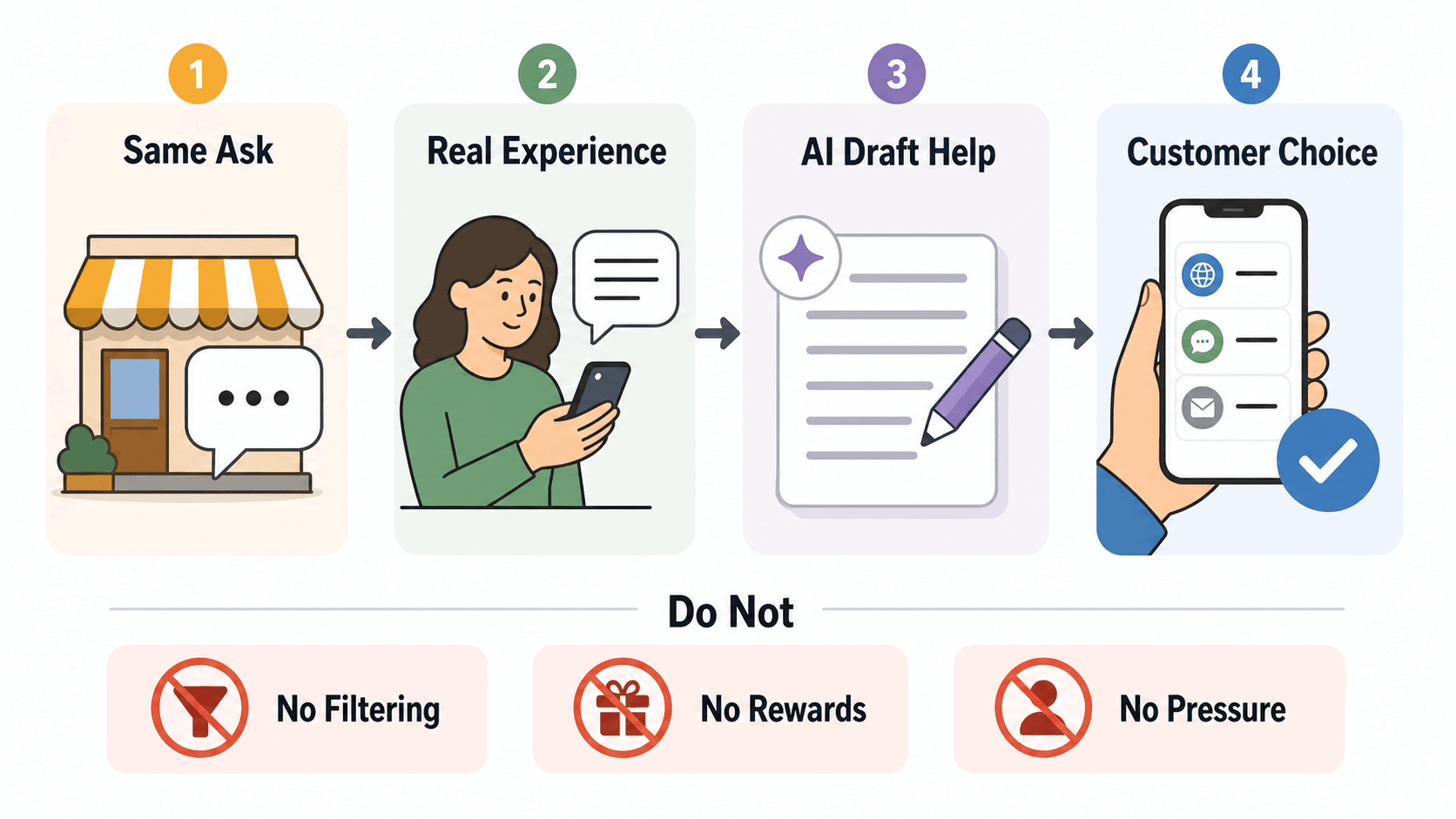
The Compliant Alternative That Actually Works
The answer is not to stop asking for reviews. Reviews help local customers make decisions, and real customer feedback helps a business improve.
The answer is to build a fair review request workflow.
1. Ask Everyone, Not Just the Happiest Customers
Make review requests part of a standard customer journey.
That could mean a table tent, a checkout card, a receipt link, a post-visit text, or an email after service. The important part is consistency. Do not let staff decide who "deserves" to see the request.
Use language like:
- "We welcome honest feedback about your visit."
- "Your experience helps us improve."
- "If you would like to share your thoughts publicly, this makes it easy."
Avoid language like:
- "Please leave five stars."
- "Only scan this if you loved the visit."
- "Show us your review for a discount."
2. Keep the Customer's Real Experience at the Center
A strong review request does not script the review. It helps the customer remember and describe what happened.
Good prompts ask about real details:
- What stood out about your visit?
- What did our team help you with?
- What would you tell a friend who is considering us?
- Was there anything we should improve?
Bad prompts try to control the answer:
- Say we are the best in town.
- Mention our employee by name.
- Write that everything was perfect.
- Leave a positive review to support us.
If AI is involved, it should help organize the customer's own input. It should not invent the experience.
3. Make Feedback Easy Without Making It Manipulative
Friction matters. Many happy customers do not leave reviews because they are busy, unsure what to write, or tired of typing on a phone.
A fair workflow can reduce that friction:
- Use a mobile-friendly review request.
- Keep the ask short.
- Let customers choose experience-based keywords.
- Help customers turn their own words into a clearer draft.
- Let them edit, ignore, or publish the result.
- Give the same opportunity regardless of sentiment.
This is where Vibpost can fit naturally. Vibpost is an AI marketing assistant for local businesses that uses a smart review QR code workflow, called a Seeding Code inside the product, to help customers turn real experiences into review drafts, social posts, testimonials, and video scripts.
Used correctly, the value is not "more positive reviews at any cost." The value is a repeatable customer proof workflow: a real customer moment, a scan, customer-selected keywords, AI-assisted wording, and customer choice.
4. Separate Service Recovery From Review Filtering
If a customer is unhappy, the business should respond. That is not gating. That is service.
The boundary is this: support should not be used to block public feedback.
Safe approach:
- "I am sorry that happened. Please contact us so we can help."
- "You are welcome to share honest feedback, and we also want a chance to fix the issue."
- "There is no pressure to post or remove anything."
Risky approach:
- "Do not leave a review until we fix this."
- "We will refund you if you remove the review."
- "Use this private form instead of posting publicly."
Good service recovery can prevent some negative reviews because customers feel heard. But the customer should still control whether they post.
5. Train Staff on What Not to Say
Many review problems do not come from the tool. They come from the script.
A manager says, "We need more reviews." A staff member hears, "Ask only the happy customers." A cashier says, "Can you leave five stars and mention my name?" The workflow becomes risky in one sentence.
Give staff simple boundaries:
- Ask neutrally.
- Do not ask for a rating.
- Do not ask for specific wording.
- Do not offer rewards for reviews.
- Do not pressure customers on the premises.
- Do not decide who gets the review option based on mood.
The best staff script is short:
If you would like to share honest feedback about your experience, this makes it easy. It is completely up to you.
A Safer Smart Review QR Code Workflow
A local business can use QR codes and AI assistance without review gating if the workflow is designed around fairness.
Here is a safer structure:
- Place one neutral QR-based feedback entry point in the customer journey.
- Invite customers to share honest feedback, not positive feedback.
- Ask them to choose keywords that match their real experience.
- Offer AI-assisted draft help based on those inputs.
- Let the customer edit, reject, or use the draft.
- Give every customer the same public review option.
- Collect private operational feedback without hiding the public path.
- Review feedback themes internally to improve service.
For a restaurant, this could happen after the meal. For a salon, after checkout. For a gym, after a class. For a pet shop, after a grooming visit. For a retail boutique, after purchase.
The workflow should feel like an invitation, not a filter.
Bottom Line: Fair Review Requests Beat Filtered Praise
Review gating is tempting because it promises a cleaner public profile. But a cleaner profile is not the same as a more trustworthy business.
Short term, gating may make ratings look better.
Long term, it can weaken trust, distort feedback, train staff into risky behavior, and create compliance problems that are much harder to fix than an honest negative review.
The better path is straightforward:
- Deliver service worth talking about.
- Ask every real customer fairly.
- Make the review process easy.
- Let customers stay in control.
- Respond professionally when something goes wrong.
- Use AI only to help express real experiences, not to manufacture them.
Vibpost is useful when it supports that path. It helps local businesses turn real customer moments into reusable proof through review drafts, social posts, testimonials, and video scripts. It should not be used to gate unhappy customers, buy praise, or promise ranking gains.
Build a review workflow that future customers can trust. The reviews that come from it will be more useful because they are earned, not filtered.
Frequently Asked Questions
What is review gating?
Review gating is filtering customers based on sentiment before giving them a public review option. If happy customers get the Google review link and unhappy customers get routed only to a private form, the business is gating reviews.
Is it okay to ask customers for reviews?
Yes. A local business can ask customers for honest reviews. The request should be neutral, voluntary, based on a genuine experience, and not tied to incentives or pressure.
Can I ask for private feedback first?
You can collect private feedback, but do not use it to decide who gets a public review path. Every customer should have an equal opportunity to post publicly if they choose.
Can I use a QR code for review requests?
Yes. A QR code can reduce friction for in-person businesses. The safer approach is to use the same neutral QR-based entry point for customers, not a code shown only to customers who seem happy.
Can AI help customers write reviews?
AI can help customers turn their own real experience into clearer wording. It should not invent visits, create fake praise, write on behalf of customers without their input, or pressure customers to publish.
What should staff say when asking for feedback?
Keep it neutral: "If you would like to share honest feedback about your experience, this makes it easy. It is completely up to you." Do not ask for five stars, specific keywords, employee names, or proof of posting.
How does Vibpost avoid the review gating problem?
Vibpost should be used as a smart review QR code workflow for real customer moments. Customers scan, choose experience-based keywords, receive AI-assisted draft help, and remain in control of whether to edit, publish, or discard the content. The workflow should ask fairly instead of filtering by sentiment.