

Review Request Workflows: What Local Businesses Must Know Before Asking for Google Reviews
Google reviews can shape how a local business is discovered, trusted, and chosen. A restaurant with thoughtful, recent feedback feels less risky to a first-time diner. A salon with detailed customer comments gives new clients more confidence before they book. A neighborhood service business with authentic reviews can look more established than a competitor with a thinner profile.
But review growth only helps when the reviews are earned in a way customers and platforms can trust. Many business owners do not set out to break a rule. They add a survey before the review link, offer a small discount, ask only the happiest customers, or let staff push for five stars because they are trying to make the process work. That is exactly where review gating and incentive problems begin.
This guide explains how to request reviews without weakening trust. It covers what Google does not allow, why review gating is risky, how incentives change the meaning of customer feedback, what staff should and should not say, how to handle negative reviews, and how a smart review QR code workflow can help local teams ask for honest feedback without filtering customers.
Google Review Policy Basics for Local Businesses
Google's review rules are built around one idea: reviews should reflect real customer experiences. That sounds simple, but it affects almost every part of a local review request workflow.
The safest review program is neutral, voluntary, and experience-based. It does not buy praise, hide criticism, pressure customers, or tell people what to write. It makes the feedback path easier without controlling the outcome.
Fake or Manipulated Reviews
Fake reviews are not only reviews written by bots or review farms. A fake or manipulated review can also come from someone who never had a real customer experience, someone pretending to be a customer, or a coordinated effort designed to push a rating up or down.
For a local business, that means:
- Do not buy reviews.
- Do not ask employees, friends, or family to pose as customers.
- Do not use AI to fabricate customer experiences.
- Do not ask customers to describe something that did not happen.
- Do not run campaigns that create unusual bursts of similar-looking reviews.
AI can help a real customer put their experience into clearer words, but it should not invent the experience. The customer's actual visit, purchase, service appointment, or interaction has to remain the source.
Off-Topic or Irrelevant Reviews
A review should be about the specific business and the customer's real interaction with it. Reviews about a different location, a political dispute, an industry complaint, or a personal conflict unrelated to the business experience can create problems.
This matters when staff ask customers for feedback. A good prompt invites the customer to describe what happened during their visit. A risky prompt pushes customers toward generic praise, slogans, or content that is not really about the experience.
Safe prompt:
What stood out about your visit today?
Risky prompt:
Please say we are the best restaurant in town.
The first gives the customer room to be truthful. The second tries to script the review.
Conflicts of Interest
Reviews lose credibility when the reviewer has a hidden relationship with the business. Current employees, managers, owners, vendors, competitors, and family members are not the same as ordinary customers. Even when they genuinely like the business, the relationship can make the review misleading.
The safer rule is straightforward: public review requests should go to real customers, not insiders. If an owner wants team members to support the business, ask them to improve service, respond professionally, and create better customer moments, not to post reviews.
Incentives and Pressure
Google's Maps user-generated content policy tells merchants not to offer incentives in exchange for reviews, discourage negative reviews, or selectively solicit positive reviews. It also warns against pressuring users to leave ratings while they are on the premises or asking them to include specific content.
For a local operator, this turns into a practical boundary:
- You can ask for honest feedback.
- You can make the review path easier.
- You can thank a customer for visiting.
- You should not reward the review action.
- You should not filter who gets the review link.
- You should not ask for specific ratings, keywords, or employee names.
The difference is not legal trivia. It changes whether a future customer sees the review as honest social proof or as a business-controlled marketing asset.
Review Gating: What It Is and Why It Creates Risk
Review gating is the practice of screening customers before sending them to a public review platform. It usually looks harmless at first.
A business sends a satisfaction survey. Happy customers are sent to Google. Unhappy customers are sent to a private feedback form. The owner thinks they are being efficient: public praise goes public, complaints go internal.
That is the problem. The workflow filters who gets the chance to leave a public review. It discourages negative reviews and selectively solicits positive ones, even if the business never uses those exact words.
What is allowed:
- Asking every customer for honest feedback.
- Giving every customer the same review option.
- Sending a review link after a completed visit without checking sentiment first.
- Using signage, receipts, email, or text as long as the request is neutral.
- Inviting unhappy customers to contact the business, without hiding the public review option.
What is not allowed:
- Sending only satisfied customers to Google.
- Asking "Were you happy?" before showing the public review link.
- Routing five-star customers to a review platform and one-star customers to a private form.
- Letting staff decide who "seems happy enough" to receive the review link.
- Using software that quietly filters customers based on sentiment.
The safest test is simple: would every real customer, regardless of their mood, see the same fair opportunity to share feedback? If the answer is no, the workflow may be gating.
Incentivized Reviews: The Line Local Businesses Should Not Cross
Many review problems start with a small reward.
"Leave us a review and get 10% off."
"Show your five-star review for a free dessert."
"Post a review this month to enter a gift card drawing."
Even when the owner means well, the incentive changes the review. The customer is no longer simply sharing an experience. They are receiving something of value for creating public proof.
The FTC's Consumer Reviews and Testimonials Rule, effective October 21, 2024, adds another reason to be careful. It focuses on deceptive review and testimonial practices, including fake reviews, sentiment-conditioned incentives, insider reviews, and review suppression. The practical lesson for local businesses is to keep compensation, discounts, gifts, and contests separate from public review requests.
Here is the useful distinction:
- Safer: "Here is a loyalty stamp for today's visit."
- Risky: "Here is a loyalty stamp after you post a review."
- Safer: "We are sorry your order was wrong; here is how we can make it right."
- Risky: "We will refund you if you remove the negative review."
- Safer: "We appreciate honest feedback."
- Risky: "Leave five stars and get a free item."
A customer perk can support the relationship. A review incentive can distort the feedback.
Staff Scripts Matter More Than Most Software Settings
Review compliance often breaks in one sentence at the counter.
An owner says, "We need more reviews." A manager turns that into a staff goal. A cashier turns that into, "Can you leave us five stars and mention my name?" The software may be neutral, but the human workflow is no longer neutral.
Staff need clear language they can use during real service moments.
Safe language:
- "If you would like to share feedback about your visit, this makes it easy."
- "We appreciate honest feedback, whether something went well or needs improvement."
- "You are welcome to describe your own experience in your own words."
- "There is no reward for reviewing, and there is no pressure to post."
- "If something was not right, please tell us so we can address it."
Risky language:
- "Can you leave us five stars?"
- "Only scan this if you had a great experience."
- "Please mention my name in the review."
- "Show me your review and I will give you a discount."
- "If you remove the bad review, we can help you out."
The best script gives the customer control. It does not steer the rating, the wording, or the platform outcome.
Negative Reviews: What to Do Instead of Filtering Them
Many businesses gate reviews because they are afraid of negative feedback. That fear is understandable, especially for small teams where one review can feel personal. But filtering criticism does not build trust. It makes the review profile less representative and can make the business look less credible over time.
A better workflow gives unhappy customers a clear path to be heard without blocking their right to review.
When feedback is negative, do three things:
- Acknowledge the issue without arguing.
- Move private details into a direct support conversation.
- Fix the operational problem if the complaint reveals a real pattern.
Public response matters. A calm, specific reply can show future customers that the business listens. It should not reveal private customer details, threaten the reviewer, accuse them without evidence, or pressure them to edit their review.
If a review is fake, off-topic, abusive, or clearly violates a platform policy, flag it through the proper channel. If it is simply negative but based on a real experience, the better path is response and improvement.
Business Owner Responsibilities in a Review Request Program
A review request program is not just a marketing task. It touches operations, customer service, staff training, and platform trust.
Keep Business Information Accurate
A good review program cannot compensate for a confusing Google Business Profile. Make sure the business name, address, phone number, hours, category, service area, and website are accurate. Customers should be reviewing the right location and the right experience.
Ask Consistently, Not Selectively
The review request should be part of a standard customer flow. That could mean a sign near checkout, a receipt message, a follow-up email, or a post-visit text. The key is consistency. Do not decide who gets the request based on whether the customer looked happy.
Separate Private Feedback From Public Review Choice
Private feedback is useful. Customers should be able to tell the business what went wrong. But private feedback should not replace the customer's public review option based on sentiment.
A fair workflow can say:
We welcome honest feedback. You can contact us directly if you need help, and you can also share your experience publicly if you choose.
That is different from hiding the public path from unhappy customers.
Keep AI Assistance Grounded in the Customer's Words
AI can reduce friction when a customer wants help expressing a real experience. The boundary is important: the AI should help draft from customer-provided details, not create a fictional review.
The customer should stay in control of whether to use the draft, edit it, discard it, or publish anything at all.
A Safer Smart Review QR Code Workflow
The goal is not to make review requests weaker. The goal is to make them easier, fairer, and more trustworthy.
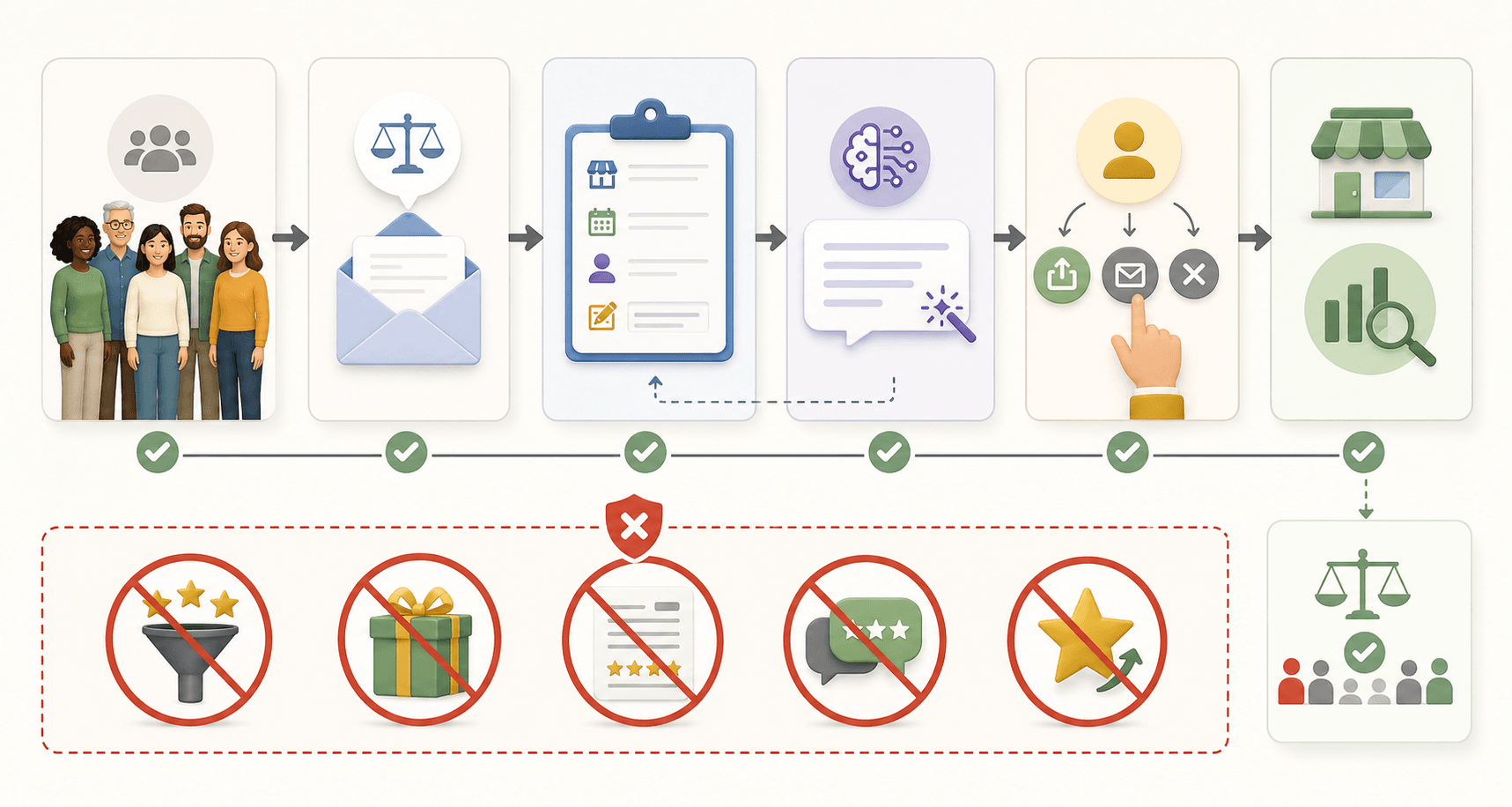
A compliant smart review QR code workflow should follow this sequence:
- Invite every customer through the same neutral entry point.
- Ask the customer to describe their actual experience.
- Make it clear that feedback is voluntary.
- Do not offer a reward for posting.
- Do not ask for a rating before showing the review option.
- Help the customer turn their own experience into clear wording if they want assistance.
- Let the customer choose whether, where, and what to publish.
- Track themes and operational issues without suppressing negative sentiment.
This is where Vibpost fits naturally. Vibpost is an AI marketing assistant for local businesses. It uses a smart review QR code workflow, called a Seeding Code inside the product, to help customers turn real experiences into review drafts, social posts, testimonials, and video scripts. For a local business, the useful part is not "more reviews at any cost." The useful part is a structured customer proof workflow that can be configured around honest feedback, customer consent, and reusable marketing material.
That distinction matters. Vibpost should support real customer moments. It should not be used to invent reviews, gate unhappy customers, buy praise, or promise ranking improvements.
Tools That Support Review Policy Compliance
When a business evaluates review or customer proof software, the compliance questions should come before the feature list.
Look for:
- No sentiment-based review gating.
- No incentive engine tied to review posting.
- Neutral request language that staff can actually use.
- Customer-controlled draft generation.
- Multi-language support for customers who can express their experience more comfortably in another language.
- Analytics that reveal feedback themes without hiding criticism.
- Customization so the workflow fits the business category and service moment.
- Clear separation between public review requests, private service recovery, testimonials, and social content.
Avoid tools that make short-term review volume look easy by filtering customers, scripting praise, or hiding negative feedback. A dashboard that creates risk is not really saving time.
Vibpost is strongest when it is used as a customer proof workflow, not a shortcut. A cafe can use it after a visit. A salon can use it after an appointment. A gym can use it after a class. A retailer can use it after a helpful in-store interaction. In each case, the customer experience comes first, and the generated content should stay anchored to what actually happened.
Recent Review Trust Changes Local Businesses Should Watch
Review trust is becoming more automated, not less. Platforms use machine learning, pattern detection, and policy enforcement to identify suspicious review behavior. Regulators also pay more attention to fake reviews, hidden incentives, insider endorsements, and review suppression.
That means old shortcuts are getting more expensive:
- Review bursts that look coordinated can draw scrutiny.
- Incentive campaigns can weaken credibility.
- Staff review quotas can pressure customers.
- AI-generated review text can become risky if it is not based on a real experience.
- Suppressing negative sentiment can create both platform and consumer trust problems.
The safer long-term strategy is not complicated: ask consistently, keep the wording neutral, help customers tell the truth clearly, respond professionally, and measure what the feedback says about the business.
Conclusion: Build a Review Workflow That Can Stand Up to Scrutiny
Local businesses do not need to be passive about reviews. They can ask. They can remind. They can make the process easier. They can use a smart review QR code workflow. They can respond to feedback and reuse customer proof when they have the right permission.
What they should avoid is controlling the outcome.
The best review request workflow gives every real customer a fair path, keeps incentives out of the review action, avoids sentiment filtering, lets the customer stay in control, and turns feedback into operational learning as well as public proof.
That is how a local business earns reviews without review gating. Not by hiding unhappy customers, buying praise, or scripting five-star language, but by making honest feedback easier to share and easier to act on.
Use Customer Proof Without Review Gating
Vibpost helps local businesses turn real customer moments into review drafts, social posts, testimonials, and video scripts through a smart review QR code workflow. Use it to make honest feedback easier, not to filter customers or manufacture praise.