

Social Proof and Retention for Cafes: How Repeat Visits Become Reusable Customer Trust
For cafes, retention and social proof are usually treated as separate problems.
Retention sounds like loyalty cards, repeat visits, personalized service, and customer relationships. Social proof sounds like Google reviews, testimonials, Instagram posts, customer photos, and word of mouth. In practice, they are part of the same loop.
A customer comes back because the cafe gave them a reason to return. That repeat visit creates evidence: a favorite drink, a known barista, a quiet table, a reliable pickup routine, a seasonal pastry worth mentioning, or a story they would tell a friend. If the cafe captures that moment respectfully, it can become a review, testimonial, social post, video idea, or private feedback signal.
The goal is not to manufacture praise. The goal is to make real customer trust easier to express, approve, and reuse.
That matters because cafes compete in crowded local markets where future customers often decide based on visible signals from other people. Reviews, recommendations, customer photos, and social interactions help people reduce uncertainty before they visit. At the same time, a cafe that listens to returning customers learns why people come back and what should be protected.
Why social proof matters for cafes
Social proof works because customers rarely judge a cafe from the menu alone.
They look for signs that other people have already had a good experience. A recent review can make a new customer feel safer trying the place. A tagged photo can show atmosphere better than a menu description. A testimonial can make a small cafe feel more credible. A comment about friendly service, reliable Wi-Fi, good pastries, or a quiet morning corner can answer the practical questions a future customer has.
For a cafe owner, the important point is that social proof is not only a marketing asset. It is evidence of the customer experience.
Useful proof often comes from small details:
- The drink that customers reorder every week.
- The staff behavior people mention by name.
- The time window when regulars feel most comfortable.
- The seasonal item people bring friends back to try.
- The atmosphere words customers use without being prompted.
- The reasons customers choose this cafe over another one nearby.
Those details are stronger than generic claims because they come from actual visits.
Retention starts with the second visit
Customer retention is not only about getting someone to buy again. It is about understanding why they wanted to return.
For cafes, retention often comes from a mix of product consistency, service memory, convenience, atmosphere, and emotional routine. A customer might return because the cappuccino is predictable, the staff remembers their oat milk preference, the counter line moves quickly before work, or the room gives them a reliable place to read, meet, or focus.
Those reasons should not stay hidden inside the business.
When a returning customer says, "This is my morning spot," that is more than a compliment. It tells the cafe what kind of promise the business is already keeping. If the cafe captures that language, it can guide both marketing and operations.
The same is true for private feedback. If repeat customers mention that weekends feel crowded, pickup signs are confusing, or a pastry sells out too early, that information can improve the experience and protect retention.
A good social proof workflow should collect both kinds of signals: public praise and private learning.
How social proof and retention reinforce each other
Social proof can bring a new customer in. Retention gives that customer a reason to come back. Returning customers then create more proof, which helps the next new customer trust the business.
That loop only works when the proof stays honest.
A cafe should not ask only happy customers for public reviews, offer rewards for positive ratings, or write reviews on behalf of customers. Google's Maps contribution policy says review content should reflect genuine experiences, and it allows businesses to ask for genuine reviews without incentives or attempts to influence rating or content. The FTC's guidance for marketers also warns businesses not to ask only people expected to leave positive reviews.
That does not mean cafes should stop asking. It means the ask should be fair, optional, and tied to a real visit.
Instead of pushing for a rating, the cafe can invite customers to share what stood out:
Enjoyed your visit? Share the part you would tell a friend.
Or:
If this cafe has become part of your routine, your honest feedback helps other neighbors know what to expect.
That kind of request leaves the customer in control.
The missing middle: from customer moment to reusable proof
Most cafes already have customer moments worth sharing. The missing middle is the workflow between the moment and the finished piece of proof.
A plain review link is a destination. It still leaves the customer with a blank box.
A smarter workflow gives the customer a small amount of structure:
- The customer scans or opens a feedback prompt after a real visit.
- The customer chooses experience keywords that match what happened.
- AI helps turn those inputs into a review draft, social caption, testimonial, or video script.
- The customer or business reviews, edits, approves, or declines the content.
- The cafe reuses only the proof that has the right permission and context.
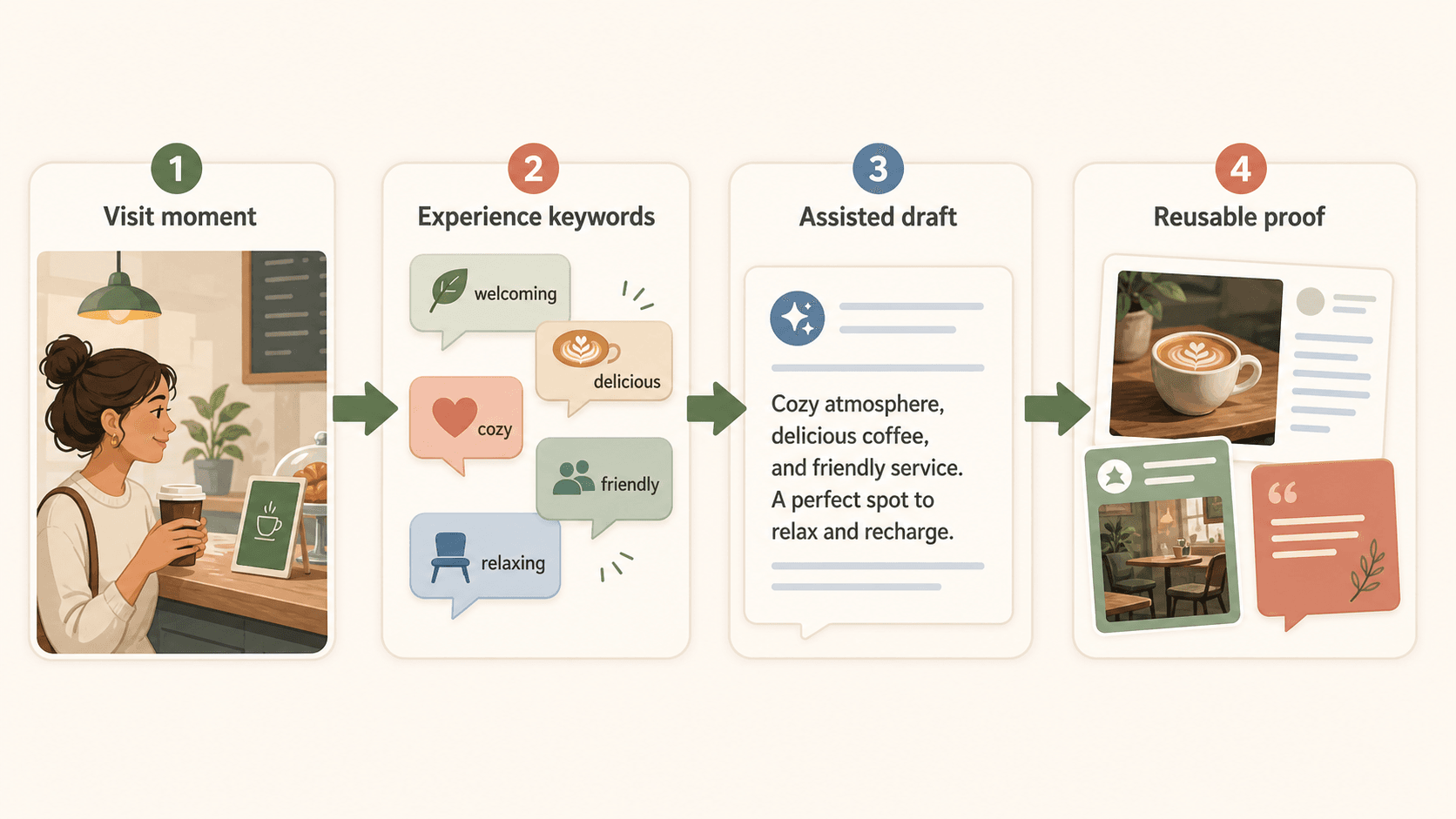
This is where Vibpost fits. Vibpost is an AI marketing assistant for local businesses that uses a smart review QR code workflow, called a Seeding Code inside the product, to help customers turn real experiences into review drafts, social posts, testimonials, and video scripts.
The value is not that AI replaces the customer. The value is that it reduces the blank-page problem while keeping the experience grounded in what the customer actually selected.
What a cafe should collect
A useful cafe workflow should collect more than a star rating.
Start with experience keywords. They help customers remember what was specific about the visit:
- Friendly service
- Quick pickup
- Cozy atmosphere
- Great pastries
- Good place to work
- Clean space
- Helpful recommendation
- Seasonal drink
- Neighborhood favorite
Then collect the intended use. The same customer moment can become different content depending on context:
- A Google review draft for local discovery.
- A testimonial for a website or menu insert.
- A social caption for Instagram, TikTok, Facebook, or X.
- A short video script about a seasonal item or morning routine.
- A private feedback note for the team.
Do not force every moment into every channel. A detailed service compliment may belong in a review. A visual drink moment may work better as a short social post. A repeated theme, such as "quiet weekday mornings," may become a broader positioning idea for the cafe.
Where to place the workflow
The best prompt appears when the experience is still fresh but the customer does not feel trapped.
For cafes, practical touchpoints include:
- A small table card near regular seating.
- A counter card at pickup.
- A receipt note after a positive interaction.
- A loyalty card insert after several visits.
- A follow-up message after catering, events, or group orders.
- A seasonal drink card that invites honest feedback.
Staff can also use verbal prompts carefully. If a customer gives a compliment, the staff member can say:
Thanks for saying that. If you ever want to share it, it really helps a small cafe like ours.
Then stop.
The customer should never feel required to post on the spot, show the review to staff, include a specific phrase, or leave a positive rating. The cleaner the workflow feels, the more trustworthy the resulting proof will be.
How AI helps without overstepping
AI is useful when it helps customers turn a real experience into clearer words.
It is risky when it makes the content sound fake, generic, exaggerated, or detached from what happened.
A safe AI-assisted workflow should follow a few rules:
- Start from customer-selected keywords or customer-written feedback.
- Let the customer edit before anything is posted.
- Avoid claims the customer did not make.
- Avoid pressure to leave a high rating.
- Keep private feedback private unless permission is given.
- Ask before reusing customer photos or quotes in marketing.
- Treat negative or mixed feedback as a service signal, not something to hide.
For cafes, this can be practical. A customer who chooses "friendly service" and "great pastries" might get a short review draft. A customer who selects "quiet morning spot" might get a social caption or testimonial draft. A cafe manager might turn repeated themes into content ideas for the week.
The important boundary is simple: AI should format and clarify, not invent the experience.
Measure retention signals, not just review count
If a cafe only measures review count, it misses the broader retention loop.
A better measurement plan looks at how customers move through the workflow:
- QR scans by location, time, or touchpoint.
- Started feedback flows.
- Completed keyword selections.
- Drafts created.
- Drafts edited or approved.
- Public reviews submitted by customers.
- Testimonials approved for reuse.
- Social post ideas created from real customer language.
- Common experience themes.
- Private feedback topics that point to service improvements.
These signals help the cafe learn what is working without making unsupported promises about rankings, sales, or growth.
Vibpost's public product context includes 2,000+ merchants, 150k+ reviews generated, and 4.8/5 merchant satisfaction. Those numbers show that the workflow has been used at merchant scale, but each cafe should still run its own local test and measure what its customers actually do.
A simple one-week test for cafes
A cafe does not need to rebuild its entire marketing system to start.
Run a small test:
- Choose one customer moment: regulars after morning pickup, weekend pastry buyers, or customers who compliment staff.
- Choose one touchpoint: table card, counter card, receipt note, or follow-up message.
- Choose one prompt: "Share what stood out while it is still fresh."
- Choose one output format: review draft, testimonial, social caption, or video script.
- Review the results weekly: themes, completion rate, approved content, private feedback, and staff observations.
If customers scan but do not finish, the prompt may be too vague. If customers finish but do not approve drafts, the draft style may be too polished or generic. If customers choose the same themes repeatedly, the cafe has found language it can use in service training, menu storytelling, and local marketing.
The test is not about forcing a spike in reviews. It is about learning whether real customer moments can become useful proof without damaging trust.
The practical takeaway
Social proof and retention are connected.
A cafe earns repeat visits by creating real customer value. Those repeat visits produce the language, stories, and trust signals that future customers need. When the cafe captures those signals respectfully, it turns customer satisfaction into reusable proof.
The strongest workflow is simple: invite honest feedback, help customers express what happened, use AI only to reduce friction, ask permission before reuse, and measure the loop over time.
That is how a cafe turns loyal customers into visible trust without turning the relationship into a transaction.
FAQs
What is social proof for a cafe?
Social proof is visible evidence that other customers trust the cafe. It can include reviews, testimonials, customer photos, social posts, word of mouth, repeat-customer stories, and comments about the experience.
How does social proof support customer retention?
It helps customers remember and share why they came back. It also gives the cafe a clearer view of what returning customers value, which can improve service, content, and customer relationships.
Can a cafe ask customers for Google reviews?
Yes, but the request should be fair, optional, and based on genuine experiences. Do not offer incentives for reviews, ask only likely-positive customers, require a rating, or pressure customers to post while they are still on the premises.
What makes a smart review QR code different from a plain review link?
A plain review link sends customers to a blank destination. A smart review QR code workflow can guide customers through experience keywords, AI-assisted drafts, and review or content options while still letting the customer edit and decide.
How should a cafe reuse customer feedback?
Use customer feedback in the right context and ask permission before turning it into marketing. A public review, private comment, customer photo, testimonial, and social caption do not all carry the same permission.