

What Local Businesses Should Avoid When Using AI-Assisted Review Drafts
AI-assisted review drafts are safest when they help a real customer express a real experience in their own words. They become risky when the business uses AI to invent the experience, steer the rating, pre-write praise, reward the review, screen out unhappy customers, or post on the customer's behalf.
For a local business, the practical rule is simple: AI can reduce writing friction, but it should not become the author of the customer's experience. The customer should provide the details, control the tone, edit the draft, choose the rating, and decide whether to publish anything at all.
That distinction matters because reviews are not ordinary marketing copy. A review is supposed to represent a customer's actual experience with a business. Google's Maps policy says reviews and ratings should reflect genuine, unbiased experiences, and the FTC's final rule on fake reviews and testimonials specifically calls out false reviews, including AI-generated fake reviews that misrepresent the reviewer or the experience. A useful AI workflow keeps the customer in charge instead of turning review collection into review manufacturing.
The line between helpful assistance and fake review creation
The line is not whether AI touched the text. The line is whether the final review still belongs to the customer and reflects what actually happened.
A safe draft starts with customer input: what they bought, who helped them, what stood out, what could have been better, and what they want future customers to know. AI can organize that into a clearer paragraph. The customer can then edit, shorten, reject, or ignore it.
A risky draft starts with the business's desired outcome: "write a five-star review for our salon," "mention our stylist by name," or "make this sound more positive." That is not assistance. That is steering.
The safer test is this: if the customer saw the draft before posting, would they say, "Yes, that is what I meant," or would they feel the business put words in their mouth?
Avoid these seven AI review draft mistakes
Most AI review problems come from trying to remove too much customer choice. The business wants more reviews, a higher rating, a cleaner public profile, or more reusable testimonials. Those goals are understandable, but the workflow has to protect authenticity first.
1. Do not invent the customer experience
Never generate a review for someone who did not provide real experience details. AI should not create a meal, haircut, class, repair, consultation, or purchase that never happened.
This includes bulk-generating "sample" reviews and asking staff to paste them into customer messages. It also includes turning a vague compliment into a detailed review the customer never said. "Great service" can become a prompt for the customer to add more, but it should not become a detailed story about speed, friendliness, value, and atmosphere unless the customer confirms those details.
Safer version: ask the customer to choose or type what actually stood out. Use AI only after that input exists.
2. Do not pre-fill praise or a specific rating
AI-assisted drafts should not start from five-star language. Avoid prompts like "write a glowing review," "make this sound excellent," or "turn this into a five-star review."
Pre-filled praise can distort the review before the customer has made their own decision. It also trains staff to think the review workflow is about positive sentiment rather than honest customer expression.
Safer version: ask neutral questions:
- What did you come in for?
- What stood out?
- What would you tell someone considering this business?
- Was anything confusing, slow, or not what you expected?
Those questions allow praise, criticism, and mixed feedback. That is the point.
3. Do not reward posting, changing, or removing a review
Do not connect AI review drafts to discounts, free items, loyalty points, upgrades, raffle entries, or special treatment. That applies whether the review is positive or negative.
Google's review link and QR code guidance allows businesses to make review requests easier, but it warns against offering incentives in exchange for reviews. The Maps policy also treats paid or incentivized reviews as fake engagement, including incentives for posting, revising, or removing a negative review.
Safer version: thank customers for their time without tying a benefit to the review. A simple "Your honest feedback helps our team and future customers" is enough.
4. Do not screen unhappy customers away from public reviews
Private feedback is useful. Review gating is not.
A business can offer customers a way to contact the team privately about a problem. What it should not do is send happy customers to a public review page while routing unhappy customers only to an internal form.
The risky pattern looks like this:
- Ask "How was your visit?"
- Send five-star customers to a public review page.
- Send everyone else to private support.
That workflow is designed to shape the public rating profile, not to collect representative feedback.
Safer version: make both paths clear without filtering. "Want help with an issue? Contact us here. Want to leave a public review? Use this link. Either way, thank you for sharing your experience."
5. Do not let staff pressure customers in person
AI drafts can make the review process feel smooth, but the in-person handoff still matters. A customer may feel pressured if staff stand nearby while they scan, choose keywords, or edit a draft.
Google's Maps policy says merchants should not require or pressure users to leave ratings or reviews while on the premises, and should not request specific content in the review. That matters for salons, cafes, clinics, studios, restaurants, and other businesses where review requests often happen at checkout.
Safer version: staff make one neutral invitation and step back. "If you would like to share honest feedback later, the link is on your receipt. No pressure."
6. Do not ask for specific words, names, or keywords
It may be tempting to ask customers to mention a staff member, product, neighborhood, service keyword, or branded phrase. That can make reviews look more useful, but it also risks turning customer expression into business-scripted content.
Specificity is good when it comes from the customer. It is risky when the business dictates it.
Safer version: let customers choose from neutral experience details such as "fast service," "helpful explanation," "clean space," "easy booking," or "great latte." The customer can decide which details fit.
7. Do not reuse a customer's words as marketing without consent
A public review does not automatically mean the business should reuse the customer's words everywhere. Turning a review into a testimonial, website quote, social post, video script, or ad can create a separate consent and context issue.
The FTC's final rule also addresses false or misleading reviews and testimonials, insider reviews, review suppression, and compensation tied to sentiment. Even when a review is real, a business should be careful not to reuse it in a way that changes context, hides a material connection, or makes the customer appear to endorse something they did not agree to.
Safer version: ask for permission before reusing customer words in marketing, especially if the customer's name, face, photo, or detailed story will appear.
A safer AI-assisted review draft workflow
The safe workflow is not complicated. It keeps the customer, not the business, at the center of the draft.
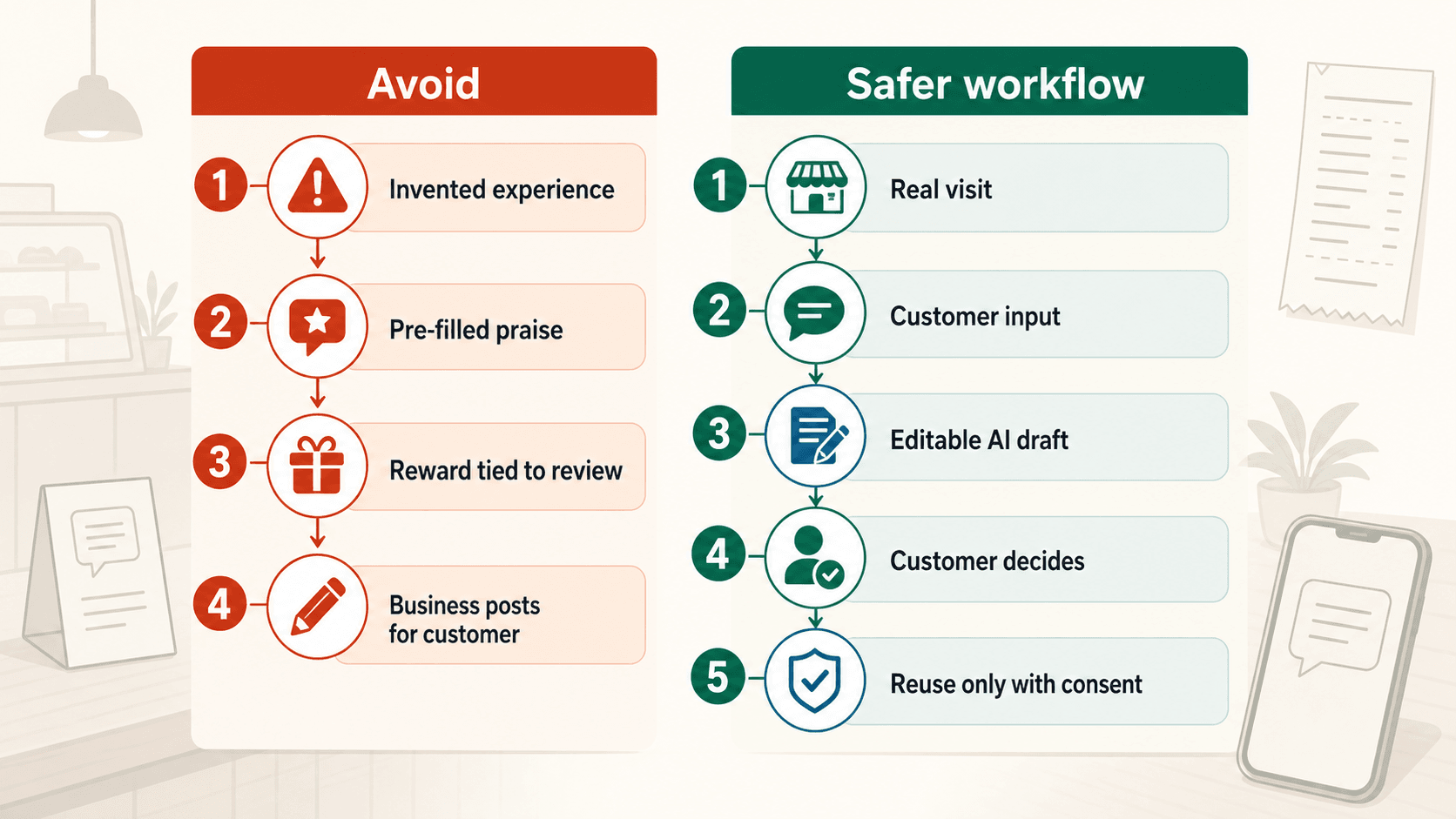
Start with a real visit. Ask a neutral question. Let the customer add their own details. Use AI to organize those details into an editable draft. Let the customer decide what to do next. Reuse the feedback only when it is appropriate and consent is clear.
That workflow protects three things:
- Authenticity: the review is grounded in a real customer experience.
- Customer control: the customer can edit, reject, or choose not to post.
- Business trust: the business is not trying to manufacture ratings or suppress criticism.
The goal is not to make every customer sound polished. The goal is to help customers who already want to share something say it more clearly.
Where AI can help without crossing the line
AI can be genuinely useful in a review workflow when it solves a writing problem, not a trust problem.
Many customers are willing to help a local business, but they do not know what to write. They may remember the visit clearly but freeze at the blank review box. AI can help turn short customer-selected details into a readable draft.
Good uses include:
- turning customer-selected keywords into a first draft
- shortening a long customer note into a concise review
- translating a customer's own input into another language when the customer reviews it
- offering tone choices such as simple, friendly, or detailed
- reminding the customer to check facts before posting
- helping the business summarize private feedback for internal improvement
Risky uses include:
- generating reviews in bulk
- writing from fake customer personas
- creating five-star templates for staff to distribute
- changing mixed feedback into positive language
- posting on behalf of the customer
- hiding negative feedback from public review options
The difference is who controls the final message. If the customer controls it, AI is a writing assistant. If the business controls it, AI becomes a review manipulation tool.
How Vibpost fits into a customer-controlled workflow
Vibpost is an AI marketing assistant for local businesses. Its smart review QR code workflow, called a Seeding Code inside the product, helps customers turn real experiences into review drafts, social posts, testimonials, video scripts, and reusable social proof.
For compliance-sensitive review work, Vibpost should be used as a customer-proof workflow, not a fake review engine. The useful pattern is:
- A real customer scans after a real visit.
- The customer selects or enters experience-based keywords.
- The AI helps turn those inputs into an editable draft.
- The customer reviews and changes the draft.
- The customer decides whether to post, save, share, or do nothing.
That keeps the workflow aligned with the core trust rule: Vibpost can help the customer express a real experience, but it should not create the experience, choose the rating, or publish for the customer.
This also gives staff a simpler job. They do not need to chase reviews or memorize awkward scripts. They can make a neutral invitation, point to the workflow, and let the customer decide.
What to say instead of risky review prompts
The wording around AI-assisted drafts should make customer control obvious. If the copy sounds like the business is asking for praise, rewrite it.
Use:
If you would like to share honest feedback, this tool can help you turn your own experience into an editable draft.
Use:
Choose what matched your visit, edit anything you want, and post only if it feels accurate to you.
Use:
Your feedback can be positive, negative, or somewhere in between. Please write what is true to your experience.
Avoid:
Scan here and get a perfect review draft.
Avoid:
Leave us five stars and show the screen for a discount.
Avoid:
Pick the positive keywords below so we can create your review.
Avoid:
Do not post if anything was wrong. Tell us privately first.
The safe copy may feel less aggressive, but it protects the value of the reviews you do receive.
A local business checklist before using AI review drafts
Before using AI to help with review drafts, review the workflow like an operator, not a marketer.
- Does the customer have a real experience with the business?
- Does the customer provide the details used in the draft?
- Can the customer edit, delete, or ignore the AI output?
- Is the request neutral about rating and sentiment?
- Is there no reward tied to posting, changing, or removing a review?
- Are unhappy customers still allowed to choose a public review path?
- Are staff trained to avoid pressure and specific wording requests?
- Are employee, family, vendor, and insider reviews excluded unless a material connection is clearly handled where appropriate?
- Is testimonial reuse separated from public review collection?
- Are private customer details protected?
If the answer to any of those questions is unclear, fix the process before asking customers to use it.
FAQ
Can AI write a Google review for a customer?
AI can help a customer draft a review based on the customer's own real experience, but the customer should control the facts, tone, rating, edits, and decision to post. AI should not invent the experience or publish on the customer's behalf.
Can a business give customers suggested review text?
Suggested structure can be helpful, but suggested praise or specific wording is risky. A safer approach is to ask neutral questions and let the customer choose their own details.
Can staff ask customers to mention an employee by name?
That is risky because it requests specific content. Let customers decide whether a staff member is relevant to their review. Staff can ask for honest feedback, but they should not tell customers what to include.
Is it okay to use AI for negative feedback?
Yes, if the goal is service recovery and internal learning. A business can summarize private feedback to understand problems, but it should not use private forms to block unhappy customers from public review options.
Can Vibpost generate review drafts safely?
Vibpost can fit a safer workflow when the draft starts from a real customer moment, uses customer-provided details, stays editable, and leaves the final posting decision to the customer. It should not be used to create fake reviews, force positive language, or reward public posting.
The safest draft is the one the customer still owns
AI-assisted review drafts should make honest feedback easier, not more controlled. The business can make the path clearer, reduce blank-page friction, and help customers organize their thoughts. It should not decide what happened, how positive the review should be, or whether criticism becomes public.
For local businesses, that is the better long-term habit: ask real customers, keep the request neutral, let AI assist only after customer input, and reuse feedback carefully. Reviews are valuable because people believe they come from customers. Keep that trust intact.